


Think a payday loan is your only quick option?
It’s not. Payday loans are expensive and often trap people in rollovers.
Borrow $500 and you might pay a $120 fee; 80% of borrowers take another payday loan within two weeks.
You need fast cash that doesn’t bury you in fees.
This post lays out safer, immediate choices: employer paycheck advances, credit union Payday Alternative Loans (PALs), small installment loans, cash-advance apps, nonprofit help, and simple payment-plan negotiations.
For each option I’ll explain how fast it funds, typical costs, and the key questions to ask so you don’t get stuck in debt.
Immediate Alternatives That Replace Payday Loans in Urgent Situations
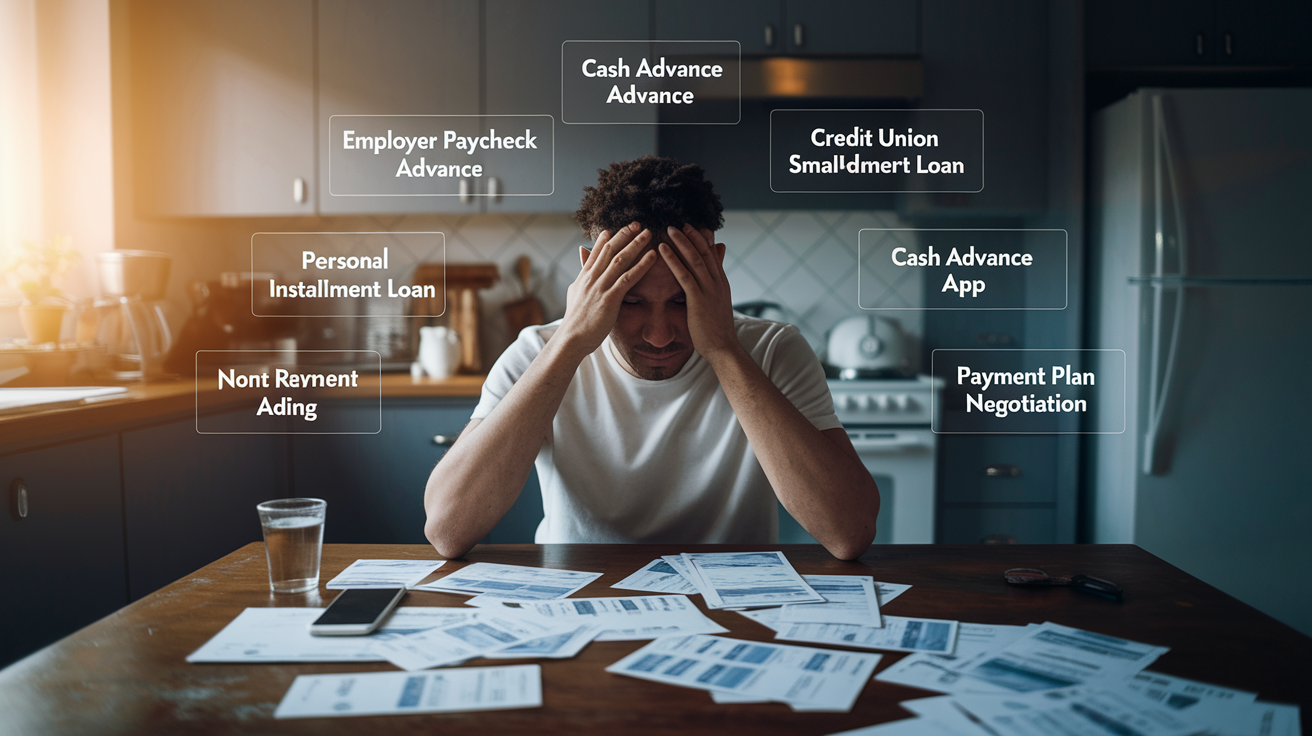
When you’re staring down an urgent bill, payday loans can feel like the only answer. They’re not. The cost is brutal. Borrow $500 and you’ll often pay a $120 fee just to walk out with $380, while still owing the full $500 when the due date hits. The effective APR regularly climbs past 100%. Worse, data shows that 80% of borrowers roll into another payday loan within two weeks.
Speed matters when you’re in a bind. So does total cost. You need options that deliver cash fast without the triple-digit interest and rollover traps. The safest immediate alternatives fall into three buckets: structured installment loans that spread payments over months, small cash advances tied to your paycheck, and nonprofit assistance programs that don’t create debt at all.
Here are the six fastest, safest replacements:
Employer paycheck advances. Ask your employer for early access to wages you’ve already earned. Often free or low cost, sometimes available same day.
Credit union small-dollar loans. Many credit unions offer Payday Alternative Loans up to a couple thousand dollars with interest rates capped around 28% and longer repayment windows.
Personal installment loans. Banks and online lenders provide loans from a few hundred to several thousand dollars, repaid over months or years with fixed payments and lower APRs than payday lenders.
Cash advance apps. Apps let you access up to about $500 from your next paycheck for a small fee, much cheaper than payday loan rollovers.
Nonprofit emergency aid. Local charities, churches, and community action agencies provide rent, utility, and food assistance with no repayment required. Call 211 to find programs near you.
Payment plan negotiations. Creditors, landlords, hospitals, and utility companies often agree to spread your balance over months with reduced or waived late fees if you ask.
Comparing Installment Loans as Emergency Alternatives

Installment loans work completely differently. Instead of demanding the full balance in two weeks, installment lenders give you a fixed monthly payment spread over months or even years. That structure removes the rollover trap. You know exactly what you’ll pay each month. Paying on time can actually help your credit because most installment lenders report to the credit bureaus.
The approval process usually takes anywhere from same day to about a week, depending on the lender and your credit profile. Banks and credit unions typically offer the lowest rates if your credit is decent. But many online lenders now serve borrowers with poor credit at rates that are still far below payday loan territory. Credit unions may require membership, but joining is often as simple as opening a small savings account. The flexible terms are worth it.
| Loan Type | Typical Borrowing Range | Turnaround Speed | Notable Benefits |
|---|---|---|---|
| Credit Union Installment Loan | $500–$5,000 | 1–7 days | Lower rates for members, flexible underwriting, credit reporting |
| Bank Personal Loan | $1,000–$50,000 | Same day–5 days | Competitive rates for good credit, established institutions |
| Online Bad-Credit Personal Loan | $500–$10,000 | 1–3 days | Accessible with poor credit, fast funding, fixed terms |
| Payday Loan (for comparison) | $250–$1,000 | Same day | Fast access, but 100%+ APR, full balance due in weeks, no credit reporting |
Payday Alternative Loans (PALs) from Credit Unions

Payday Alternative Loans, or PALs, are small-dollar loans offered by federally insured credit unions under rules set by the National Credit Union Administration. They’re designed specifically to replace payday loans. You can borrow up to a couple thousand dollars, and the interest rate is capped at around 28%. That’s a fraction of the 100% to 400% APRs common at payday lenders. Repayment stretches over months instead of weeks, so you’re not scrambling to cover the full balance on your next payday.
PALs cost less because they’re regulated and issued by nonprofit credit unions that prioritize member service over profit. Credit unions still check your income and credit, but they often take a relationship-based approach. If you’ve been a member for a while and can show steady income, you may qualify even with less than perfect credit. If you’re not already a credit union member, joining is usually straightforward. You open a small savings account, sometimes as little as $5, and you’re in.
PALs work best when you need more than a few hundred dollars, want predictable monthly payments, and can wait a few days for approval. The main eligibility factor is credit union membership and the ability to verify income. Some credit unions require you to be a member for at least a month before applying for a PAL. If you don’t have that history yet, other options may be faster.
Five practical reasons PALs beat payday loans:
- Interest rate cap. Federal rules limit PAL interest to about 28%, compared to payday loan APRs that routinely exceed 100%.
- Longer repayment terms. You get months to pay instead of a lump sum due in two weeks, which reduces the risk of rollovers.
- Credit reporting. Many credit unions report PAL payments to credit bureaus, so on time payments can improve your credit score.
- Transparent fees. Application fees are typically capped at $20, and there are no hidden rollover charges.
- Member focused underwriting. Credit unions consider your full financial picture and relationship, not just your credit score.
Employer-Based Emergency Cash Options

Many employers offer ways to access your earned wages before the regular payday. These programs are usually free or charge only a small flat fee. The most common setup is a paycheck advance, where your employer simply pays you early for hours you’ve already worked. Some companies use payroll apps that let you pull a portion of your wages on demand. Those apps typically charge modest fees or ask for optional tips. Either way, you’re not borrowing from a lender. You’re getting your own money sooner.
The big benefit is cost. When your employer advances your pay, there’s often no interest at all. Even payroll apps that charge fees come in far below payday loan costs. The main drawback is that your next paycheck will be smaller because you’ve already taken part of it. That can create a tight spot if you don’t plan ahead. But it’s still safer than owing a payday lender a lump sum plus fees two weeks later. Eligibility depends entirely on whether your employer participates, so the first step is asking your HR or payroll department.
Six steps to request a paycheck advance safely:
- Check your employee handbook. Look for any existing policy on paycheck advances or emergency pay.
- Talk to HR or payroll. Explain your situation briefly and ask if the company offers wage advances or works with an earned wage app.
- Provide documentation if needed. Some employers ask for proof of the emergency expense, like a medical bill or repair estimate.
- Agree to repayment terms upfront. Confirm how much will be deducted from your next paycheck and on what schedule.
- Get it in writing. Ask for an email or signed note that spells out the advance amount, repayment, and any fees.
- Budget for the reduced paycheck. Plan your spending for the next pay period so the smaller check doesn’t create a new crisis.
Credit Card Cash Advances and Balance Transfer Strategies

Credit card cash advances let you pull cash from an ATM or bank counter using your existing credit card. The money is available immediately, which makes it tempting in an emergency. But cash advances come with higher interest rates than regular card purchases, often several points above your standard APR. Interest starts accruing the day you take the cash, with no grace period. On top of that, most cards charge a cash advance fee, usually around 3% to 5% of the amount you withdraw. If you need $500 fast and your card charges a 5% fee plus 27% APR, you’ll pay $25 upfront and then interest on $500 until you pay it off. That’s still cheaper than a payday loan’s effective 400% APR, but it adds up quickly if you can’t repay within a few weeks.
Balance transfer cards are a different tool. They’re designed to move high interest debt from one card to another. Many offer 0% APR for an introductory period of 12 to 18 months. If you already have payday loan debt or high interest credit card balances, a balance transfer can freeze the interest clock and give you over a year to pay down the principal. The catch is you need decent credit to qualify for the best offers, and there’s usually a 3% to 5% transfer fee. Balance transfers aren’t instant cash. They’re a way to consolidate and stop bleeding interest on existing debt.
When you’re deciding between a cash advance and a balance transfer, think about timing and what you already owe. If you need physical cash today and have no other option, a cash advance beats a payday loan. If you’re already trapped in payday loan rollovers or high interest card debt and you qualify for a 0% transfer card, moving that debt can save hundreds of dollars in interest and give you breathing room to pay it off. Either way, avoid bank overdraft fees by keeping track of your available credit and making at least the minimum payment on time. Overdraft fees can hit $35 per transaction, which stacks up fast.
Emergency Assistance Programs That Replace Borrowing

Nonprofits and community organizations across the country offer emergency help with rent, utilities, food, and other basic needs. No loan, no repayment, no interest. These programs exist specifically to prevent evictions, utility shutoffs, and hunger during financial crises. Eligibility varies by program and location, but many can provide assistance within a day or two if you have the right documentation. The key is knowing where to look and acting fast, because funding is often limited and awarded on a first come basis.
Rent and utility assistance programs are usually run by local charities, churches, United Way chapters, community action agencies, and government social services offices. If your power is about to be shut off or you’re facing eviction, call the utility company or landlord first and ask if they work with any assistance programs. They often have referral lists. For food and immediate household needs, food banks and pantries operated by organizations like Feeding America affiliates, the Salvation Army, and local churches provide groceries and essentials without paperwork beyond proof of address and household size.
The fastest way to find help is dialing 211. It’s a free, confidential referral service available in most of the United States that connects you to local emergency assistance programs, health services, and crisis support. When you call, a specialist will ask about your situation and location, then give you phone numbers and addresses for organizations near you that can help. Some programs have online applications, but many require a phone call or in person visit, so start the process as soon as you know you need help.
Five types of organizations that provide emergency aid without loans:
Community Action Agencies. Federally funded nonprofits that offer rent, utility, weatherization, and emergency financial assistance based on income.
United Way and 211 Referral Networks. Coordinate access to food, shelter, utility help, and crisis counseling across most states.
Faith-Based Charities. Churches, synagogues, mosques, and other religious organizations often maintain benevolence funds for members and neighbors in crisis.
Salvation Army and St. Vincent de Paul. National nonprofits with local chapters providing rent and utility assistance, food, clothing, and emergency vouchers.
Local Housing Authorities and Homelessness Prevention Programs. City and county offices administer emergency rental assistance and eviction prevention grants.
Negotiating Payment Plans Instead of Using Payday Loans

When the bill is already overdue or about to be, the fastest solution is often calling the creditor directly and asking for a payment arrangement. Utility companies, medical providers, landlords, and even some lenders will agree to spread your balance over several months and waive late fees or reduce interest if you explain your situation and propose a realistic payment schedule. This approach avoids taking on new debt entirely. You’re simply restructuring what you already owe.
Hospitals and medical billing offices are especially willing to negotiate. Many hospitals have financial assistance programs that can reduce your bill or eliminate it completely if your income is below a certain threshold. Even if you don’t qualify for full assistance, billing departments will usually set up interest-free payment plans. Start by asking for an itemized bill, then call the billing office and request a hardship review or payment plan. If the hospital pushes back, ask to speak with a patient advocate or financial counselor. They have more authority to adjust bills.
Landlords and utility companies also negotiate, particularly if you have a history of on time payments and can show proof of a temporary hardship like a medical emergency or job loss. Bring documentation: a layoff notice, medical bills, or proof that you’ve applied for assistance. Propose a specific plan. “I can pay $200 now and $150 a month for the next three months” rather than just asking for help. Creditors are more likely to agree when you show you’ve thought it through and can commit to a schedule.
Borrowing from Family or Friends Safely and Responsibly

Asking a family member or friend for money can feel uncomfortable, but it’s one of the lowest cost ways to cover an emergency if both sides handle it carefully. The advantage is obvious. You can often borrow interest free, and the repayment timeline is flexible. The risk is just as clear. Money disputes can damage or destroy relationships, especially when expectations aren’t clear upfront.
The solution is treating it like a real loan even though it’s personal. Write down the amount, the repayment schedule, and what happens if you can’t make a payment. You don’t need a lawyer. A simple signed note with the terms, dated and kept by both people, is enough. Putting it in writing protects both of you. The lender knows you’re serious about paying it back, and you have a clear target to work toward. If you’re comfortable, you can also agree to pay a small amount of interest as a gesture of appreciation, but that’s optional.
Four documentation tips for family or friend loans:
Write down the loan amount, repayment schedule, and any interest or fees. Include the date, both signatures, and keep a copy.
Agree on what happens if you miss a payment. Will there be a grace period? A small late fee? Decide before trouble starts.
Set up automatic transfers or calendar reminders. Make repayment as automatic as possible so it doesn’t slip your mind.
Communicate immediately if something changes. If you lose your job or have another emergency, tell the lender right away and propose an adjusted plan.
Community and Peer Alternatives to Payday Loans

Peer to peer lending platforms connect individual borrowers with individual investors who fund loans in small increments. You apply online, describe why you need the money, and investors decide whether to fund part or all of your loan. Interest rates are typically below 36%, and some borrowers with decent credit see rates as low as 8%. Funding usually happens within one to two business days once your loan is fully funded. P2P platforms are regulated and report to credit bureaus, so they’re a legitimate alternative to payday lenders when you need a few thousand dollars and can qualify.
Lending circles are a completely different model. A small group, usually six to twelve people, agrees to contribute a set amount of money each month into a shared pool. Each member takes turns receiving the full pot. It’s based on trust and community, and most circles charge little or no interest. The catch is timing. If you’re last in the rotation, you won’t get the money for months. Some nonprofit organizations, especially those serving immigrant and low income communities, run formal lending circle programs that report payments to credit bureaus to help participants build credit while accessing no interest loans.
Community Development Financial Institutions, or CDFIs, are mission driven lenders that serve low income and underserved communities. They offer small personal loans, microloans for small businesses, and financial coaching. CDFIs are regulated but focus on community benefit rather than profit, so their rates and terms are more borrower friendly than payday lenders. Loan amounts vary widely, from a few hundred dollars to several thousand. Approval depends on your income and ability to repay, not just your credit score.
| Program Type | Typical Amount | Cost | Speed |
|---|---|---|---|
| Peer-to-Peer Loan | $1,000–$40,000 | APR often 8%–36% depending on credit | 1–2 business days after full funding |
| Lending Circle | $300–$2,500 per round | Low or no interest; small admin fees possible | Weeks to months depending on rotation |
| CDFI Small Loan | $500–$10,000 | Below-market rates, often 10%–20% APR | Few days to 2 weeks |
Secured Alternatives: When They’re Safe and When They’re Not

Secured loans use something you own as collateral, which lets lenders offer lower interest rates because they can take the asset if you don’t pay. Home equity loans and home equity lines of credit, or HELOCs, are common examples. They typically carry interest rates far below credit cards or personal loans, and you can borrow larger amounts. But the closing process takes time, often two weeks to a month. If you default, the lender can foreclose on your house. HELOCs make sense for large, planned expenses when you have time to close and a solid repayment plan. They’re a terrible choice for a small, urgent bill.
Pawn shops offer a different kind of secured loan. You bring in something valuable like jewelry, electronics, or musical instruments, and the shop lends you a fraction of its resale value, usually 25% to 60%. You get cash on the spot. If you repay the loan plus interest within the agreed period, often 30 to 90 days, you get your item back. If you don’t repay, the shop keeps the item and sells it. The interest can be high, but there’s no credit check, no long term debt, and your credit isn’t affected. The trade off is simple: you risk losing the item permanently.
Car title loans are secured by your vehicle’s title. You hand over the title, and the lender gives you cash, usually a few hundred to a few thousand dollars. The interest rates are sky high, often as bad as payday loans. If you can’t repay within the short term, usually 30 days, the lender can repossess your car. Losing your car can cost you your job, especially if you rely on it for work. Car title loans are a last resort that often makes the situation worse.
Five warning signs of unsafe collateralized lending:
Extremely short repayment terms. 30 days or less with no flexibility means high rollover risk.
APR above 36%. Many states cap consumer loan rates at 36%. Anything higher is predatory.
No clear written terms. If the lender won’t put the interest rate, fees, and repayment schedule in writing, walk away.
Pressure to sign immediately. Legitimate lenders give you time to review and compare. Scammers rush you.
Collateral disproportionate to loan amount. Lending $500 against a $5,000 car and threatening repossession is a setup for asset seizure.
Nonprofit Credit Counseling and Budget Tools for Crisis Management
Nonprofit credit counseling agencies offer free, confidential sessions, usually lasting about 40 to 45 minutes, to help you assess your finances, build a realistic budget, and explore all your options before taking on new debt. A certified counselor will review your income, expenses, and debts, then walk you through alternatives like debt management plans, hardship programs, and community assistance resources you might not know about. Many people avoid counseling because they think it’s expensive or complicated. Sessions are free and there’s no obligation.
Counselors can also negotiate directly with your creditors on your behalf. If you’re behind on credit card payments, medical bills, or other unsecured debts, a debt management plan can consolidate those payments into one monthly amount, often with reduced interest rates and waived fees. The counseling agency manages the payments and distributes them to your creditors. It’s not a loan. It’s a structured repayment plan that can stop collection calls and prevent further damage to your credit. Debt management plans typically take three to five years to complete, but they’re a proven way to get out of high cost debt without bankruptcy.
Five key services nonprofit credit counselors provide:
Budget creation and spending analysis. Identify where your money is going and find room to redirect funds toward urgent bills.
Creditor negotiation and hardship assistance. Contact lenders, utilities, and medical providers to request reduced payments or temporary relief.
Debt management plan setup. Consolidate unsecured debts into a single monthly payment with lower interest.
Financial education and crisis planning. Teach strategies for building emergency savings and avoiding future payday loan traps.
Referrals to local assistance programs. Connect you to rent, utility, food, and legal aid resources in your area.
Safety Checks to Avoid Predatory Lenders
Payday lenders and other predatory operations use a handful of tricks to lock borrowers into expensive, repeating debt. The first red flag is the rollover fee. When your two week loan comes due and you can’t pay the full balance, the lender offers to “renew” or “roll over” the loan for another two weeks but charges another fee to do it. That $120 fee you paid to borrow $500? You’ll pay it again, and again, every time you roll over. The principal never goes down, and the fees stack up fast.
Another warning sign is vague or missing APR disclosure. Legitimate lenders are required by federal law to tell you the APR in writing before you sign. If a lender only talks about a “small fee” or “finance charge” and won’t give you an APR number, they’re hiding the true cost. Payday lenders also rarely report your payments to credit bureaus, which means even if you repay on time, it won’t help your credit score. That’s a clear sign the loan is designed to extract money, not help you build financial stability.
Comparing APRs properly means looking at the total cost of the loan, principal, fees, interest, divided by the amount you actually receive, then annualized. A $500 payday loan with a $120 fee due in two weeks has an effective APR over 600%. A personal loan at 25% APR costs far less, even though 25% sounds high, because it’s calculated over a year and you’re making gradual payments, not facing a lump sum balloon due in two weeks.
Six red flags that signal predatory lending:
Guaranteed approval regardless of credit. Legitimate lenders assess ability to repay. “No credit check” usually means a debt trap.
Fees or interest rates not disclosed upfront in writing. Any lender unwilling to provide a clear loan agreement is hiding something.
Rollover or renewal fees that let you extend the loan repeatedly. This structure is designed to keep you paying fees without reducing the debt.
Pressure to take the loan today without time to compare options. Real lenders give you time to decide. Scammers rush you.
Secured loans against essential assets like your car or home for small amounts. Risking your transportation or housing for a $500 loan is disproportionate.
No reporting to credit bureaus. If the lender doesn’t report your payments, you gain no credit benefit and they’re likely unregulated.
Building a Small Emergency Fund to Avoid Payday Loans Later
The most effective long term defense against payday loans is having even a small cash cushion. Financial experts often recommend three to six months of expenses in an emergency fund, but if you’re living paycheck to paycheck, that target feels impossible. The reality is that starting with just $500 can cover most surprise expenses. A car repair, a medical copay, a broken appliance. It keeps you out of the payday loan cycle. The strategy is to start tiny and build slowly.
One common approach is to save $10 to $20 from every paycheck. If you’re paid biweekly, that’s $20 to $40 a month. In six months, you’ll have $120 to $240. In a year, $240 to $480. It’s not fast, but it’s also not complicated. Set up an automatic transfer from checking to savings on payday so the money moves before you see it. If your employer offers direct deposit to multiple accounts, split your paycheck so a small amount goes straight into savings. The less you have to think about it, the more likely it is to stick.
The other half of the equation is boosting your income temporarily. Side gigs, selling things you don’t use, or picking up a few extra hours at work can accelerate your savings without requiring a lifestyle overhaul. Even small wins add up. Sell an old phone for $50, work a weekend gig for $100, cancel a subscription and bank the $15 a month. Every dollar you add to your emergency fund is one less dollar you’ll need to borrow at triple digit interest later.
Six fast ways to start or grow emergency savings:
Automate $10 to $20 per paycheck into a separate savings account. Make it invisible and automatic so you don’t skip it.
Sell unused items online or at a garage sale. Old electronics, furniture, clothes, tools. Anything worth $20 or more adds up.
Pick up gig work on weekends. Food delivery, rideshare, task apps like TaskRabbit, or local cash jobs can bring in $50 to $200 extra per week.
Redirect one small recurring expense into savings. Cancel or pause a subscription, cut one meal out per week, brew coffee at home. Bank the difference.
Claim any tax refund or stimulus payment immediately. Deposit windfalls straight into savings instead of spending them.
Use savings apps that round up purchases or move small amounts automatically. Apps like Qapital or Digit can build savings in the background with minimal effort.
Final Words
You’ve just seen fast, lower‑cost choices that can replace a payday loan in a pinch — installment loans, PALs from credit unions, employer advances, cash‑advance apps, balance transfer moves, community aid, and bill negotiation.
You also saw why payday fees and 100%+ APRs can trap you, how to compare true cost and speed, and when secured loans are too risky.
Use these emergency loan alternatives to payday loans, pause before you borrow, and try a nonprofit counselor or small savings step first. You’ve got options and a plan.
FAQ
Q: What is the best alternative to a payday loan? What to do instead of payday loan? What are the alternatives to emergency loans?
A: The best alternatives to a payday loan are employer paycheck advances, credit union small-dollar loans or PALs, short-term installment loans, cash-advance apps, nonprofit emergency aid, and negotiating payment plans.
Q: What is a flipper loan?
A: A flipper loan is a short-term rehab loan for real estate investors to buy, fix, and resell a property quickly; it’s higher-rate, based on the property’s value, and meant for fast turnaround.