


Most people stick with monthly payments and pay more interest, and you don’t have to.
Choosing weekly, biweekly, or monthly changes how fast your principal falls, how much interest you pay, and how steady your cash flow stays.
This post walks you through simple checks, helps you match a schedule to your pay dates, shows quick-number examples, and tells you how to confirm the lender actually applies payments to principal so you can pick the plan that fits your budget and saves real money.
Comparing Weekly, Biweekly, and Monthly Repayment Schedules

Weekly payments mean 52 withdrawals from your account each year. You’re spreading the same total cost across more payments. Biweekly means 26 payments, which lines up with most paychecks and produces an interesting side effect. 26 half-payments equal 13 full monthly payments instead of 12. Monthly payments are the standard most lenders push. It’s 12 payments a year, one bill per month, simple to track in a household budget.
Each schedule produces different outcomes for the same loan. Weekly payments chip away at principal fastest because interest has the smallest window to compound between payments. Biweekly sits in the middle but creates that extra-payment benefit without forcing you to think about it. 13 monthly-equivalents per year shaves months off your loan and reduces total interest. Monthly is the slowest option for paying down principal, so you pay more interest over time. But it’s the easiest to budget and the only option some borrowers can afford because the monthly chunk is lower than any accelerated plan.
Your income pattern should drive the choice. If you get paid every two weeks, biweekly payments lock your loan schedule to your paychecks and you never have to juggle cash-flow timing. If you freelance, get paid weekly, or have unpredictable income, forcing yourself into a high-frequency schedule can cause overdrafts and late fees. If you receive a single monthly salary, one monthly payment keeps your budget predictable and leaves room to make an occasional extra payment when a tax refund or bonus lands.
Which borrower profile matches each schedule:
Weekly: Best for workers paid every seven days who want to minimize interest and keep debt payments small and steady each week.
Biweekly: Right for biweekly-salaried employees who can handle two extra half-payments each year and want automatic acceleration without manual extra contributions.
Monthly: Best for monthly-paid workers or anyone with irregular income who needs maximum budget flexibility and predictable single withdrawals.
Accelerated biweekly mimicry: If your lender only allows monthly, add 8.33% to each monthly payment to simulate one extra payment per year. If your payment is normally $200, pay $217 each month to replicate the biweekly benefit.
Stick with monthly, pay extra when you can: Right for anyone who needs cash-flow cushion but can occasionally throw a windfall like a bonus or tax refund at principal.
Key Factors That Determine the Right Repayment Schedule

Income frequency is the first box to check. If you get paid every Friday, your bank balance peaks 52 times a year. If you get paid on the 1st and 15th, that’s 24 inflows. If you get one salary check each month, that’s 12. Aligning your loan payment with your income timing prevents the trap of scheduling a withdrawal before your paycheck arrives. When income and payment schedules mismatch, you either overdraft or you shuffle cash manually every cycle. Both cost time or money.
Cash-flow volatility is the second factor. A teacher on a stable monthly salary can commit to any schedule because the same amount arrives on the same day. A freelance designer with $8,000 one month and $1,200 the next can’t safely promise weekly or biweekly withdrawals without a large savings buffer. If your income varies, you need either a monthly schedule with room to make extra payments when earnings are high, or you need 3 to 6 months of expenses saved so that a lean month won’t bounce your loan payment.
Interest implications also matter. More frequent payments reduce the average daily principal balance, which lowers interest. But the dollar savings are small unless the loan is large or the rate is high.
Lender rules sometimes force the decision. Many servicers only offer monthly payments as the default and make you request biweekly or weekly if they even allow it. Some lenders batch biweekly payments and only apply them once a month, which kills the interest-saving benefit. Before you choose, confirm whether the lender applies each payment immediately to principal or holds it in a suspense account. If they hold it, you’re not getting the compounding benefit and you should stick with monthly.
Pros and Cons of Each Repayment Frequency
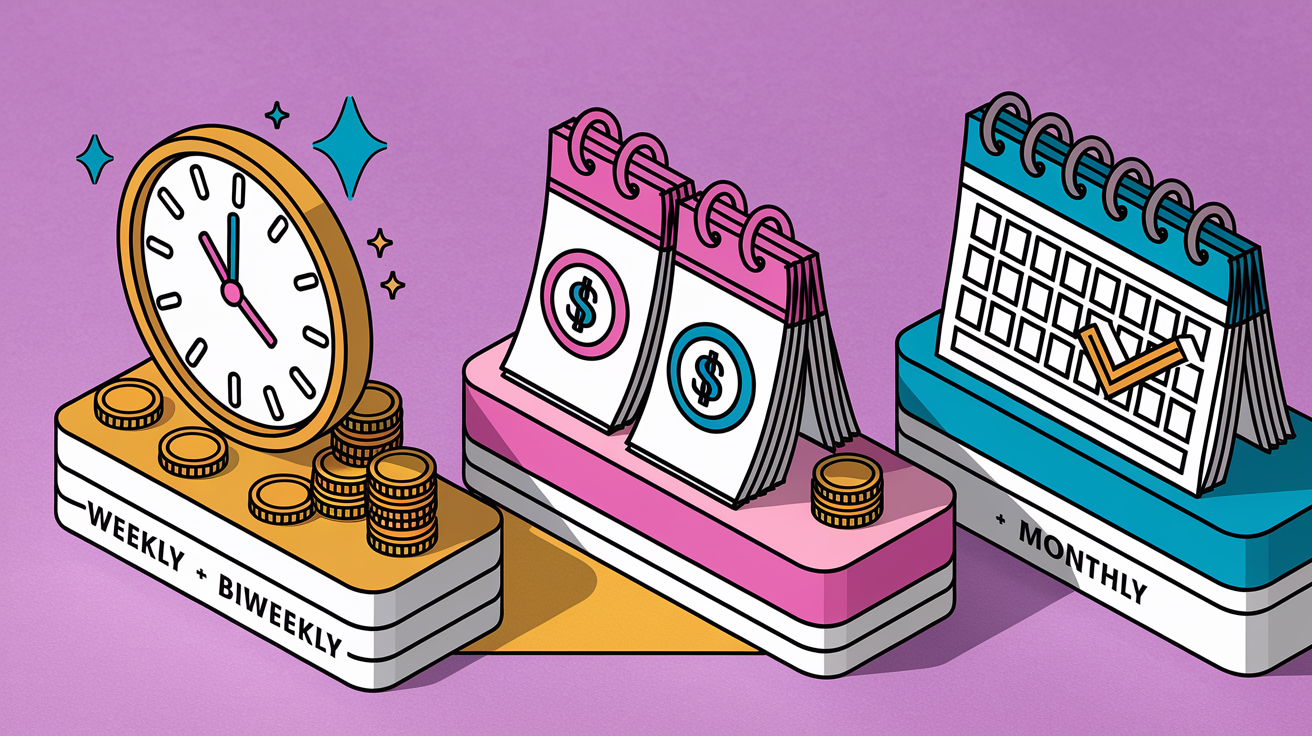
Here’s a side-by-side look at what each schedule gives you and what it costs.
| Schedule Type | Pros | Cons |
|---|---|---|
| Weekly | Smallest per-payment amount; reduces interest fastest; aligns with weekly paychecks; builds discipline through frequent small habits. | 52 transactions per year increase admin and potential for missed payments; many lenders don’t support it or charge fees; harder to track in monthly budgets. |
| Biweekly | Aligns with biweekly paychecks; 26 payments equal 13 monthly-equivalents, shaving months off the loan; moderate interest savings without manual extra payments. | Two extra half-payments each year require cash-flow headroom; some lenders batch payments monthly, erasing the benefit; complicates budgets that track monthly expenses. |
| Monthly | Simplest to budget; fewest transactions; default option at almost all lenders; easiest to align with other monthly bills. | Slowest principal reduction; highest total interest over the life of the loan; requires manual discipline to make extra payments and capture acceleration benefits. |
Simple Numerical Examples to Show Interest and Timeline Differences

Numbers clarify the real impact better than any description. For a $10,000 personal loan at 6% APR over five years, changing payment frequency shifts both the payoff timeline and the interest you hand to the lender.
Below is a comparison assuming the lender applies each payment immediately to principal and that weekly and biweekly schedules produce true acceleration. Small differences in lender processing can shift these numbers by a few dollars or a month, so always run your exact loan through a calculator before deciding.
| Schedule | Annual Payments | Total Interest | Months to Pay Off |
|---|---|---|---|
| Weekly | 52 | ≈ $1,520 | ≈ 57 |
| Biweekly | 26 | ≈ $1,550 | ≈ 58 |
| Monthly | 12 | ≈ $1,600 | 60 |
The weekly schedule saves roughly $80 in interest and cuts three months off the term compared to monthly, because the 52 small payments attack principal faster and leave less time for interest to compound. Biweekly sits in between, saving about $50 and finishing two months early.
For a larger loan like a $200,000 mortgage at 4% over 30 years, the monthly schedule costs approximately $143,000 in interest and takes the full 360 months. Switching to accelerated biweekly typically shaves three to five years off the term and cuts interest by $20,000 to $30,000, depending on precise rate and lender processing. On a 30-year mortgage, one extra payment per year can knock five years off the back end and save you a new car’s worth of interest.
Step-by-Step Process for Choosing Your Ideal Repayment Schedule

Start by listing your exact income timing. Write down every paycheck date and amount for the next two months so you can see whether you’re paid weekly, biweekly, twice-monthly, or monthly. If your income is irregular, note the lowest monthly total you’ve earned in the past six months. That’s your floor for budgeting.
Calculate your monthly cash-flow margin by subtracting all fixed expenses and minimum debt payments from net income. The leftover amount is your discretionary cushion.
Determine how much cushion you can safely dedicate to loan acceleration without risking overdrafts or skipping an emergency-fund contribution. A common rule is to keep at least one to two months of essential expenses in savings before committing extra cash to faster loan payoff.
Estimate interest savings by plugging your loan balance, APR, and term into an online amortization calculator, then run scenarios for monthly, biweekly, and weekly schedules. Compare total interest and months to payoff.
Check your lender’s rules. Call or review your loan agreement to confirm whether they accept biweekly or weekly payments, whether payments are applied immediately to principal, and whether any prepayment penalties exist.
Test the new payment amount in your budget for at least one full pay cycle before switching. If biweekly means two half-payments per month most of the time, plus two months per year with three half-payments, make sure those three-payment months won’t overdraft your account.
Confirm feasibility by ensuring your emergency fund is funded to at least three months of expenses and your total monthly debt obligations remain below 36% of gross income. If accelerating the loan pushes you over those thresholds, stick with monthly and make occasional extra payments instead.
Once you’ve confirmed the numbers and the lender allows it, set up autopay aligned to your paycheck dates so you never manually manage timing. If your lender won’t accept biweekly, mimic it by dividing your monthly payment by 12 and adding that amount to each monthly payment. This creates one extra monthly payment per year without changing your payment schedule.
Final Words
Compare weekly, biweekly, and monthly schedules by how often you get paid, how steady your cash flow is, and whether extra payments fit your budget. Weekly and biweekly can shave interest and shorten the loan; monthly is the simplest for most people.
Check your income timing, run the numbers with a calculator, and confirm the lender’s options before you switch.
Use this guide to figure out how to pick the best loan repayment schedule for your budget. Take small steps, test a plan, and you’ll save time and money.
FAQ
Q: What is the 70/20/10 rule budget?
A: The 70/20/10 rule budget divides take-home pay: 70% for essentials, 20% for savings and debt payments, and 10% for wants or extras, a simple way to balance spending and build savings.
Q: What is the 15 3 payment trick?
A: The 15 3 payment trick generally means making 15 monthly-sized payments in a year by adding three extra payments annually, which speeds payoff and reduces total interest paid.
Q: What is the best loan repayment strategy?
A: The best loan repayment strategy is to pay on time, pay more than the minimum when possible, prioritize high-interest debt (avalanche) or small balances (snowball), and keep an emergency cushion.
Q: What are the 3 C’s for a loan?
A: The 3 C’s for a loan are character (your credit history), capacity (your income and DTI—debt-to-income), and capital or collateral (savings, down payment, or assets lenders can use as security).