


Picking the loan with the lowest monthly payment can actually cost you thousands.
Sounds unfair, but it happens when people only look at one number.
Before you sign, you need a quick, reliable way to compare offers side by side.
This post walks you through the exact things to check.
APR (the all-in yearly cost), repayment term, monthly payment, total interest, and fees.
I’ll show a simple, step-by-step method you can use with an online calculator or a spreadsheet.
Do this and you’ll pick the loan that costs the least over time and fits your budget today.
Key Factors for Comparing Debt Consolidation Loan Offers

Comparing debt consolidation loan offers isn’t about picking the lowest monthly payment or the fastest approval. It’s about figuring out which offer costs you the least over the life of the loan while actually fitting your monthly budget. Most people skip this part and just pick based on one number. Then months later they realize they’re paying hundreds more than they needed to.
The right comparison means looking at several cost drivers at once. APR shows you the true annual cost including fees. The repayment term controls how long you’ll be paying and how much interest piles up. Monthly payment affects your cash flow right now. Total interest paid shows the real price tag over time. Fees can quietly eat into savings. Miss any one of these and you can’t tell which offer is actually better.
Here are the five criteria to compare side by side:
- APR (annual percentage rate), which includes interest plus mandatory fees when disclosed. Lower is better.
- Repayment term, typically 24 to 84 months. Shorter means less total interest. Longer means lower monthly payments.
- Monthly payment, which has to fit your budget without creating new stress.
- Total interest cost. Multiply your monthly payment by the number of months, then subtract the principal to see what the loan actually costs.
- Fees like origination fees (1–10% of the loan), late fees, prepayment penalties, and any other charges that raise the effective cost.
Follow this comparison method:
- Write down the loan amount, APR, term (in months), and all fees for each offer.
- Use a loan calculator to compute the monthly payment and total interest for each offer.
- Subtract any origination fees from the amount you’ll actually receive (net proceeds).
- Add up total cost: principal + total interest + all fees.
- Compare total cost and monthly payment across offers. Pick the one with the lowest total cost that you can afford monthly.
Before you choose an offer, verify these details:
- The APR is fixed, not variable, so your rate won’t jump later.
- You’ve confirmed the exact origination fee amount and whether it’s deducted from proceeds.
- There are no prepayment penalties if you want to pay off early.
- The lender is licensed in your state and has reasonable customer reviews.
- You’ve received a written loan estimate or disclosure showing all terms in black and white.
Understanding APR and How It Impacts Consolidation Costs
APR stands for annual percentage rate. It’s the single most important number when comparing loan offers. Unlike the interest rate, which only reflects the cost of borrowing, APR includes the interest rate plus lender-required fees like origination fees. If one lender quotes you 9% interest but charges a 5% origination fee, and another quotes 10% with no fee, the APR will tell you which deal actually costs less. Many people compare interest rates and pick the wrong loan because they ignore fees. APR fixes that.
Small differences in APR create surprisingly large differences in what you pay over time. A $10,000 loan at 8% APR for 48 months costs you roughly $1,724 in total interest. The same loan at 14% APR costs about $3,127 in interest. That 6 percentage point gap means you’ll pay an extra $1,403 over four years, plus a higher monthly payment. When you’re consolidating $15,000 or $25,000 in debt, those differences multiply fast.
To estimate total interest quickly, use this approach: find your monthly payment (most lenders or online calculators will compute it from the APR, loan amount, and term), multiply it by the number of months, then subtract the principal. The result is total interest paid. Compare that number across offers to see which loan truly costs the least.
Loan Terms and How They Affect Monthly Payments

Most debt consolidation loans offer repayment terms between 24 and 84 months. The most common options are 36, 48, and 60 months. The term you choose controls both your monthly payment and your total interest cost. It’s a trade-off. Longer terms spread payments out and lower the monthly amount, but they also give interest more time to accumulate. Shorter terms require higher monthly payments but cut down the total interest you’ll hand to the lender.
A longer term can look attractive because it frees up cash each month, but it can quietly cost you thousands more. If your budget is very tight, a longer term might be necessary to avoid missing payments. But if you can afford a higher monthly payment, a shorter term saves you money and gets you out of debt faster.
Here’s a concrete example using a $10,000 loan at 10% APR. With a 36 month term, your monthly payment will be around $322.79, and you’ll pay roughly $1,620 in total interest. Stretch that same loan to 60 months and your monthly payment drops to about $212.39, which feels easier on the budget. But now you’ll pay approximately $2,743 in total interest. That’s $1,123 more than the shorter term. That’s the cost of the lower monthly payment.
Fees That Influence the True Cost of Debt Consolidation Loans
Origination fees are the most common and often the biggest fee you’ll encounter. Lenders typically charge between 1% and 10% of the loan amount as an upfront fee, and many deduct it directly from your proceeds. If you borrow $10,000 and the lender charges a 3% origination fee, you’ll receive $9,700 but repay as if you borrowed the full $10,000. That $300 fee increases the effective cost of the loan, especially if you were counting on the full amount to pay off your debts.
Other fees to watch include late payment fees (usually $25–$40), returned payment or NSF fees (often $25–$35), and in some cases prepayment penalties. Prepayment penalties are less common on personal loans but can still appear, especially on secured loans. A prepayment penalty might be a flat fee or a percentage of your remaining balance if you pay off the loan early. If you think you might refinance or pay extra toward the principal, check for this fee before signing.
Fees alter the effective cost even when the APR looks low. If one lender offers 8% APR with no origination fee and another offers 7% APR but charges a 5% origination fee, the second loan might actually cost you more once you factor in the fee. Always subtract the origination fee from the amount you’ll receive and add it to your total cost calculation to compare offers accurately.
Comparing Monthly Payments and Total Interest

Your monthly payment is what you’ll feel in your budget every month, so it has to be affordable. But focusing only on the monthly number can lead you to pick a loan that costs far more in the long run. A lender might offer you a low monthly payment by stretching the term to 72 or 84 months. That sounds great until you see how much extra interest you’re paying for that convenience.
Total interest is the amount you pay above and beyond the principal. It’s calculated by multiplying your monthly payment by the term (in months), then subtracting the original loan amount. This number shows you the real price of the loan. Two offers with similar monthly payments can have wildly different total interest costs if the terms or APRs differ. Always compare both the monthly payment and the total interest side by side to see the full picture.
For example, take a $15,000 loan. Offer A has an APR of 9% over 48 months, giving you a monthly payment of about $373 and total interest of roughly $2,904. Offer B has an APR of 12% over 60 months, with a monthly payment of around $334. Lower, easier on your budget. But the total interest on Offer B is approximately $5,040. You’ll pay $2,136 more in interest to save $39 per month. If your budget can handle the higher payment, Offer A is the smarter choice.
Tools and Methods for Comparing Loan Offers

Start with prequalification tools offered by most online lenders. Prequalification uses a soft credit check, which means you can see estimated rates, terms, and monthly payments without affecting your credit score. This lets you shop around and compare multiple offers before you commit to a formal application, which will trigger a hard inquiry.
Use these methods and tools to make the comparison easier:
- Online loan calculators to compute monthly payments, total interest, and amortization schedules from APR, principal, and term.
- Spreadsheet templates (Excel or Google Sheets) with columns for lender name, APR, term, monthly payment, total interest, origination fee, and total cost.
- Debt consolidation calculators that let you input your current balances and APRs to see whether a new loan will actually save you money.
- Amortization schedule generators to see exactly how much of each payment goes toward interest versus principal over time.
Prequalification is one of the best tools available because it shows you real numbers without the risk. Most lenders let you enter basic information (income, employment, rough credit score, loan amount) and return an estimated APR and payment within minutes. You can gather three or four prequalified offers in an afternoon, then use a calculator or spreadsheet to compare total cost. Once you’ve identified the best offer, that’s when you submit the formal application and accept the hard credit pull.
Red Flags When Evaluating Debt Consolidation Lenders

Some lenders make their money by hiding costs or pressuring you into bad terms. If a lender won’t clearly disclose the APR in writing, that’s a problem. APR is a legal requirement in loan advertising and disclosures, so any lender dodging that number is either disorganized or dishonest. Walk away.
Watch for these warning signs:
- Guaranteed approval claims, especially if they don’t mention credit checks. Legitimate lenders assess risk and sometimes decline applicants.
- Requests for upfront payment by wire transfer, gift card, or prepaid debit card before the loan is funded.
- Pressure to “act now” or sign documents without time to review or compare offers.
- Vague or missing fee disclosures, especially if the origination fee or other costs aren’t stated in dollars or percentages.
- Unlicensed lenders or lenders that aren’t registered in your state. Check your state financial regulator’s website to verify.
Aggressive marketing that promises to fix your credit score or wipe out your debt with no consequences is another red flag. No lender can guarantee credit improvement, and any claim like that is designed to pull you in before you realize the loan terms are terrible. If something feels off or too good to be true, trust that feeling and keep looking.
Eligibility Factors That Affect Your Loan Offer

Your credit score is the single biggest factor in determining your APR. Borrowers with excellent credit (typically a FICO score of 750 or higher) qualify for the lowest rates, sometimes in the 6–10% range depending on the lender and market conditions. Borrowers with good credit (around 700–749) will see slightly higher APRs. If your score is in the fair range (640–699), expect APRs in the mid-teens to low twenties. Below 640, rates can climb to 30% or higher, and some lenders may decline the application or require a secured loan or cosigner.
Lenders also review your income and debt-to-income ratio (DTI). DTI is your total monthly debt payments divided by your gross monthly income. Most lenders prefer a DTI below 40%, though some will accept up to 50% if other factors are strong. If your DTI is too high, the lender may offer a smaller loan amount or a higher APR to offset the risk. Or they may deny the application entirely.
If your credit score or DTI isn’t ideal, you have options to improve your eligibility before applying. Pay down a few smaller balances to lower your DTI. Dispute any errors on your credit report. Mistakes can drag your score down by dozens of points. If you’re on the border of a better credit tier, waiting a few months while making on-time payments can bump your score enough to qualify for a significantly lower APR. Even a small improvement in your credit profile can save you hundreds or thousands over the life of the loan.
Secured vs. Unsecured Debt Consolidation Loans
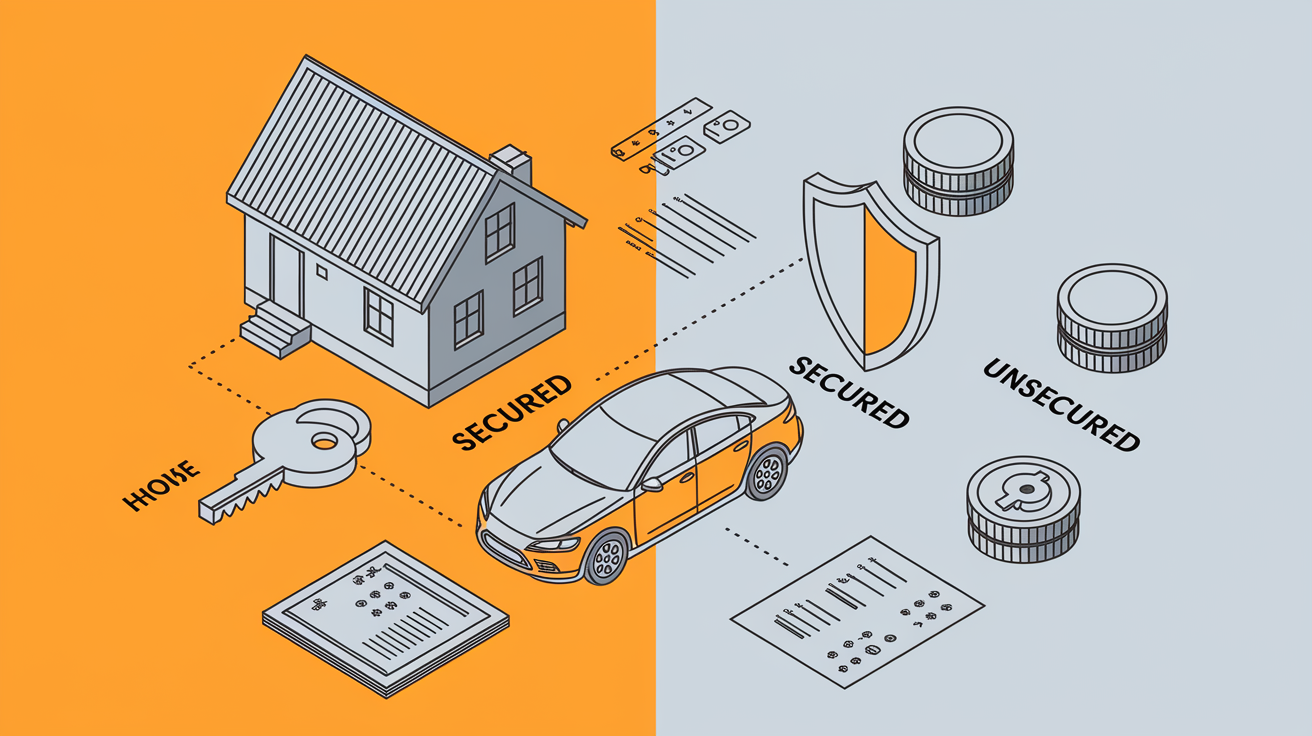
Unsecured debt consolidation loans are the most common type. They don’t require collateral, so you’re not risking your car or home if you miss payments. Approval is based on your credit score, income, and debt-to-income ratio. APRs on unsecured loans typically range from around 6% to 36%, depending on your creditworthiness. The downside is that if your credit isn’t strong, you’ll pay a higher rate. And if your credit is poor, you may not qualify at all.
Secured loans require you to pledge an asset (often a vehicle, savings account, or home equity) as collateral. Because the lender can seize the asset if you default, they’re taking less risk, and that usually translates into a lower APR. For example, a secured loan might offer you 6% when an unsecured loan would charge 11%. That rate difference can mean significant savings on a large loan. But the trade-off is real. If you can’t make the payments, you could lose your car, drain your savings, or face foreclosure on your home.
Here are the key differences:
- Unsecured loans require no collateral. Approval depends entirely on credit, income, and DTI. Higher APRs for borrowers with fair or poor credit.
- Secured loans require collateral (vehicle, home equity, savings). Lower APRs because the lender has a fallback if you default. Risk of losing the asset.
- Unsecured loans are faster to fund and simpler to close. No appraisal or lien paperwork in most cases.
- Secured loans may involve additional costs like appraisals, lien filing fees, or closing costs, especially for home-equity-based products.
Consider a secured loan only if the interest savings are large enough to justify the risk and you’re confident you can make every payment on time. If there’s any chance you’ll struggle with payments, an unsecured loan is safer even if it costs a bit more.
Final Words
In the action, you got the exact checklist: compare APR, repayment term, monthly payment, total interest, and fees; learn APR vs interest; weigh short vs long terms; spot common lender fees and red flags; and use tools to run the numbers.
Next, use the quick method: get APR and fees, match terms, calculate payments, compare total cost, and confirm no nasty penalties.
Use this guide to practice how to compare loan offers for debt consolidation, and you’ll feel more confident picking a lower‑cost, safer option.
FAQ
Q: How to compare debt consolidation loans?
A: To compare debt consolidation loans, compare APR (all-in cost), term, monthly payment, total interest, and fees; use the same term, calculate total cost, and check prepayment penalties.
Q: Why does Dave Ramsey not recommend debt consolidation?
A: Dave Ramsey doesn’t recommend debt consolidation because he favors the debt-snowball method; consolidation can stretch repayment, add fees, and risk repeating bad habits if you keep using credit cards.
Q: How much is the payment on a $50,000 consolidation loan?
A: The payment on a $50,000 consolidation loan depends on APR and term; for example, at 7% over 5 years it’s about $990/month, and at 10% over 7 years it’s about $830/month.
Q: Is it possible to get a $20,000 loan for debt consolidation?
A: You can often get a $20,000 loan for debt consolidation if your credit, income, and DTI meet lender standards; unsecured offers are common, or use collateral to qualify with lower APRs.