


Think closing an old credit card will clean up your finances?
It can actually pull your score down.
Closing a card cuts your available credit and can spike your credit utilization right away.
It can also shorten your average account age later, which matters for your score.
So yes, closing old cards often hurts your credit, but not always.
This post shows the exact ways your score changes and the smart times to close a card.
Read on to learn simple rules to protect your score before you cancel.
Key Credit Score Effects When Closing Old Credit Cards

Yes, closing old credit cards can hurt your credit score. Often it will. The damage comes from two things that happen right away: your credit utilization ratio goes up, and your average account age can shrink over time. Credit scoring models (FICO and VantageScore) pay close attention to how much of your total available credit you’re using. When you close a card, your total available credit drops while your balances stay the same. That pushes your utilization percentage up. At the same time, your average account age may shrink down the road as older, closed accounts eventually fall off your report after up to 10 years.
Here’s a quick example showing how utilization changes the moment you close a card:
- Before closing: You’ve got three credit cards with limits of $2,000, $3,000, and $1,500. Your balances are $500, $0, and $1,500. Total available credit is $6,500, total balance is $2,000. Your credit utilization ratio is $2,000 ÷ $6,500 = 30%.
- You close the second card (the one with the $3,000 limit and $0 balance) because you aren’t using it.
- After closing: Your new total available credit is $3,500 ($2,000 + $1,500). Balances stay the same at $2,000.
- New utilization: $2,000 ÷ $3,500 = 57%.
- Score impact: Jumping from 30% to 57% can trigger score drops of 20 to 100+ points depending on your overall profile.
Positive closed accounts remain on your credit report for up to 10 years, continuing to contribute to your payment history and average age during that window. But once they drop off, your average account age may shrink again. Negative information (late payments, collections) remains for about 7 years. The utilization increase hits your score immediately. The average age effect may creep in later when the closed account disappears from your file.
How Credit Utilization Changes After Closing a Credit Card

Credit utilization is the percentage of your total available credit that you’re currently using. The formula is simple: total balances ÷ total credit limits. Scoring models prefer to see utilization under 30%, and scores often peak when utilization stays under 10%. When you close a credit card, your total available credit shrinks. That drives up your utilization percentage even if you don’t carry a single extra dollar of debt.
Here’s a real example: you’ve got $3,000 in balances and $10,000 in total credit limits across your cards, giving you 30% utilization ($3,000 ÷ $10,000). If you close a card with a $6,000 limit, your new total limit is $4,000. Your $3,000 balance hasn’t changed, but your new utilization is $3,000 ÷ $4,000 = 75%. Triple your original ratio. This kind of jump can lead to score declines of 20 to 100+ points depending on your credit mix, payment history, and the number of accounts you have left.
Four ways closing a card can spike your utilization:
Removing a large limit card while keeping balances unchanged has the biggest effect when the closed card held a large percentage of your total credit line. Closing a zero balance card instead of a card with balances is common. Many people close the “safe” unused card, which paradoxically harms them more by removing clean, available credit. Closing multiple cards in a short period compounds the utilization increase with each closure. Closing a card before paying down other balances means you get hit with the high utilization first and the benefit later. That can hurt your score right when it matters most (before a loan application).
How Closing Old Credit Cards Affects Your Length of Credit History

Your average age of accounts is calculated by taking the total age of all your open (and some closed) accounts and dividing by the number of accounts. For example, if you have accounts aged 12 years, 6 years, and 2 years, your average account age is (12 + 6 + 2) ÷ 3 = 6.7 years. Closing the 12 year account leaves you with ages 6 and 2, so your new average is (6 + 2) ÷ 2 = 4 years. That’s a 2.7 year drop that can modestly lower your score, especially if you have only a few accounts total.
The effect isn’t always immediate because closed positive accounts can remain on your credit report for up to 10 years after closure. During that decade, the closed account still counts toward your payment history and your average age. But once the closed account is removed from your report, your average age can shrink again. If you close your oldest account and don’t have other long standing accounts to balance it, the age drop can be meaningful over time.
Three specific age related impacts:
Immediate average age shift. If the closed account is much older than your remaining accounts, your average age drops the moment it falls off your report years later. Fewer long aged accounts is another factor. Scoring models also look at the age of your oldest account. Closing that oldest card shortens your overall credit history timeline. Compounding effect with few accounts matters too. If you only have three or four total accounts and you close one that’s 8+ years old, the remaining accounts may all be relatively new, which hurts your credit depth component in VantageScore and the length of history component in FICO.
Payment History and Closed Accounts: What Still Counts

Closing a credit card doesn’t erase its payment history. Your past on time payments and any late payments on that account are still counted by FICO and VantageScore for as long as the account remains on your credit report. Positive closed accounts can stay on your report for up to 10 years, and they continue to help your score during that window by contributing to your payment history track record. Negative information (late payments, charge offs, collections) remains for about 7 years from the date of the first delinquency.
This is a critical distinction: closing an account with a spotless payment history doesn’t make you lose credit for those on time payments. The harm comes from the other mechanics (utilization and average age), not from the disappearance of your good payment record. If you close an account that has late payments or other negatives, those marks stay on your file for the same 7 year window whether the account is open or closed, so closing the account won’t improve your score by removing derogatory items.
When Closing Old Credit Cards Is Most Likely to Hurt Your Score
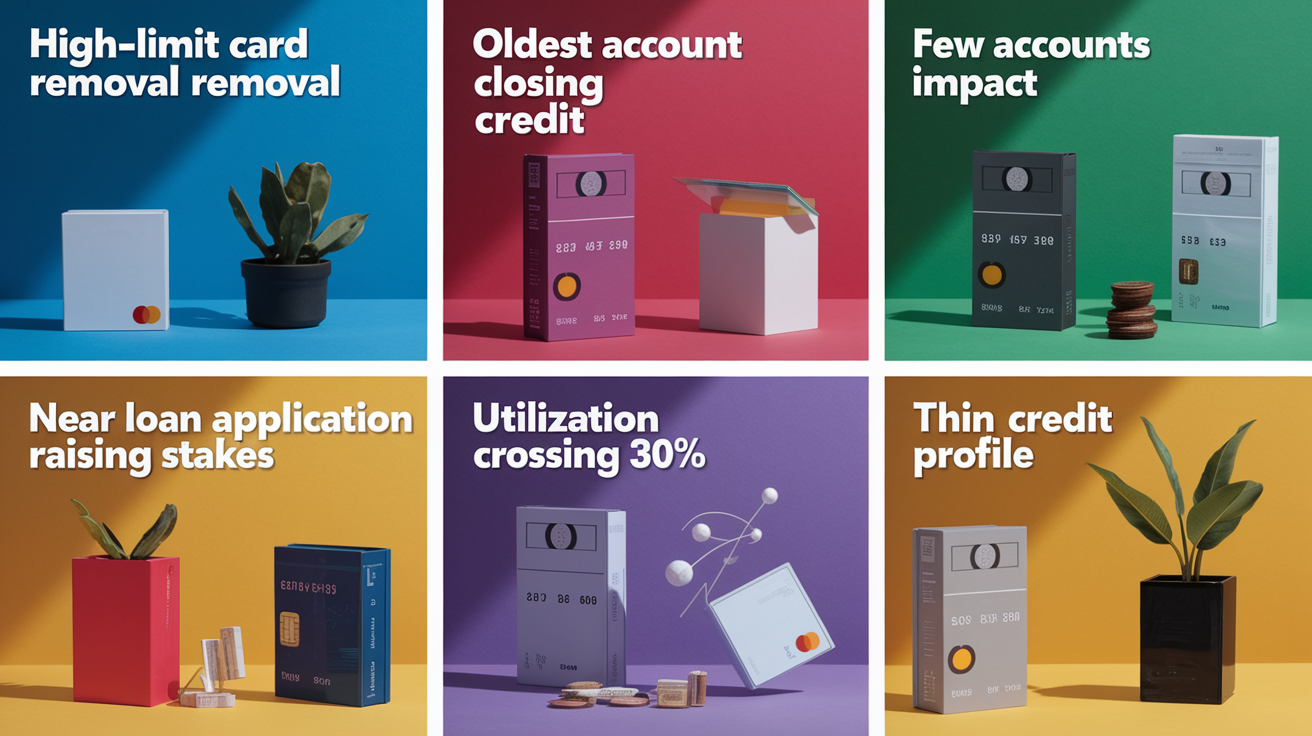
Closing old credit cards inflicts the most damage when it triggers large changes to your utilization ratio, shortens your average account age significantly, or reduces your credit mix. Some consumers see score drops of 20 to 100+ points, especially if their overall credit profile is thin or already near the 30% utilization threshold.
Six scenarios where closing a card is most likely to hurt:
The card has a high credit limit that represents a large chunk of your total available credit. For example, closing an $8,000 limit card when your total limits are $12,000 removes two thirds of your available credit. You’re already close to or above 30% utilization and closing the card pushes you well over that threshold. This can move you from “good” credit to “fair” credit in many scoring models. The card is your oldest account by several years, and you have only a handful of other accounts to absorb the loss. This shrinks your average age and reduces your overall credit depth. You have few total credit accounts (three or fewer), so closing one account has an outsized effect on both average age and credit mix. You’re planning to apply for a major loan (mortgage, car loan, large personal loan) in the next 6 to 12 months and the utilization increase or age drop could lower your score below approval thresholds. You have a thin credit file with only revolving accounts (credit cards) and no installment loans. Closing a card reduces your credit mix, which accounts for a smaller but still meaningful piece of your score.
When Closing Old Credit Cards Won’t Hurt Much (or At All)
There are situations where closing an old credit card has minimal or even negligible impact on your credit score. These usually occur when the card has a very small credit limit, when your overall utilization stays well below 30% after the closure, or when you have many other long aged accounts to cushion the average age calculation.
If you have ten credit cards with an average age of 8 years and you close a 3 year old card with a $500 limit while your total limits exceed $50,000, the closure will barely move the needle. Closing your newest card instead of your oldest one also minimizes the age impact, since the newer account contributes less to your average age and hasn’t had time to build a long payment history yet.
| Scenario | Why Impact Is Low |
|---|---|
| Closed card has a very small credit limit ($500 or less) and your total available credit is high | The loss of a tiny limit barely changes your utilization percentage, especially if you have $20,000+ in total limits remaining |
| Your overall utilization stays under 10% even after closing the card | Scoring models reward utilization under 10%. As long as you remain in that range, the closure won’t trigger a meaningful score drop |
| You have many other long aged accounts (five or more accounts older than 5 years) | Your average account age and oldest account age remain strong. Losing one account doesn’t materially shorten your credit history |
Practical Examples Showing Score Impact After Closing a Card

Here’s a detailed numeric example showing exactly how closing a card changes your score inputs. Start with two cards: Card 1 has a $4,000 limit with a $1,800 balance, and Card 2 has a $6,000 limit with a $1,200 balance. Your combined balance is $3,000 and your total credit limit is $10,000, giving you a utilization ratio of $3,000 ÷ $10,000 = 30%.
Step by step closure scenario:
You decide to pay off Card 2 and close it. Your $1,200 balance on Card 2 goes to $0. Your total balance is now $1,800 (only Card 1), and your total limit is still $10,000. New utilization: $1,800 ÷ $10,000 = 18%.
You close Card 2. The $6,000 limit is removed from your total available credit. Your remaining limit is $4,000 (only Card 1). Your balance is still $1,800.
New utilization after closing Card 2: $1,800 ÷ $4,000 = 45%.
Utilization jumped from 30% to 45% even though you paid down debt. This can cause a score drop of 20 to 50+ points depending on your overall profile.
Alternative outcome if you had kept Card 2 open: Balance $1,800, total limit $10,000, utilization 18%. Well below the 30% threshold, which would likely improve your score instead of hurting it.
Timeline: The closed account appears on your report within a few weeks. The utilization change affects your score in the next billing cycle. The closed account remains on your report for up to 10 years, continuing to contribute to payment history and average age until it’s removed.
Alternatives to Closing Credit Cards That Protect Your Credit Score
If your goal is to simplify your finances, avoid annual fees, or reduce temptation, there are safer strategies than outright closing old credit cards. These alternatives let you stop using the card while preserving your available credit and account age.
One common option is to ask the card issuer to downgrade your card to a no fee product instead of closing it. For example, if you have a rewards card with a $95 annual fee that you no longer use, you can request a product change to a basic card with no fee from the same issuer. This keeps the account open, preserves your credit limit and account age, and eliminates the fee. Another option is to keep the card open with a $0 balance and set one small recurring charge (like a $5 monthly subscription) with autopay to prevent the issuer from closing the account due to inactivity.
Five alternatives to closing:
Downgrade to a no annual fee card. This keeps the account alive without ongoing costs and preserves your credit limit and history. Request a credit limit increase on other cards. If you must close a card, first increase limits on your remaining cards to offset the lost available credit and keep utilization stable. Pay down balances before closing. Reduce your total balances as much as possible before you close the card. This minimizes the utilization spike. Lock or freeze the card. Some issuers let you lock the card through their app so you can’t use it, but the account stays open and reports to the bureaus. Keep the card open with minimal activity. Charge a small amount once every few months and pay it off immediately to keep the account active without accumulating debt.
Steps to Take Before Closing a Credit Card to Reduce Damage

If you’ve decided that closing a card is necessary, follow a practical checklist to minimize the score impact and avoid surprises. Calculating your before and after utilization is the single most important step because it shows you exactly how your score inputs will change.
Seven steps to close a card safely:
Calculate your current credit utilization. Add up all your credit card balances and all your credit limits. Divide total balances by total limits to get your current utilization percentage. Simulate the closure. Subtract the closing card’s limit from your total limits and recalculate utilization. If the new ratio exceeds 30%, consider paying down balances or increasing other limits first. Identify your oldest account. If the card you’re closing is your oldest, understand that your average account age may drop when the account eventually falls off your report (up to 10 years later). Avoid closures 6 to 12 months before major loan applications. Higher utilization or a lower average age can hurt your approval odds and interest rate. Delay the closure until after you secure the loan. Request credit limit increases on other cards. Before closing, ask your other issuers to raise your limits to offset the lost credit line and keep utilization stable. Check your credit report after the closure. Verify that the account shows as closed with a $0 balance and that no errors appear. Dispute inaccuracies with the credit bureaus if needed. Monitor your credit score for changes. Use a free credit monitoring service or your bank’s score tracker to watch for score movements. Expect the utilization effect within one to two billing cycles.
Special Situations: Authorized Users, Joint Cards, Secured Cards, and Business Cards

Authorized user accounts can complicate the closing decision because they may provide a large portion of your total available credit even though you’re not the primary cardholder. If the primary account holder closes the card or removes you as an authorized user, your total available credit drops and your utilization can spike. Joint credit card accounts (less common today) affect both parties’ credit reports. Closing a joint card impacts both individuals’ utilization and average age.
Secured credit cards (backed by a cash deposit) can be closed once you’ve built enough credit to qualify for unsecured cards. When you close a secured card in good standing, the issuer typically returns your deposit within a few billing cycles. Business credit cards often don’t report to consumer credit bureaus unless the account goes delinquent, so closing a business card may have little or no effect on your personal credit score. But confirm with the issuer, as some business cards do report to personal bureaus.
Four special case points:
Authorized user removal. If you’re an AU on a high limit card, losing that account can raise your utilization and lower your average age. Consider becoming the primary cardholder or opening your own card before removal. Joint card closure affects both account holders. Both see utilization and age effects. Coordinate timing and make sure both parties understand the score impact. Secured card closure. Closing a secured card after upgrading to unsecured cards is usually safe if you’ve replaced the limit elsewhere and the secured card isn’t your oldest account. Business card closure. Verify reporting behavior with your issuer. If the card doesn’t report to your personal credit file, closing it won’t affect your consumer score.
Loan Application Timing: Should You Close Cards Before Applying for Credit?
Avoid closing credit cards in the 6 to 12 months before you apply for a major loan. Mortgage lenders, auto lenders, and other creditors pull your credit score and review your credit report during underwriting. A recent closure that raised your utilization or lowered your average age can reduce your score and hurt your approval odds or interest rate. Higher utilization can also increase your debt to income ratio perception, even though available credit isn’t technically debt.
In rare cases, a loan officer may ask you to close certain accounts to meet underwriting guidelines. For example, some mortgage programs set limits on the total number of open revolving accounts. If a lender requests closure, get the instruction in writing and confirm that the closure is required for approval. Otherwise, keep your cards open and your utilization low to present the strongest possible credit profile.
Four timing scenarios by loan type:
Mortgage applications. Avoid any account closures for at least 6 to 12 months before applying. Mortgage underwriters scrutinize credit closely and even a 10 to 20 point score drop can affect your rate or require a larger down payment. Auto loans. Similar to mortgages, avoid closures for several months before you shop for a car loan. Many auto lenders use credit score tiers, and a small score decrease can push you into a higher interest tier. New credit card applications. If you’re applying for a new rewards card or balance transfer card, keep existing cards open to maintain low utilization and strong average age. Close old cards only after you’ve been approved and received the new card. Refinancing (mortgage or student loan). Treat refinancing like a new loan application. Avoid closures beforehand and focus on paying down balances to keep utilization as low as possible.
Frequently Asked Questions About Closing Old Credit Cards
Many borrowers worry about the mechanics of account closure and how long changes will appear on their credit reports. Closed positive accounts remain on your credit report for up to 10 years from the closure date, continuing to contribute to your payment history and average age during that window. Negative items (late payments, charge offs) remain for about 7 years from the date of first delinquency, whether the account is open or closed.
Six common questions and answers:
Will closing a $0 balance card increase my credit score? No. Closing a zero balance card usually decreases your score because it reduces your total available credit and raises your credit utilization ratio. The card’s positive payment history remains, but the utilization effect often outweighs it.
Do closed accounts remain on my credit report? Yes. Closed accounts in good standing can stay on your report for up to 10 years after closure. Accounts with negative marks remain for about 7 years from the first missed payment.
Can I reopen a closed credit card? Maybe. Some issuers allow you to reopen a recently closed account if you contact them within a few weeks or months. Approval depends on the issuer’s policies and your current creditworthiness, and there’s no guarantee.
What if my credit report shows errors after I close a card? Dispute inaccuracies with the three nationwide credit bureaus (Equifax, Experian, TransUnion) online or by mail. Provide documentation (account statements, closure confirmation) and the bureaus must investigate within 30 days.
How long does it take for my credit score to recover after closing a card? Recovery time varies. If you pay down balances or increase other limits to restore low utilization, your score may rebound within one to three months. If the closure caused a large utilization spike and you don’t offset it, the damage can persist for many months.
Should I close a card before applying for a mortgage or car loan? No, unless a lender specifically instructs you to do so for underwriting reasons. Closing cards before a major application usually hurts your score by raising utilization, which can reduce your approval odds or increase your interest rate.
Final Words
If you’re deciding whether to close an old card: Yes — it can hurt your score by raising your credit utilization and lowering your average account age.
Payment history still counts, but utilization changes show up right away. Use the simple examples in the post to see how much your numbers shift.
If you ask “does closing old credit cards hurt my credit score”, do the before/after math on limits and ages and consider downgrading or keeping a zero-balance card open. Small steps and timing usually limit harm, and scores often recover.
FAQ
Q: Is it a bad idea to close my oldest credit card?
A: Closing your oldest credit card can be a bad idea because it usually lowers your average account age and may raise your credit utilization, which often leads to a noticeable drop in your score.
Q: What is the 7 year rule on credit cards?
A: The 7 year rule on credit cards means most negative items, like late payments, remain on your credit report about seven years from the first missed payment before they fall off.
Q: What is the biggest killer of credit scores?
A: The biggest killer of credit scores is missed payments (payment history). But high credit utilization also quickly cuts scores, so both late payments and big balances are the main threats.
Q: How do I raise my credit score 100 points in 30 days?
A: Raising your credit score 100 points in 30 days is usually unlikely, but you can pay down balances to lower utilization, dispute errors on your report, and avoid new debt for the best short-term lift.