


Which saves you more: a debt consolidation loan or a balance transfer card?
Both roll multiple debts into one payment, but they work very differently.
Balance transfers can offer 0% APR for a short time, which cuts interest to nearly zero if you pay the balance during the promo.
Loans lock a fixed rate and term, so your payment stays steady.
If you can afford higher monthly payments and finish inside the promo, a balance transfer usually costs less; if you need more time or a predictable payment, a consolidation loan is the safer bet.
Key Comparison Factors When Evaluating a Debt Consolidation Loan vs Balance Transfer Credit Card
Balance transfer cards and debt consolidation loans both let you roll multiple debts into one payment. But they’re built differently.
Balance transfers usually come with 0% APR for 6 to 21 months, plus a transfer fee of 3% to 5% on whatever you move over. Consolidation loans, which are typically unsecured personal loans, charge interest anywhere from 6% to 36% depending on your credit. You’ll also see origination fees between 1% and 12%. With a balance transfer, the savings only happen if you pay off everything before the promo ends. Loans give you fixed monthly payments over 24 to 84 months, which makes budgeting simpler but might cost more in interest if your rate’s high.
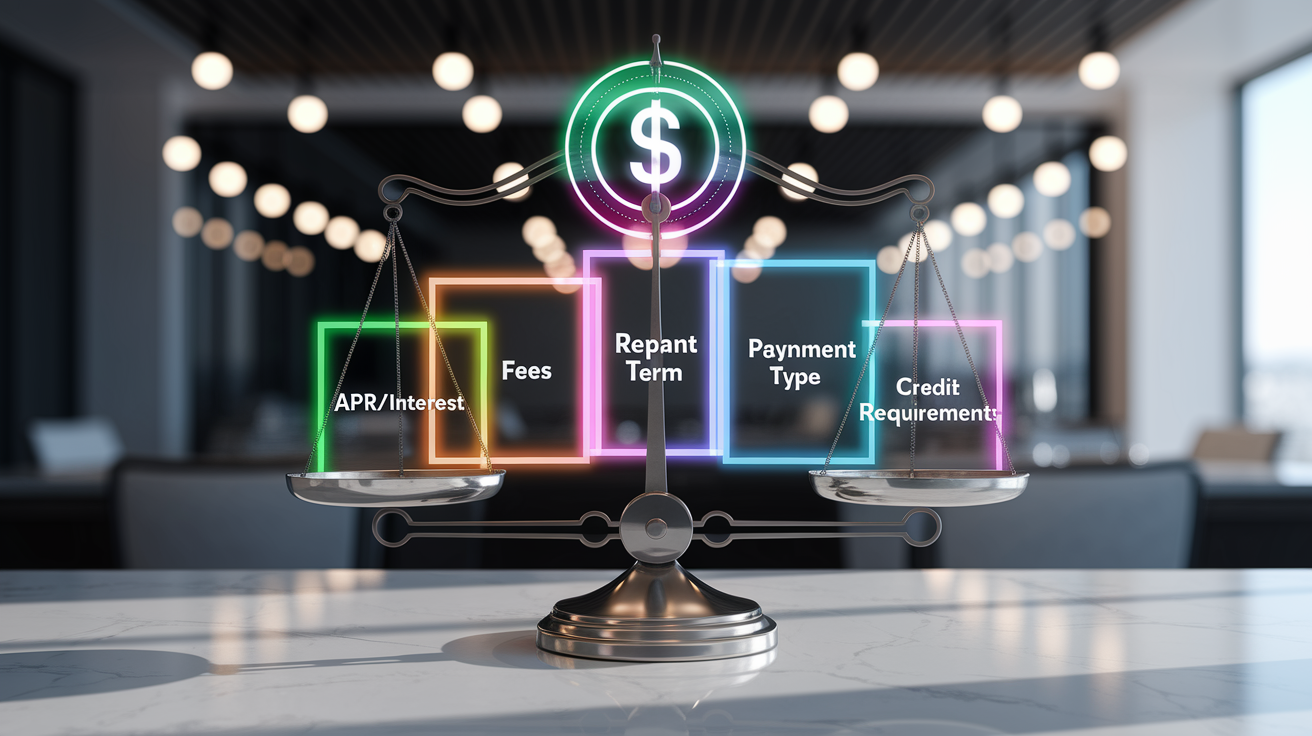
When you’re comparing, look at five things: the interest rate or promo APR, upfront fees, the repayment term, whether your payment is fixed or flexible, and what credit score you need. Post-promo APR matters too. Any balance left on a transfer card after the promo expires gets hit with the standard rate, often 15% to 25%. With a loan, your APR stays locked the whole time, so you know exactly what you’ll pay and when you’ll be done.
Your choice comes down to how much you can pay monthly and how long you need to get out of debt. If you can realistically pay off the full balance during the promo window and qualify for a big enough credit limit, a balance transfer will save you the most money. If you need two years or more and want payments you can count on, a loan’s usually the safer pick.
| Feature | Balance Transfer Card | Debt Consolidation Loan |
|---|---|---|
| Interest Rate | 0% for 6–21 months, then 15–25% | 6–36% fixed for entire term |
| Fees | 3–5% transfer fee | 1–12% origination fee |
| Repayment Term | Must pay within promo period | 24–84 months fixed |
| Monthly Payment Type | Flexible (but must finish on time) | Fixed and predictable |
| Credit Requirements | Good to excellent (670–750+) | Fair to excellent (wider range) |
| Ideal Scenario | Card-only debt, pay within promo | Mixed debt, need longer to repay |
How Balance Transfer Credit Cards Work for Debt Consolidation

A balance transfer moves your existing credit card balances to a new card with a promotional rate, often 0%, for a set period. Usually 12 to 21 months. You apply, get approved, then request the transfer. The issuer pays off your old cards, and you owe the new card the transferred amount plus a transfer fee. That fee’s typically 3% to 5% of each balance. So if you transfer $8,000 with a 3% fee, you’re actually starting at $8,240. Transfers can take several days to process, which means you might need to keep making minimum payments on your old cards until everything clears.
Your new credit limit decides whether you can move all your debt in one go. If you’ve got $15,000 across three cards but your new limit’s only $10,000, you can’t consolidate everything. A lot of issuers also cap the transfer amount below your full limit to make room for fees. Some won’t let you transfer balances between their own branded cards either, so check that before applying.
If you don’t pay off the whole balance before the promo ends, whatever’s left starts accruing interest at the card’s standard APR. That’s commonly 15% to 25%. It can wipe out any savings you got during the 0% window. Miss even one monthly payment and you might lose the promotion entirely, plus get hit with a penalty APR that could be higher than what you were trying to escape.
Limitations and risks to watch for before you initiate a transfer:
- Transfer limits might be lower than your approved credit limit
- Promo APR can disappear with a single late payment
- Post-promo APR applies to the remaining balance and can be higher than your original rates
- Some issuers exclude cash advance balances or restrict transfers from their own family of cards
How Debt Consolidation Loans Work and What Borrowers Should Expect

A debt consolidation loan is a lump sum you borrow to pay off existing debts. You’re left with a single monthly payment to the new lender. Most are unsecured personal loans, so you don’t put up collateral. When you apply, many lenders offer soft-pull prequalification that estimates your APR and loan amount without affecting your credit score. If you decide to move forward, the lender runs a hard credit inquiry, verifies your income and documents, then issues a formal offer. Approval can happen in minutes to a few days. Funding typically shows up in your bank account within the same day to three days.
Since the loan has a fixed term, usually 12 to 120 months (2 to 7 years is most common), the lender calculates a monthly payment that covers both principal and interest in equal installments. That’s called amortization. Each payment reduces the balance a little more, and your final payment brings the loan to zero. The interest rate stays locked for the entire term, so your payment never changes unless you refinance. This makes budgeting straightforward compared to revolving credit.
Loan fees, especially origination fees, can cut into the net proceeds you receive. Origination fees commonly run 1% to 12% of the loan amount. They’re either deducted from the loan or added to the balance. For example, a $10,000 loan with a 3% origination fee means you get $9,700. So if you need exactly $10,000 to pay off balances, you’ll have to borrow $10,310. Eligibility depends on credit score, income, and debt to income ratio. Personal loan APRs range widely, from 6.25% for excellent credit to 35.99% for poor credit. Secured options like home equity loans may offer lower APRs but put your collateral at risk if you can’t make payments.
Cost Comparison: Calculating the Total Savings for a Debt Consolidation Loan vs Balance Transfer Credit Card
To figure out which option saves you more money, you need to calculate the total cost of each, including all fees and interest. Start by listing your current balances, interest rates, and minimum monthly payments. Then model each scenario over the time it would realistically take you to pay off the debt.
Five steps to calculate true total cost:
- Add up your outstanding balances and current minimum payments
- For a balance transfer, multiply the balance by the transfer fee percentage (like $10,000 × 3% = $300) and divide the new total by the promo period in months to find your required monthly payment
- For a loan, use a loan calculator or the payment formula to find the monthly payment, then multiply that by the number of months to get the total repaid and subtract the original principal to find total interest
- Add any origination fees to the loan total cost, and compare that number to the balance transfer fee
- Calculate the difference between the two total costs to see which option saves you more money over the entire repayment period
The required monthly payment for a balance transfer is often much higher than a loan’s fixed payment because you’ve got far fewer months to pay it off. For example, $10,000 with a 3% transfer fee becomes $10,300. If the promo lasts 18 months, you need to pay $572 per month to clear the balance and avoid any interest. If you take out a personal loan for $10,000 at 12% APR over 36 months, your monthly payment’s roughly $332, and the total you repay is about $11,952, which includes $1,952 in interest. If the loan also has a 3% origination fee ($300), your total cost is $12,252. The balance transfer saves you $1,952 in interest, but only if you can afford $572 per month and stick to the plan.
| Scenario | Balance Transfer Total Cost | Loan Total Cost |
|---|---|---|
| $5,000 debt, 0%/15 months, 3% fee | $5,150 ($343/month required) | $5,600 (12% APR, 24 months, ~$235/month) |
| $10,000 debt, 0%/18 months, 3% fee | $10,300 ($572/month required) | $12,252 (12% APR, 36 months, ~$332/month + 3% origination) |
| $20,000 debt, 0%/18 months, 3% fee | $20,600 ($1,144/month required) | $25,500 (10% APR, 60 months, ~$425/month + 2% origination) |
Real World Scenarios Showing When a Balance Transfer or Consolidation Loan Works Best

Picture a borrower with $8,000 in credit card balances carrying an average APR of 18%. If they qualify for a 0% balance transfer for 18 months with a 3% fee, the total cost is $8,240. To finish on time, they need to pay $458 per month. If they pull it off, they save roughly $2,190 compared to a five year personal loan at 10% APR with a 3% origination fee, which would cost about $10,430 total. The balance transfer wins decisively. But only if the borrower can afford $458 each month and maintain discipline for a year and a half.
Different scenario: $15,000 spread across cards at 20% APR. A balance transfer with 0% for 18 months and a 3% fee costs $15,450 total and requires monthly payments of about $858. A personal loan at 10% APR over 60 months with no origination fee costs roughly $19,140 total, with a monthly payment of $319. The loan costs about $3,690 more in the long run, but the monthly payment is $539 lower. If the borrower can’t reliably pay $858 per month or risks missing the 18 month deadline, the loan’s the safer path even though it costs more.
For larger balances like $30,000, credit limits on balance transfer cards often become a barrier. Most issuers won’t approve a credit line that high for a single cardholder. And even if they do, the transfer cap might restrict how much you can actually move. Personal loans commonly allow amounts of $50,000 or more. They offer a fixed term and predictable amortization. In this range, a loan with a competitive APR below your current card rates will almost always be the more practical choice, especially when spread over five to seven years.
Credit Score Impact When Choosing a Balance Transfer or Debt Consolidation Loan

Both a balance transfer and a debt consolidation loan will generate a hard credit inquiry when you apply, which can temporarily lower your score by a few points. The new account will also reduce your average account age, which is another minor short term hit. But the long term effects depend on how you manage the new debt and what happens to your old accounts.
Opening a personal loan and using it to pay off credit cards lowers your credit utilization ratio because you’re reducing the balances on revolving accounts. If you keep those old cards open with zero balances, your total available credit stays the same or increases, and your utilization percentage drops. That can raise your score over time. A balance transfer can have a similar effect if the new card has a high enough limit. But if the limit’s small, your utilization might actually go up and hurt your score. For example, transferring $8,000 to a card with a $10,000 limit puts you at 80% utilization on that card, which can lower your score even if your total debt didn’t change.
Closing old credit card accounts after a balance transfer or loan payoff is a common mistake. Doing so removes that available credit from your credit file, which raises your overall utilization ratio and can shorten your credit history. Keep the accounts open and use them sparingly to maintain the scoring benefits.
Four common credit impact pitfalls borrowers should avoid:
- Closing old credit card accounts right after paying them off
- Maxing out the new balance transfer card or using it for new purchases during the promo period
- Applying for multiple cards or loans in a short window, stacking hard inquiries
- Missing a payment on the new account, which can trigger penalty rates and credit score damage
Eligibility Requirements for Debt Consolidation Loans vs Balance Transfer Credit Cards

Balance transfer cards with 0% promotional rates generally require good to excellent credit. That means a FICO score of 670 or higher, with the best offers typically going to applicants above 700. Issuers also consider your income, existing debt, and payment history. If your credit’s below 670, you may still qualify for a balance transfer card, but the promotional APR will be shorter or nonexistent, and the ongoing interest rate will be higher.
Personal loans are available across a much wider credit spectrum. Lenders offer products for fair credit (scores in the mid 600s), bad credit (scores below 600), and excellent credit. The difference shows up in the APR and origination fee. A borrower with a 750 score might see rates starting around 6% to 10%, while someone with a 620 score may be quoted 18% to 28%. Debt to income ratio also plays a major role in loan approval. Most lenders prefer a DTI below 40%, meaning your total monthly debt payments, including the new loan, don’t exceed 40% of your gross monthly income. Adding a cosigner with strong credit can help you qualify for a better rate or a larger loan amount.
Five eligibility checkpoints to review before you apply:
- Your current credit score and whether it meets the minimum for 0% balance transfer offers or low APR loans
- Your debt to income ratio, calculated by dividing total monthly debt payments by gross monthly income
- Whether your debt’s eligible to be transferred or consolidated (some issuers exclude certain balance types or restrict same issuer transfers)
- Your expected credit limit or loan amount compared to the total debt you want to consolidate
- Whether you can prequalify with a soft credit check to estimate approval odds and rates before a hard inquiry
Fees, Risks, and Fine Print That Can Change Your Debt Consolidation Outcome

A 3% balance transfer fee might sound small until you see it on a $10,000 transfer. That’s $300 added to your balance immediately. If the promotional period’s only 12 months and you can’t pay the full $10,300 before it ends, any remaining balance starts accruing interest at the standard APR, which could be 20% or higher. Missing a single payment during the promotional period can void the 0% rate entirely and trigger a penalty APR that may be even worse than the rate you started with.
Debt consolidation loans come with their own traps. Origination fees range from 1% to 12%, and some lenders deduct the fee from the proceeds, leaving you short if you need a specific amount to pay off your debts. A handful of lenders still charge prepayment penalties if you pay the loan off early, which erases the benefit of making extra payments. Always confirm whether prepayment’s allowed without penalty before you sign.
Payment allocation rules on balance transfer cards can also catch you off guard. If you make new purchases on the same card during the promotional period, your payments may be applied to the promotional balance first and the new purchases last. That means those purchases sit there accruing interest at the standard APR until the transfer balance is gone. Some issuers use different allocation methods, so check the terms or avoid using the card for anything other than the transferred balance.
Four fees and risks that can negate your savings:
- Transfer fees that add hundreds of dollars to your balance before you start paying it down
- Origination fees deducted from loan proceeds, forcing you to borrow more than you need
- Penalty APRs triggered by late payments, sometimes exceeding 29%
- Payment allocation rules that leave new purchases accruing high interest while you pay down the 0% balance
Decision Framework: Choosing the Right Option Based on Debt Size, Timeline, and Credit Profile

Start by calculating how much you can realistically pay each month without straining your budget. Take that number and divide your total debt by it to estimate how many months you’ll need to become debt free. If the answer’s 18 months or less and you have good credit, a balance transfer card’s likely your best option. If the answer’s two years or longer, or if your credit score’s below 670, a personal loan will probably cost you less stress and give you more predictable monthly payments.
Next, run the total cost math. Add the transfer fee or origination fee to the balance, then calculate the total interest you’ll pay under each option based on your estimated payoff timeline. Use an online calculator or the payment formula to get exact numbers. Compare those totals side by side. The option with the lower total cost wins, as long as the monthly payment fits your budget.
Six step decision checklist for choosing between both options:
- Calculate your monthly budget surplus available for debt repayment
- Divide your total debt by that monthly amount to estimate how many months you need to pay it off
- If your timeline’s 18 months or less and you have a credit score above 670, model a balance transfer with a 3 to 5% fee and confirm the required monthly payment
- If your timeline’s longer than 18 months or your score’s below 670, model a personal loan using the best APR you prequalify for and include any origination fee
- Compare total cost (fees plus interest) for each option over your intended payoff period
- Choose the option with the lower total cost and a monthly payment you can sustain without missing deadlines
Common Mistakes to Avoid When Comparing Debt Consolidation Loans and Balance Transfer Credit Cards

The biggest mistake is choosing a balance transfer without a realistic plan to pay it off within the promotional period. If you transfer $12,000 to a card with 0% for 15 months and can only afford $600 per month, you’ll still owe $3,000 when the promo ends. That remaining balance will start accruing interest at the standard rate, potentially costing you more than if you’d taken a loan from the start.
Another common error is continuing to use your old credit cards after you’ve transferred the balances or paid them off with a loan. If you rack up new debt on those cards, you end up with both the consolidation payment and new balances, putting you in a worse position than before. To avoid this, consider putting your old cards in a drawer or setting up alerts to remind you not to use them until the consolidation debt’s fully paid.
Five mistakes that can derail your debt consolidation plan:
- Underestimating the monthly payment required to clear a balance transfer within the promo window
- Ignoring transfer fees or origination fees when comparing total costs
- Using old credit cards for new purchases after consolidating the balances
- Missing a single payment on a balance transfer card, which can void the 0% rate and trigger penalty APRs
- Skipping autopay setup, which increases the risk of late payments and fees
Final Words
In the action we compared balance transfer cards and debt consolidation loans: how each works, fees, credit needs, payment math, and real examples that show the real cost.
We walked through eligibility, credit impact, common traps, and a step-by-step decision checklist so you can run the numbers yourself.
Now use those steps to compare totals, check fees, and pick the option that fits your budget and timeline. You’ve got this—small choices now can save a lot later on how to compare a debt consolidation loan vs balance transfer credit card.
FAQ
Q: Is it better to get a debt consolidation loan or balance transfer credit card?
A: Whether a debt consolidation loan or a balance transfer credit card is better depends on your timeline, budget, and credit. Balance transfers save if you’ll pay the debt during the 0% promo; loans give longer, fixed payments and broader approval.
Q: Why does Dave Ramsey not recommend debt consolidation?
A: Dave Ramsey doesn’t recommend debt consolidation because he prefers the debt snowball method and worries consolidation can extend repayment, add fees, and let people keep using cards instead of fixing money habits.
Q: How to pay off $30,000 in debt in 1 year?
A: To pay off $30,000 in one year you need about $2,500 a month plus interest. Cut expenses, boost income, sell items, use bonuses, and prioritize high‑rate balances or a lower‑rate consolidation.
Q: What is the downside of a balance transfer credit card?
A: The downside of a balance transfer credit card is transfer fees (usually 3–5%), short 0% promos, post‑promo APR spikes, small transfer limits, and losing the promo if you miss a payment.