


What if that “low” rate on your loan is hiding thousands in fees and interest?
Most people only check the monthly payment.
That misses the real question: how much will you hand over in total?
True cost is the principal plus every cent of interest and every fee.
Also factor in amortization (the way your payment splits between interest and principal) over time.
This post shows a simple step-by-step method to calculate the true cost so you can compare offers apples to apples and avoid costly surprises.
You’ll finish knowing the exact dollars each loan will cost.
Core Method to Calculate the True Cost of a Loan (Interest, Fees, and Amortization)

The true cost of a loan isn’t just your monthly payment. It’s every single dollar you’ll hand over during the life of the loan: the principal, all the interest, and every fee the lender bakes in. Most borrowers stop at “Can I swing the monthly payment?” Wrong question. You need to know what you’re paying in total, then decide if the loan’s worth it.
The calculation gets simple once you’ve got the loan’s basics in front of you. Principal amount, interest rate, term length, whether it’s simple or amortizing interest, and a full list of fees. With an amortizing loan (think mortgage or car loan), payments stay fixed but the interest portion shrinks each month as your balance drops. You’ll need an amortization schedule to see how much interest piles up over time. Simple interest loans are easier. Just multiply principal times rate times the number of years, and there’s your total interest.
Once you’ve got total interest, add every fee the lender’s charging upfront or along the way. Then add the principal back in. That’s your true cost.
Here’s how to do it step by step:
- Write down the loan amount, interest rate, term, and monthly payment if you already have it.
- List every single fee the lender disclosed. Origination, closing, servicing, prepayment penalties, application charges, all of it.
- For amortizing loans, calculate or look up the monthly payment, multiply it by the number of months, then subtract the principal to get total interest.
- For simple interest, use Principal × Annual Rate × Term (in years) to get total interest.
- Add total interest plus every fee from step two, then add the principal. That’s the true cost.
Breaking Down Loan Interest and Accrual Methods for True Cost Calculation
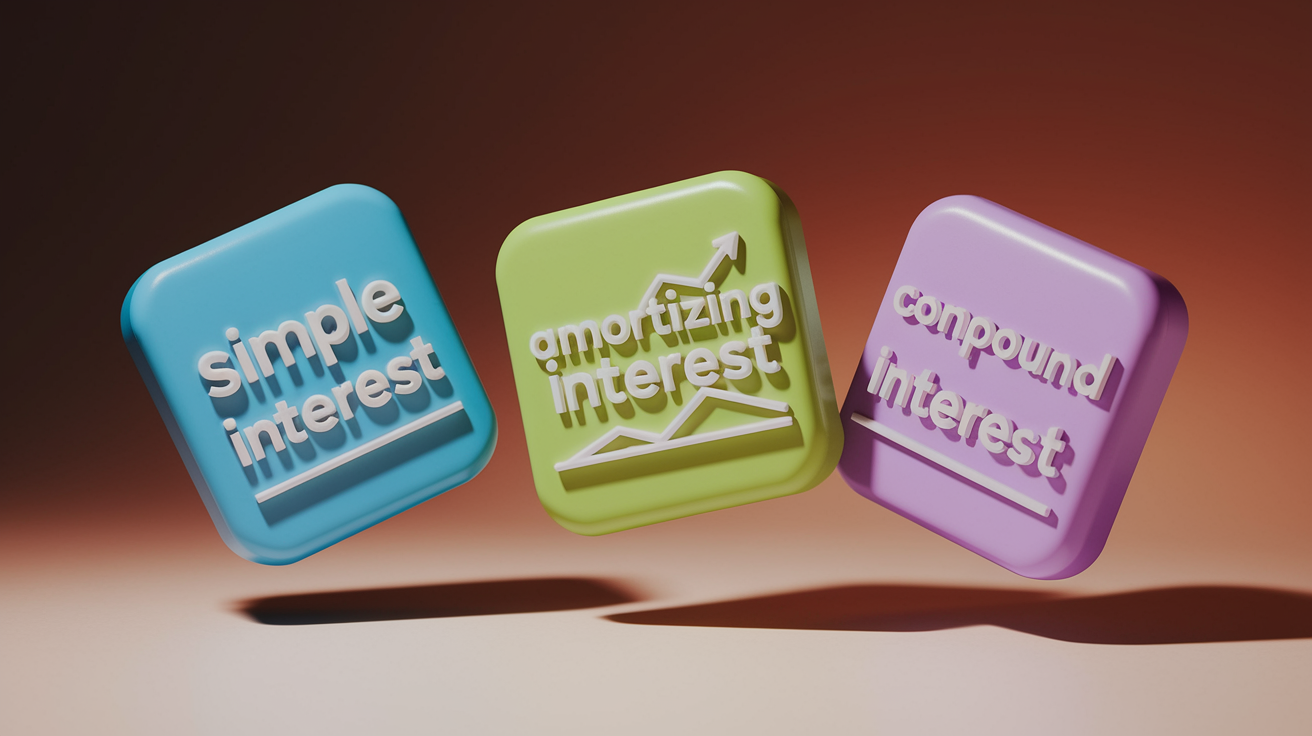
Interest accrual determines how fast the cost of borrowing stacks up, and the method matters. Simple interest calculates the charge once, based on the principal, rate, and term. You’re paying interest on the same balance the whole time. Amortizing interest (used on most installment loans) charges interest on the remaining balance each month, so the interest part of your payment shrinks as you knock down the principal. Compound interest, common on credit cards but rare for installment loans, adds unpaid interest back into your balance. You end up paying interest on interest. For true cost, you need to know which method you’re dealing with because the total can swing by hundreds or thousands of dollars even at the same rate.
Simple interest in action: borrow $20,000 at 5 percent for five years. Total interest is $20,000 × 0.05 × 5, which equals $5,000. Your total repayment is $25,000. Pay it off early and you save interest because the charge is based on how long you keep the money.
Amortizing loans work differently. The lender sets a fixed monthly payment using a formula that splits each payment between interest and principal. Early on, most of your payment goes to interest. For example, if you’ve got a $5,000 one-year loan at 12.58 percent, your first month’s interest might be around $52 and only $400 goes to principal. By the final month, almost the entire payment reduces the balance. Over time, you’ll pay more total interest on an amortizing loan with a longer term because you’re carrying a higher balance for more months.
Six things control how much interest you actually pay:
Loan amount. Bigger principal, more interest accumulates.
Interest rate. Even one or two percentage points adds hundreds of dollars over a typical loan’s life.
Credit score. Higher scores unlock lower rates and lower total cost.
Loan term. Shorter terms mean higher monthly payments but less total interest. Longer terms spread payments out but cost more overall.
Repayment frequency. Making payments more often (like biweekly instead of monthly) lowers the average outstanding balance and cuts total interest.
Extra payments. Applying extra cash to principal early in the loan reduces future interest charges because the lender calculates each month’s interest on a smaller balance.
Understanding Fees and How They Change the True Loan Cost

Lenders charge fees on top of interest, and these fees are part of the true cost even though they don’t show up in your interest rate. The most common is the origination fee, a flat charge or percentage of the loan that covers the lender’s work to process your application and fund the loan. Closing costs appear on mortgages and sometimes on larger personal or business loans. They bundle appraisals, title searches, and attorney fees. Servicing fees or monthly maintenance fees can show up on certain loans and add cost over time. Some lenders also charge prepaid interest to cover the gap between your closing date and the first payment due date.
All of this stacks on top of the interest you’ll pay.
The formula to include fees in your true cost calculation is straightforward. Take the principal you borrowed, add the total interest you’ll pay over the life of the loan, then add every upfront fee and every ongoing charge. The sum is what you’re actually paying to borrow that money.
For example, you borrow $10,000 at 8 percent over three years and total interest is $1,300. But the lender also charges a 3 percent origination fee, that’s an extra $300 upfront. Your true cost is $10,000 principal plus $1,300 interest plus $300 fee, which equals $11,600 total. The monthly payment might look affordable, but the real question is whether $11,600 total is worth it.
Fees matter because they’re cash out of your pocket that doesn’t reduce the loan balance. Some fees are negotiable, especially on mortgages and business loans. Others are fixed. When you compare loan offers, add up the fees alongside the interest so you’re comparing apples to apples. A loan with a slightly higher interest rate but no origination fee can cost less in total than a loan with a lower rate and a big upfront charge.
Here’s a breakdown of the most common fees and how each one affects your bottom line:
| Fee Type | Description | Impact on True Cost |
|---|---|---|
| Origination Fee | Upfront charge, often 1 to 5 percent of the loan principal, for processing and underwriting. | Adds directly to total cost. Not applied to balance so you pay this on top of interest. |
| Closing Costs | Bundle of fees for appraisal, title, attorney, recording, and inspection on mortgages. | Can run thousands of dollars. Either paid upfront or rolled into the loan and then charged interest. |
| Servicing or Maintenance Fees | Monthly or annual charge to keep the loan account active. | Small per-period cost that adds up over a long term. Multiply by number of months to see total. |
| Prepaid Interest | Interest covering the partial first period between funding and the first regular payment date. | Raises total interest paid. Calculate days × daily rate to estimate the amount. |
Step-by-Step Guide to Creating an Amortization Schedule to Determine Total Cost

An amortization schedule is a month-by-month breakdown showing how each payment splits between interest and principal and how the balance falls over time. Building one yourself lets you see exactly where your money goes and calculate total interest without relying on a lender’s estimate. You can do this manually with a calculator, or set up a simple spreadsheet with formulas that auto-fill the table. Either way, the logic’s the same: calculate interest on the current balance, subtract that from your fixed payment to get the principal portion, reduce the balance, and repeat for every month until the loan’s paid off.
The schedule is useful because it shows you the total interest line by line. Add up the interest column and you’ve got the total interest cost for the loan. Add that number to your upfront fees and the principal, and you’ve got the true cost. It also shows how extra payments change the outcome. Pay an extra $50 or $100 toward principal in any month, and the next month’s interest drops because you’re multiplying the rate by a smaller balance. That savings compounds through the rest of the loan.
Manual amortization formulas and calculation steps
Start with the monthly payment amount. If you don’t have it, calculate it using the standard amortization formula: M = P × r × (1+r)^n / ((1+r)^n − 1), where P is the loan amount, r is the monthly interest rate (annual rate divided by 12), and n is the total number of payments.
Once you have M, follow these steps for each month. Multiply the current balance by the monthly rate to get the interest charge for that period. For example, if your balance is $5,000 and your monthly rate is 0.005 (6 percent annual divided by 12), the interest is $5,000 × 0.005 = $25. Subtract that interest from your monthly payment to find how much went to principal. If your payment is $430.33, then $430.33 − $25 = $405.33 goes to principal. Subtract the principal portion from the current balance to get the new balance: $5,000 − $405.33 = $4,594.67.
Repeat this process for the next month using the new balance. After the final payment, the balance will be zero and the sum of all your monthly interest amounts is your total interest paid.
Sample amortization table with first three payments
Here’s what the first three rows of an amortization schedule look like for a $5,000 loan at 6 percent annual interest over 12 months, with a monthly payment of $430.33:
| Payment # | Interest | Principal | Remaining Balance |
|---|---|---|---|
| 1 | $25.00 | $405.33 | $4,594.67 |
| 2 | $22.97 | $407.36 | $4,187.31 |
| 3 | $20.94 | $409.39 | $3,777.92 |
Notice how the interest portion drops each month because the balance is shrinking. By the time you reach payment 12, almost the entire payment goes to principal and only a few dollars cover interest. If you sum the interest column for all 12 rows, you get the total interest paid on the loan, which you then add to fees and principal to find the true cost.
APR vs. Interest Rate and How APR Reveals the True Borrowing Cost

The interest rate is the percentage the lender charges on the outstanding balance, and it’s the number most people compare first. APR, or annual percentage rate, includes the interest rate plus certain lender fees, expressed as a yearly percentage. APR is designed to show the real annual cost of borrowing so you can compare loans with different fee structures on equal footing.
A loan with a 5 percent interest rate and a 2 percent origination fee will have a higher APR than a loan with a 5 percent interest rate and no fees. The APR calculation spreads those upfront costs over the life of the loan and factors them into an annualized rate.
APR is most useful when you’re comparing two or more loan offers with different combinations of rates and fees. For example, Lender A offers 6 percent interest with no origination fee, and Lender B offers 5.5 percent interest with a 3 percent origination fee. The stated interest rate is lower at Lender B, but when you run the APR calculation, Lender B’s APR might end up higher because that 3 percent fee adds significant cost. APR gives you a single number to compare, which makes the decision clearer.
But APR has limits. It assumes you’ll keep the loan for the full term, so if you plan to pay off the loan early or refinance, APR can overstate the impact of upfront fees. It also doesn’t include every fee. Items like late fees, prepayment penalties on some loans, or third-party charges that aren’t required by the lender might not show up in the APR.
Here’s what you need to know about APR to use it correctly:
APR always includes the interest rate plus mandatory lender fees like origination and underwriting charges.
APR is standardized by law for most consumer loans, which is why lenders are required to disclose it in loan estimates and truth-in-lending statements.
A higher APR than interest rate signals that fees are adding cost. The bigger the gap, the heavier the fees.
APR can mislead on short-term loans or loans you intend to pay off early, because it spreads upfront fees over the full original term and assumes you’ll make every scheduled payment.
When you’re calculating the true cost yourself, use APR as a comparison shortcut but still add up the actual dollar amounts: total interest, total fees, and principal. APR helps you spot which loan is more expensive, but the real true cost is the sum of every dollar you’ll hand over.
Examples of Loan True Cost Calculations Using Real Numbers

Seeing the math in action with real loan numbers makes the process clear. The following examples show how to calculate total interest, apply fees, and arrive at the true cost for different loan types. Each scenario walks through the inputs, the formulas, and the final totals so you can follow the same steps with your own loan details.
Short-term personal loan example. You borrow $5,000 for one year at an interest rate of 12.58 percent (the average personal loan rate in August 2025 cited in the source material). The lender charges no origination fee. Your monthly payment, calculated with the amortization formula, is approximately $446.17. Over 12 months, you’ll pay $446.17 × 12 = $5,354.04 total. Subtract the $5,000 principal and you get $354.04 in total interest. Since there are no fees, the true cost is $5,000 principal + $354.04 interest = $5,354.04. If the lender had charged a 2 percent origination fee ($100), the true cost would jump to $5,454.04.
Long-term mortgage example. You take out a $300,000 mortgage at 5 percent annual interest for 30 years (360 monthly payments). Using the amortization formula, the monthly payment is $1,610.46. Multiply that by 360 months: $1,610.46 × 360 = $579,765.60 total paid. Subtract the $300,000 principal and total interest is $279,765.60. If closing costs are $6,000, the true cost becomes $300,000 + $279,765.60 + $6,000 = $585,765.60. That’s nearly double the amount you borrowed, and the bulk of it is interest because the term is so long.
Extra-payment impact on the mortgage. Take the same $300,000 loan at 5 percent over 30 years, but add $50 extra to each monthly payment and apply it to principal. The loan will pay off 23 months early and you’ll save $21,662.67 in interest. Your new total interest is $279,765.60 − $21,662.67 = $258,102.93, and your true cost drops to $300,000 + $258,102.93 + $6,000 = $564,102.93. That’s a $21,662.67 difference just by adding $50 per month, which over the shortened term costs you $50 × 337 payments = $16,850 in extra cash out of pocket. You spend $16,850 more upfront but save $21,662.67 in interest, netting a $4,812.67 gain and getting out of the loan almost two years earlier.
Comparing Loan Offers by Their True Borrowing Cost

When you’ve got multiple loan offers, the only fair way to compare them is by calculating the true cost of each one and lining up the totals side by side. Interest rate alone doesn’t tell the story. A low rate with high fees can cost more than a higher rate with no fees. Monthly payment doesn’t tell the story either, because a lower payment often just means a longer term and more total interest.
You need to add up every dollar: principal, interest, and fees, then compare those sums.
APR is a useful starting point for comparison because it rolls fees into an annualized rate, but it has blind spots. It assumes you keep the loan for the full term and doesn’t always include optional insurance or third-party charges. So use APR to screen offers, then do the full true-cost math on your top two or three choices. If you’re comparing a 15-year loan to a 30-year loan, run the numbers for both and decide whether the higher monthly payment on the 15-year is worth the tens of thousands in interest savings. If one lender lets you make extra payments with no penalty and another charges a prepayment fee, factor in how likely you are to pay early and what that fee would cost if you do.
Here’s a quick checklist for comparing loan offers accurately:
Compare APR first to spot which loans have heavy fees rolled in. Eliminate offers with APRs far above the stated interest rate unless the lower monthly payment or other term is worth the extra cost.
Calculate total interest for each loan by multiplying monthly payment by number of months, then subtracting principal. This shows the pure interest cost before fees.
Add up every disclosed fee, upfront and ongoing, for each offer. Include origination, closing, servicing, and prepayment penalties if they apply.
Check loan term length and monthly payment together. A stretched-out term lowers the payment but raises total cost, so decide what fits your budget and your tolerance for paying interest.
Confirm prepayment flexibility. If you plan to pay extra or refinance, avoid loans with prepayment penalties or fees that limit how you can apply extra payments to principal.
Run the true cost math, write down the totals, and pick the loan that costs the least in actual dollars unless another feature, like faster payoff or lower monthly obligation, justifies paying more.
Strategies to Reduce the True Cost of Any Loan

Once you understand how interest and fees add up, you can take specific actions to cut the total cost. Most of these tactics work by either lowering the interest rate you qualify for, reducing the amount of time you carry the balance, or shrinking the fees the lender charges. Even small moves, like improving your credit score by 20 points or making one extra payment per year, can save hundreds or thousands of dollars over the life of a loan.
The most direct way to reduce cost is to make extra payments that go straight to principal. Every dollar you pay above the minimum reduces the balance, and the next month’s interest charge is calculated on that smaller number. If you’ve got a $10,000 loan and you pay an extra $100 one month, you save interest on that $100 for every remaining month of the loan.
Lenders won’t always apply extra payments to principal automatically, so when you send extra money, specify in writing or through your online account that it should reduce principal, not prepay future interest.
Biweekly payments work similarly. Instead of 12 monthly payments per year, you make 26 half-payments, which equals 13 full payments annually. That extra payment per year shortens the term and cuts total interest.
Choosing a shorter loan term upfront is another powerful strategy. A 15-year mortgage costs more per month than a 30-year, but the total interest can be less than half because you’re paying down the balance faster and the lender often offers a lower rate on shorter terms. Negotiating fees is worth the effort, especially on mortgages and business loans. Ask the lender to waive or reduce the origination fee, or shop around and use a competing offer as leverage.
Improving your credit score before you apply can drop your interest rate by a full percentage point or more, which on a large loan translates to thousands in savings. Pay down existing debt to lower your debt-to-income ratio, dispute any errors on your credit report, and avoid opening new credit accounts right before you apply.
Make extra principal payments whenever possible and confirm the lender applies them correctly. Even $25 or $50 extra per month adds up.
Switch to biweekly payments if your lender allows it. The extra payment per year shortens the term and reduces total interest without a big change to your budget.
Negotiate or shop around to reduce upfront fees like origination and closing costs. Some fees are fixed but many are negotiable or can be waived by competing lenders.
Improve your credit score and lower your debt-to-income ratio before applying. Higher credit and lower existing debt unlock better rates and save you money on every payment.
Choose the shortest term you can afford. Higher monthly payments hurt in the short run but cut total interest dramatically and get you out of debt faster.
Final Words
You learned the step-by-step method: gather the loan numbers, list every fee, calculate monthly payments for amortized loans, and build a simple amortization schedule to watch how payments split between interest and principal. Add total interest, fees, and principal to get the true cost. We also covered APR, fee types, and real examples so you can compare offers fairly.
If you want to know how to calculate the true cost of a loan including interest fees and amortization, use the 5-step workflow, get written estimates, and try a few extra-payment scenarios. Small changes can save a lot—you’re ready to make smarter choices.
FAQ
Q: How do I calculate the total cost of a loan?
A: The total cost of a loan is the sum of the principal, all interest paid over the term, and any upfront or ongoing fees; calculate monthly payments (if amortized) to total interest first.
Q: How do you calculate the true interest cost and what is the formula for loan cost?
A: The true interest cost is the total interest you pay over the loan. For simple interest use Principal × Rate × Term. For amortized loans, sum each month’s interest: balance × (annual rate/12).