


Don’t pick the loan with the lowest rate. It might be the most expensive.
Fees like origination, application, and closing can wipe out any rate savings.
If you want the cheapest loan, you have to convert every fee to dollars, add total interest over the term, and compare the combined price.
This guide shows a simple step-by-step method: get written fee lists, turn percentage fees into dollar amounts, calculate total interest, then add fees plus interest to find the true cost.
Do the math, and the real winner becomes obvious.
Evaluating Total Loan Cost Across Different Fee Structures

Most people look at the interest rate first. A loan at 6.5% seems cheaper than one at 7%. But if the first one charges a 3% origination fee and the second has no origination fee, the cheaper loan just became more expensive.
The real cost of borrowing isn’t just interest. It’s interest plus every fee you have to pay to get the loan and keep it active. Origination fees, application fees, underwriting charges, closing costs, prepaid interest. All of it counts.
If you want to compare loans correctly, you need to turn everything into dollars and add it up.
Start by getting the interest rate, term, and full fee list from each lender in writing. Then convert any percentage fees into actual dollar amounts. A 2% origination fee on a $50,000 loan is $1,000. Add up every upfront fee and any recurring charges the lender requires. Next, calculate total interest over the loan term using an amortization calculator or basic interest formula.
Now add total interest to total fees. The loan with the lowest combined number wins, even if it doesn’t have the lowest rate.
Interest rate matters, but it’s not the whole story. A 5.9% loan with $2,500 in fees can cost more than a 6.3% loan with $400 in fees, especially on shorter terms. Calculate the full price before you decide anything.
Common Loan Fees and How They Affect Borrowing Costs

Loan fees come in different shapes depending on who you’re borrowing from. Some hit you upfront. Others get buried in your monthly payment or subtracted from the loan amount before the money even reaches your account.
Origination fees usually run between 1% and 10% of what you’re borrowing. On a $30,000 personal loan, a 5% origination fee takes $1,500 right off the top. Application fees, underwriting fees, document prep charges are smaller but they still add up. Some lenders bundle everything into one origination charge. Others list them separately.
Here’s what shows up most often:
- Origination fee – 1% to 10% of the loan amount, typically deducted before you get funded
- Application fee – flat charge to submit your request, usually $25 to $100
- Underwriting fee – covers the lender’s review and approval work, often $50 to $150
- Late payment fee – charged when you miss a payment, usually $15 to $50 or a percentage of what you owe
- Prepayment penalty – fee if you pay off early, sometimes a percentage of the remaining balance
- Annual or monthly servicing fees – ongoing charges on some personal loans and lines of credit
Origination and underwriting fees are almost always mandatory if they’re listed. Application fees can sometimes be waived if you ask or if you’re already a customer. Prepayment penalties and servicing fees are avoidable if you pick a lender that doesn’t charge them. Confirm which fees are required and which can be negotiated before you commit.
Understanding APR vs Interest Rate
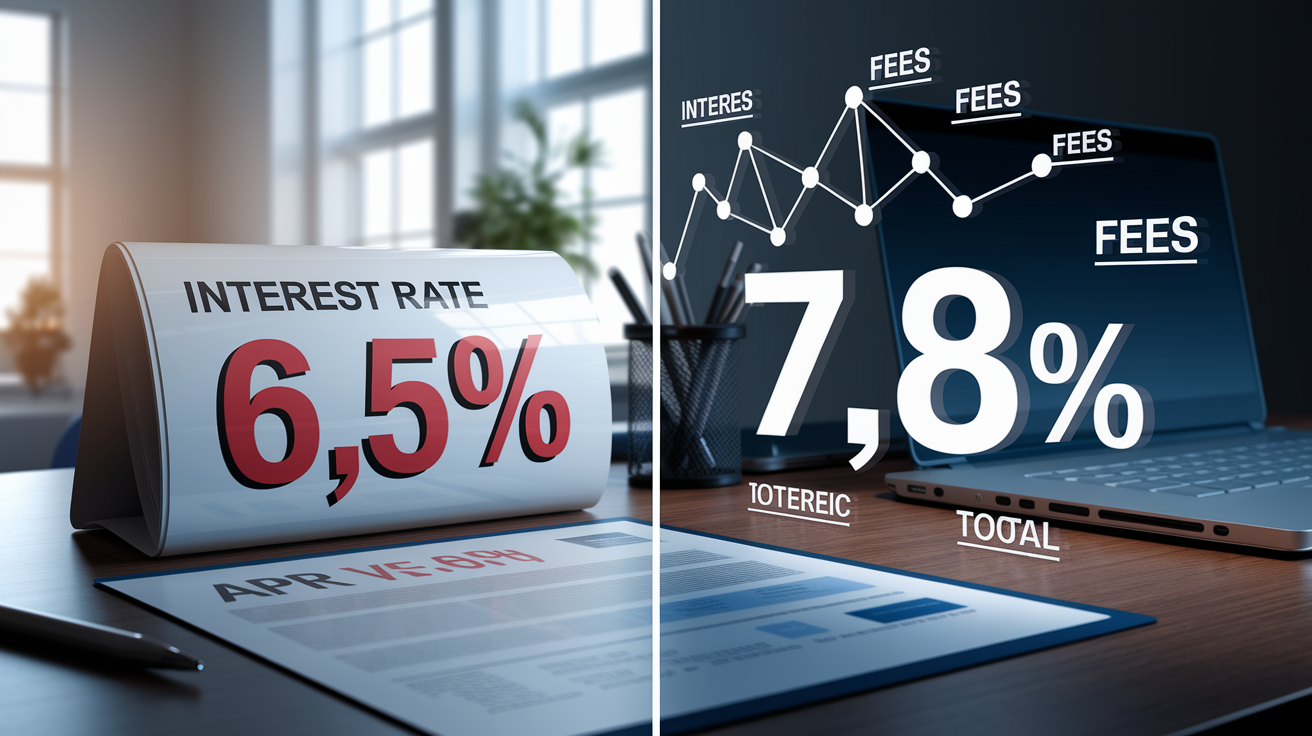
Interest rate is the percentage charged on what you borrow. It’s what you pay each month on the unpaid balance. A 7% rate on a $20,000 loan means you’re paying 7% annually on whatever’s left.
APR wraps the interest rate and most mandatory fees into one number. It’s a fuller picture because it includes origination fees, underwriting costs, and other required charges that don’t show up in the rate alone. Two loans with the same interest rate can have very different APRs if one has higher fees.
APR is better for comparing loans with different fee structures. A loan at 6.5% with $1,200 in fees might have an APR of 7.8%. A loan at 7% with $200 in fees might have an APR of 7.3%. The second one costs less even though the rate is higher.
The catch is that APR assumes you’ll keep the loan for the full term. If you plan to pay off early, the real cost could be different. Still, APR gives you a standardized number that accounts for both interest and fees, making it easier to spot the cheapest option at a glance.
Step-by-Step Method to Compare Offers Accurately
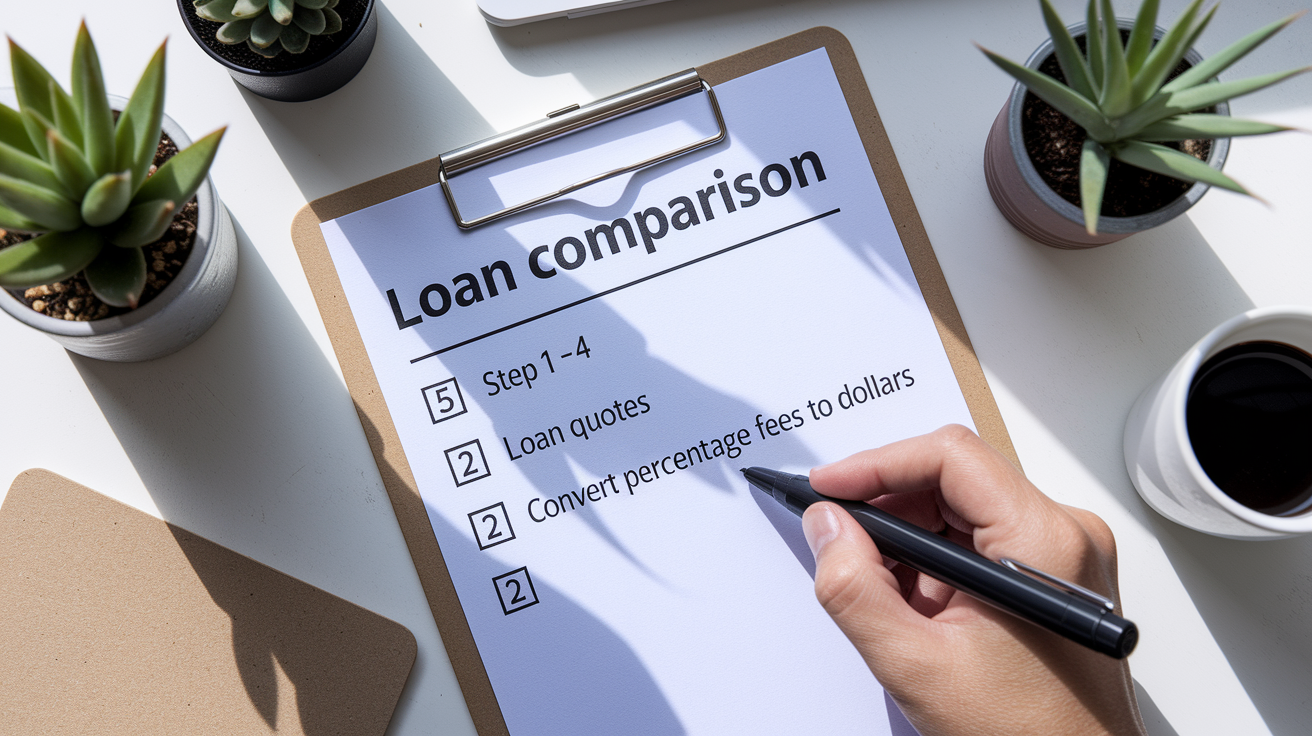
Comparing loan offers gets messy fast when every lender structures fees differently. A clear method keeps you from missing hidden costs or picking the wrong loan based on a low rate that doesn’t tell the full story.
Here’s how to compare without missing anything:
Gather written loan estimates from at least three lenders. Make sure each one lists the interest rate, APR, term, monthly payment, and an itemized breakdown of all fees.
Convert percentage fees into dollars. If the origination fee is 4% on a $40,000 loan, write down $1,600. Do this for every percentage charge so you’re comparing actual money.
Add up all one-time fees. Origination, application, underwriting, document prep, anything upfront. This is your total cost to open the loan.
Calculate total interest over the life of the loan. Multiply the monthly payment by the number of months, then subtract the loan principal. What’s left is total interest paid.
Add total interest to total fees. The loan with the lowest combined cost is your best option, even if it doesn’t have the lowest rate or monthly payment.
Use the same loan amount and term for every offer. If one lender offers 36 months and another offers 60, the payments and interest will differ just because of time, not because one deal is better. Lock the term and amount across all quotes so you’re actually comparing the same product.
This removes guesswork and makes sure you’re choosing based on total cost, not just the number that looks prettiest at first glance.
Calculating Total Loan Cost With Real Numbers
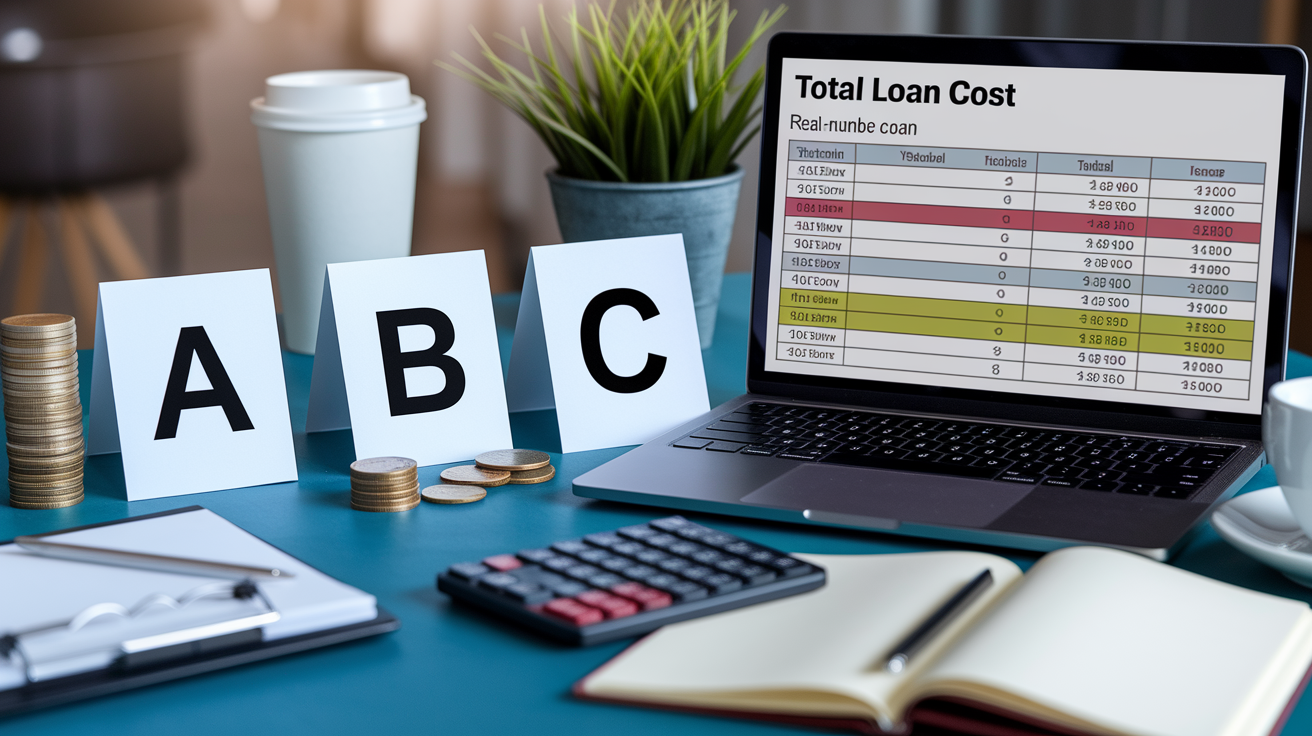
Total loan cost is every dollar you pay to borrow money. Interest plus fees. Walking through a real example shows how two loans that seem similar can cost hundreds or thousands apart.
Say you’re comparing three $25,000 personal loan offers, all with 60-month terms. Offer A has a 6.5% rate, $750 in fees, and a $489 monthly payment. Offer B has a 7.2% rate, $200 in fees, and a $498 monthly payment. Offer C has a 6.0% rate, $1,500 in fees, and a $483 monthly payment.
At first glance, Offer C looks best because of the low rate and low payment. Here’s what the full picture looks like:
| Offer | Interest Paid | Fees | Total Cost |
|---|---|---|---|
| Offer A (6.5%) | $4,340 | $750 | $5,090 |
| Offer B (7.2%) | $4,880 | $200 | $5,080 |
| Offer C (6.0%) | $3,980 | $1,500 | $5,480 |
Offer B wins by $10 over Offer A, even with a higher interest rate. Offer C, despite the lowest rate, costs $390 more than Offer B because of the $1,500 fee.
If you picked based on interest rate alone, you’d choose Offer C and lose money. When you calculate total cost, the best deal becomes obvious. This works for any loan type. Personal loans, auto loans, mortgages, business loans. Collect the numbers, do the math, let total cost guide your decision.
Identifying Break-Even Points When Fees Differ

A low-rate loan with high upfront fees can become the cheaper option. But only if you keep the loan long enough for the interest savings to cover the extra fees. That’s the break-even point.
Say you’re choosing between a $50,000 loan at 5.5% with $2,000 in fees and a $50,000 loan at 6.5% with $400 in fees. Both 60-month terms. The first loan saves you about $28 per month in interest, but you paid $1,600 more upfront. Divide $1,600 by $28 and you get roughly 57 months. That’s your break-even point.
If you plan to keep the loan for the full 60 months, the low-rate loan saves you money. If you plan to pay off early or refinance in two years, you’ll lose money because you won’t reach month 57.
Break-even analysis matters most when comparing loans with big fee differences or when you’re not sure how long you’ll carry the debt. If the break-even point is 48 months and you expect to pay off in 24, choose the loan with lower fees and a slightly higher rate. If you’re confident you’ll hold the loan for the full term, paying higher fees for a lower rate can save hundreds.
Always calculate the break-even point in months by dividing the fee difference by the monthly payment savings. Then compare that number to how long you plan to keep the loan.
Negotiable Loan Fees and How to Reduce Them

Some loan fees are set by third parties or required by law. But many are controlled by the lender and open to negotiation. Asking about fee reductions or waivers can save you hundreds without changing your rate or terms.
Origination fees are one of the most negotiable items, especially if you have strong credit or competing offers. Some lenders will cut the origination fee in half or waive it entirely if you’re a repeat customer or if you just ask. Application fees and document prep fees are also worth questioning. Lenders sometimes waive these to win your business.
If a lender quotes a $75 application fee, ask if it can be removed. Worst they can say is no.
Here are the fees most likely to be reduced or waived if you ask:
- Application fee – often waived for existing customers or borrowers with strong credit
- Origination fee – can sometimes be reduced by 0.5% to 1% if you have competing quotes
- Underwriting fee – occasionally negotiable, especially on larger loans
- Document preparation or processing fees – administrative charges that some lenders drop to close the deal
Government fees, third-party appraisal costs, and credit report fees are usually non-negotiable because the lender pays them to someone else. Late fees and prepayment penalties are set by the loan contract and can’t be changed after you sign. But you can choose a lender that doesn’t charge them in the first place.
Always compare fee structures across lenders and bring competing offers to the table when negotiating. If one lender is charging $1,200 in fees and another is charging $300 for the same loan, use that difference as leverage to ask for a reduction.
Final Words
in the action, we showed why interest rate alone can mislead and why fees change the true cost. We explained common fee types, APR vs interest rate, and a step-by-step method to normalize offers.
We ran numbers, showed break-even points, and flagged negotiable fees you can try to reduce.
Use the checklist and calculation steps to learn how to compare loan offers with different fees and pick the real winner. Take it slow, ask for clear fee breakdowns, and you’ll likely save money.
FAQ
Q: How to compare loan offers?
A: To compare loan offers, add APR (interest plus required fees), total fees, and monthly payments for the same term; then compare total cost and check for prepayment penalties or hidden charges.
Q: What is the 3 7 3 rule?
A: The 3 7 3 rule is a nonstandard lender shorthand that varies; ask the lender what each number measures. If used, treat it as a quick screening tool, not a full cost comparison.
Q: What are the 5 C’s of loan appraisal?
A: The 5 C’s of loan appraisal are character (credit history), capacity (ability to repay), capital (your assets), collateral (security), and conditions (loan purpose and economic factors).
Q: What does 3.99% comparison rate mean?
A: A 3.99% comparison rate means the loan’s estimated annual cost including interest and most required fees, shown as a single percentage to help compare different loans with the same term.