


Thinking about asking someone to cosign your personal loan? It can be the fast way to get approved or the quickest route to a broken friendship. A cosigner with strong credit can slash your rate, raise the loan amount, or flip a denial into an approval. But they also accept full legal responsibility and see the loan on their credit report. This post breaks down the exact signs a cosigner helps and the moments you should skip it, plus a short checklist to decide before you ask.
Key Factors That Determine Whether You Should Use a Cosigner

Whether you need a cosigner really comes down to your credit, income, and what kind of loan terms you’re after. A cosigner makes sense when your credit score isn’t where it needs to be, your income falls short of what lenders want, or your debt-to-income ratio is sitting too high. They can also help if you want better rates or a bigger loan amount than you’d get on your own. But if you already qualify for decent terms? You probably don’t need one.
A cosigner helps most when your credit history is thin or spotty, your income doesn’t hit the lender’s minimum, you’re going for a larger amount than you can swing solo, or you want to drop your interest rate and someone’s willing to jump in. Lenders look at both of you, so a cosigner with solid credit and steady income can patch up weak spots in your application. Plenty of borrowers see their approval chances jump when a qualified cosigner comes on board.
You can usually skip the cosigner if your credit score is mid-600s or better, your debt-to-income ratio stays below 36%, you’ve got consistent documented income that meets the lender’s bar, and you’re okay with the rates and amounts you’re seeing. If prequalification tools are showing you’re likely approved at reasonable terms, bringing in a cosigner won’t do much except add another layer of shared responsibility.
Advantages of Adding a Cosigner to a Personal Loan

When you bring in a qualified cosigner, lenders see less risk. That usually means better terms. A cosigner with great credit can knock your interest rate down, sometimes by a few percentage points, which cuts your total cost over the loan’s life. You might also qualify for a higher amount than you would alone, giving you more room to cover what you’re actually financing.
Beyond better terms, a cosigner can flip a denial into an approval. Borrowers with limited credit history, recent dings, or borderline income for the amount they want often get turned down without help. A strong cosigner brings their credit and income into play, which can tip your application over the line.
Here’s what you stand to gain:
- Higher approval odds – You’re way more likely to get approved, especially if your credit or income is shaky
- Lower interest rates – A cosigner with a score in the 700s can get you closer to prime rates
- Access to larger loan amounts – Lenders might approve amounts they wouldn’t touch if it was just you
- Better repayment terms – You could qualify for longer terms or more flexible setups with a cosigner
- Credit-building opportunity – On-time payments on a cosigned loan help boost your credit score over time
Potential Drawbacks and Risks of Using a Cosigner

The biggest risk? Both of you become fully responsible for the debt. If you miss a payment or default, the lender can come after either one of you for the full balance. Both credit reports take the hit. This isn’t some backup arrangement where the cosigner only steps in if things go south. It’s equal liability right from the start.
Your cosigner’s credit score and borrowing power take a hit as soon as the loan gets approved. The full balance shows up on their credit report and counts toward their debt-to-income ratio, making it harder for them to qualify for their own loans, mortgages, or credit cards. Even if you make every payment perfectly, their DTI stays elevated until the loan’s paid off. Any late payment you make damages their credit just like it damages yours.
The relationship risk is real too. Money and family or friendship don’t always play nice together. If you struggle with payments, the cosigner faces financial fallout they didn’t cause. That can stir up tension, resentment, or even lasting damage to the relationship. Even when everything goes smoothly, the cosigner might feel uneasy knowing they’re on the hook. And you might feel pressure or guilt about involving them in the first place.
How Lenders Evaluate Cosigners and Borrower Profiles

Lenders don’t just eyeball the cosigner. They check both the primary borrower and the cosigner to get the full risk picture. Your credit and income still count because the lender wants to see that the person getting the money can actually repay it. The cosigner’s profile then strengthens the application by covering gaps or shoring up weak spots.
When reviewing a cosigner, lenders typically look at:
- Credit score – Ideally 700 or higher. Most lenders want at least 580 to 620, but better terms come from higher scores
- Debt-to-income ratio – Lenders prefer DTI below 36%, though some go up to 43% depending on other factors
- Income stability and documentation – Recent pay stubs, tax returns, or bank statements to confirm steady income
- Employment history – At least one to two years of consistent work in the same field or with the same employer
- Existing credit obligations – The lender reviews the cosigner’s other loans, credit card balances, and monthly payment commitments
- Legal responsibility awareness – Some lenders make sure the cosigner knows they’re equally liable for the full loan term
Alternatives to Using a Cosigner

If you don’t have a willing or qualified cosigner, or you’d rather keep the loan in your name, there are other ways to boost your approval odds and terms. Start by working on the factors lenders care about most, like cutting your debt load or raising your credit score before you apply. Even small improvements can bump you into a better rate tier or push your application over the approval threshold.
You can also hunt for lenders that work with borrowers in your credit range, or consider offering collateral to secure the loan. Some credit unions and online lenders have looser underwriting and might approve applicants that bigger banks would pass on.
Practical alternatives include:
- Build your credit score – Pay down credit card balances, make all payments on time for at least six months, and dispute any errors on your credit report
- Increase your income – Add a side job, freelance work, or document additional income sources you weren’t originally counting
- Lower your debt-to-income ratio – Pay off smaller debts or consolidate high-interest balances to trim your monthly obligations
- Apply for a smaller loan amount – Requesting less money improves approval odds and might unlock better terms even without a cosigner
- Use collateral – Some lenders accept a savings account, certificate of deposit, or vehicle as collateral, which can lower rates and improve approval odds
- Shop multiple lenders – Prequalify with several lenders using soft credit checks to compare offers and find the best fit for your situation
What Cosigners Need to Know Before Agreeing

A cosigner isn’t a character reference or a backup plan. It’s a legal commitment to repay the full loan if the borrower doesn’t. As soon as the loan gets approved, it shows up on the cosigner’s credit report with the full balance. It stays there until the loan’s paid off or refinanced. Every payment, whether on time or late, affects the cosigner’s credit score exactly the same way it affects the borrower’s.
This also means the cosigner’s ability to borrow takes a hit. Lenders count the cosigned loan when calculating the cosigner’s debt-to-income ratio, so qualifying for a mortgage, car loan, or new credit card gets harder. If the borrower misses a payment, the lender will come after the cosigner for the money. That missed payment shows up on the cosigner’s credit report within 30 days. There’s no grace period or warning. The damage happens immediately and can take years to fix.
Step-by-Step Guide to Deciding Whether You Need a Cosigner
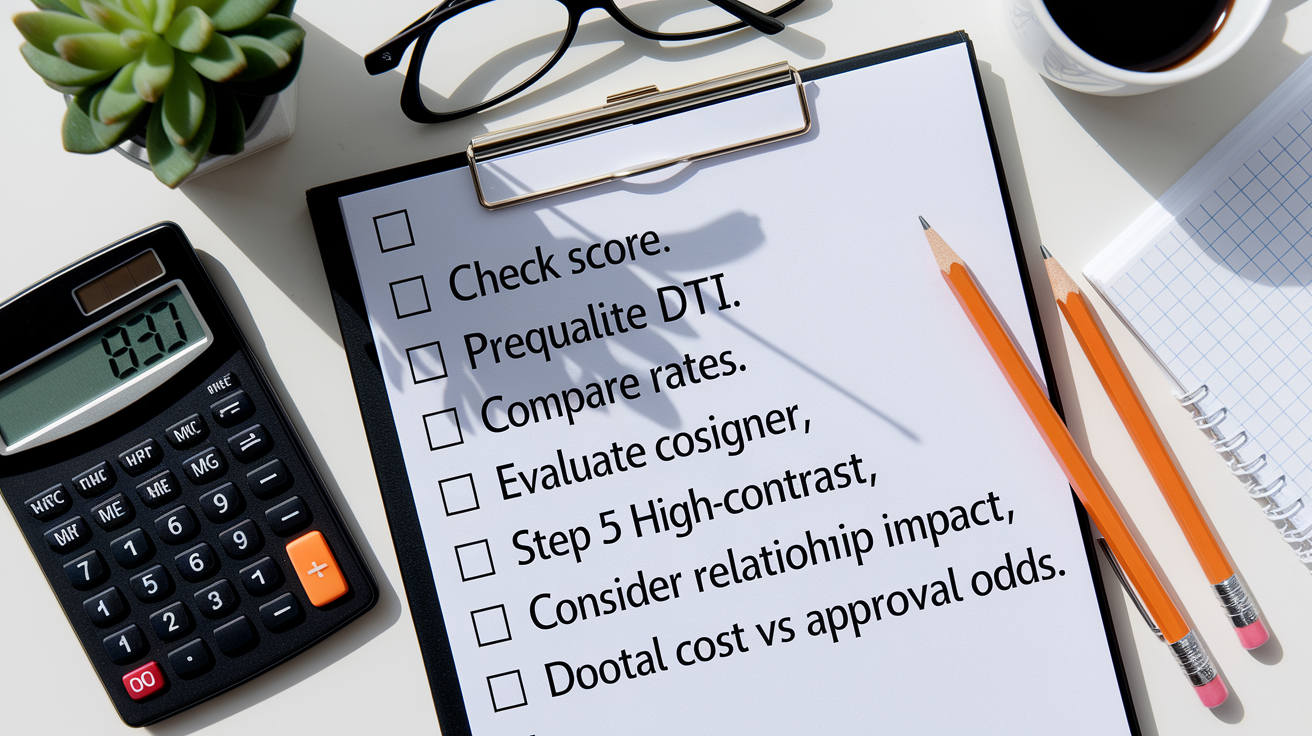
Before you ask someone to cosign or start filling out applications, walk through these steps to figure out whether a cosigner is the right call for your situation.
- Check your credit score – Pull your score from a free service or your bank. If it’s below 620, a cosigner will likely help
- Calculate your debt-to-income ratio – Add up all monthly debt payments and divide by your gross monthly income. If it’s above 36%, lenders might require a cosigner
- Prequalify on your own – Use soft-credit prequalification tools from multiple lenders to see what rates and amounts you qualify for without a cosigner
- Compare the rate difference – If adding a cosigner drops your APR by 3% or more, or bumps up your loan amount significantly, the benefit is real
- Evaluate the cosigner’s willingness and credit – Make sure the person has a credit score above 700, a DTI below 36%, and fully understands the risks
- Consider relationship impact – Ask yourself if you’re comfortable with the shared responsibility and whether the relationship can handle financial stress if things go sideways
- Decide based on total cost and approval odds – If you can’t get approved without a cosigner, or if the rate improvement saves you hundreds of dollars, it’s worth it. If the benefit is small and you can qualify alone, skip the cosigner
Final Words
In the action, this post explains when a cosigner helps, the main benefits, the real risks, how lenders vet both people, solid alternatives, what cosigners must know, and a 7-step decision checklist.
Quick recap: a strong cosigner can lower your rate or win approval, but they take legal responsibility and your relationship can suffer. Try alternatives first if you can.
If you’re still asking should I get a cosigner on a personal loan, follow the checklist, compare offers, and choose the path that protects your money and your relationships.
FAQ
Q: Is it better to have a cosigner for a personal loan? Is it a bad idea to cosign a loan for someone?
A: Deciding whether to add a cosigner or to cosign depends on credit, income, and trust. Use a cosigner to get approval or lower rates. Don’t cosign unless you’re ready for full repayment risk.
Q: How much would a $10,000 loan cost per month over 5 years?
A: A $10,000 loan over 5 years would cost about $192/month at 6% APR and about $212/month at 10% APR. The actual payment depends on the exact rate and fees.
Q: How much would a $5000 personal loan cost a month?
A: A $5,000 personal loan would cost about $162/month for 3 years at 10% APR, or about $101/month for 5 years at 8% APR. The final amount depends on rate and term.