

Think the interest rate tells the whole story? Think again.
Fees, points, and upfront charges can add hundreds or thousands to what you actually pay.
APR (annual percentage rate) bundles interest with mandatory fees, discount points (an upfront fee to lower your rate), and some closing costs, giving a single number for fair comparison.
This post shows how to calculate your true loan cost step by step, with a simple formula, worked examples, and a quick checklist so you can compare offers the right way and avoid surprises.
Understanding the Full Cost of Borrowing
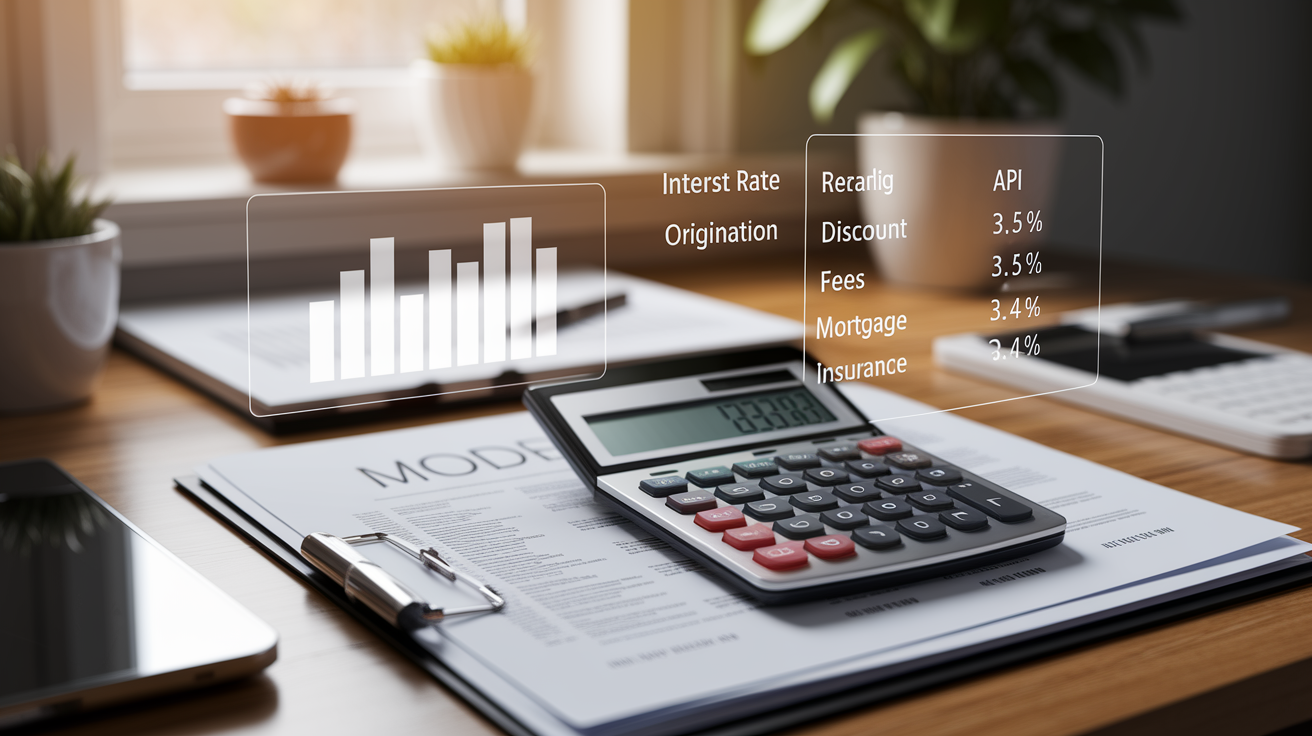
APR (Annual Percentage Rate) is a yearly measure that bundles the interest rate with mandatory lender fees, discount points, and certain closing charges. Unlike the simple interest rate, which only shows the percentage you’ll pay on borrowed money, APR gives you the real annualized cost. Lenders have to disclose APR within three business days of your application. That disclosure hands you a clear number for comparing one loan against another.
The formula for true loan cost is simple: Total cost = Principal + Total interest paid + Upfront fees + Discount points. Say you borrow $10,000 at 6.0% annual interest for three years. You might pay around $960 in interest. Add a $300 origination fee (3% of the loan), and your true cost is $1,260 beyond the principal. That single number, $1,260, is what you’re actually paying to borrow $10,000.
APR captures these core pieces:
- Interest rate (the base percentage charged on your balance)
- Origination fees (upfront charge to process the loan, usually 0.5% to 6%)
- Discount points (optional fee that lowers your interest rate)
- Certain mandatory third-party fees (broker fees, underwriting, mandatory insurance premiums)
- Prepaid interest or daily interest charges (when interest accrues before your first payment)
APR gives you a more accurate comparison than the nominal interest rate when you’re choosing between offers. Two loans with identical 6% rates can have very different APRs if one charges a $500 application fee and the other charges a $1,500 origination fee. The higher fee loan will have a higher APR even though the rate looks the same on paper.
Breaking Down Loan Fees and Points

Lenders collect several types of fees when issuing a loan. The most common is the origination fee, which typically runs 0.5% to 1% of the loan amount for personal and auto loans. It can climb to 1% through 6% for certain specialized products. This fee compensates the lender for underwriting, processing, and funding your loan. You may also see an application fee (a flat charge, often $25 to $100, just to review your request), servicing fees (ongoing monthly or annual charges to manage the account), late fees (penalty for missed payments), and prepayment penalties (a charge if you pay off the loan early). Not every loan carries every fee. Some mission-driven lenders, such as Community Development Financial Institutions certified by the U.S. Department of the Treasury, charge no application, origination, servicing, or prepayment fees at all.
Discount points are a separate, optional charge most common in mortgages, though some auto and personal lenders offer them too. One discount point equals 1% of the loan amount. On a $300,000 mortgage, one point costs $3,000. In exchange for paying that upfront fee, the lender reduces your interest rate, typically by about 0.25% per point. If your base rate is 7.00%, buying one point might drop it to 6.75%. That lower rate means smaller monthly payments and less interest over the life of the loan. But you need to keep the loan long enough for the monthly savings to exceed the upfront cost. That’s the break-even point, usually around five to seven years for a mortgage.
Closing costs appear mainly in mortgage transactions and include third-party charges like appraisal ($300 to $600), title search and insurance ($700 to $1,200), credit report ($25 to $50), and underwriting ($300 to $900). The total closing package usually runs 2% to 6% of the loan amount. On a $300,000 mortgage, that’s $6,000 to $18,000 before you even consider discount points. These costs are disclosed on your Loan Estimate form within three business days of application. Closing costs aren’t rolled into APR for the shortcut methods used by calculators, but they still affect your out-of-pocket cash and overall affordability.
Formulas Used to Calculate Total Loan Cost
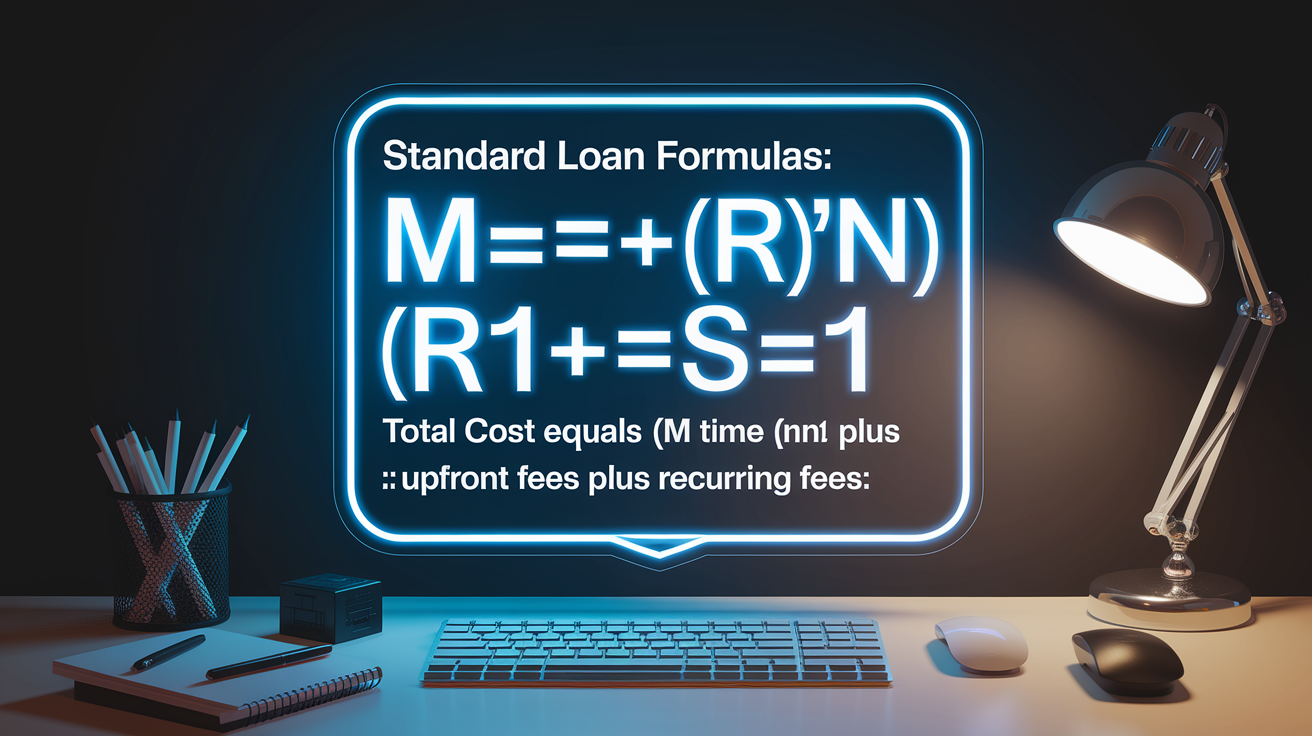
The standardized federal APR formula is mathematically complex and involves solving for the interest rate that equates the present value of all loan payments (including fees) to the net amount you actually receive. Most borrowers rely on lender disclosures and online calculators rather than computing APR by hand. For a practical “total true cost” number, you can use this simple addition:
Total cost = (Monthly payment × Number of months) + Upfront fees + Recurring fees
Here’s how to plug fees into that equation:
-
Find the monthly payment using the loan payment formula. For a fixed rate amortizing loan: M = P × [r(1 + r)^n] / [(1 + r)^n − 1], where M is the monthly payment, P is the principal, r is the monthly interest rate (annual rate ÷ 12), and n is the total number of months. A $10,000 loan at 6% annual (0.5% monthly) for 36 months yields a monthly payment of about $304.
-
Multiply the monthly payment by the number of months. In the example above, $304 × 36 = $10,944. That’s the total you’ll pay in monthly installments.
-
Add upfront fees. If there’s a 3% origination fee ($300 on a $10,000 loan), add it: $10,944 + $300 = $11,244.
-
Include recurring fees if any. Some lenders charge an annual servicing fee or monthly account fee. Add those to get the final true cost. If there are none, your total is $11,244. Subtract the original principal ($10,000) to see that you paid $1,244 in interest and fees combined.
APR attempts to express that $1,244 as an equivalent yearly percentage. When you see an APR of 6.5% on a loan with a 6.0% nominal rate, the extra half-point reflects the cost of the upfront fee spread over the loan’s life.
Worked Examples: Calculating True Loan Cost

Example 1: Personal loan with origination fee. You borrow $5,000 at 9% annual interest for 24 months. The lender charges a 4% origination fee ($200). Monthly interest rate is 9% ÷ 12 = 0.75% (0.0075). Using the payment formula, the monthly payment is approximately $228. Total of monthly payments: $228 × 24 = $5,472. Add the $200 origination fee: $5,472 + $200 = $5,672. Your true cost is $5,672, meaning you paid $672 in interest and fees to borrow $5,000. The nominal 9% rate understates the real cost because it doesn’t include the $200 fee.
Example 2: Mortgage with discount points. You take a $200,000 mortgage at 4.00% for 30 years (360 months). You pay one discount point ($2,000) plus a $750 origination fee, total upfront cost $2,750. Adjust the loan amount to $202,750 to reflect the cash you’re putting in. At 4.00%, the monthly payment on $202,750 is about $968. Now find the rate on the original $200,000 principal that also produces a $968 payment. Trial and error or a mortgage calculator shows that rate is approximately 4.11%. That 4.11% is the effective APR. Over 30 years, you’ll pay roughly $968 × 360 = $348,480 in total payments. Subtract the $200,000 principal, and you paid $148,480 in interest. The $2,750 in upfront fees is part of your cash outlay but isn’t added to the payment stream. APR captures its effect by raising the effective annual rate from 4.00% to 4.11%.
| Item | Loan A (Example 1) | Loan B (Example 2) |
|---|---|---|
| Principal | $5,000 | $200,000 |
| Nominal Rate | 9.00% | 4.00% |
| Upfront Fees | $200 (4% origination) | $2,750 (1 point + $750 origination) |
| Total Paid (Payments + Fees) | $5,672 | $351,230 (payments $348,480 + fees $2,750) |
How Discount Points Change Long‑Term Costs

One discount point costs 1% of your loan amount and typically reduces your interest rate by about 0.25%. On a $300,000 mortgage, paying $3,000 upfront might lower your rate from 7.00% to 6.75%, cutting your monthly payment from roughly $1,996 to $1,946. That’s a $50 per month saving. Over 30 years, that $50 adds up to $18,000 in total savings, but you need to stay in the loan for 60 months (five years) just to break even on the $3,000 you paid upfront.
Discount points make the most financial sense in these situations:
You plan to keep the loan longer than the break-even period. Otherwise you’ll pay the upfront cost but won’t recoup it in monthly savings.
You have cash on hand after making your down payment and covering other immediate needs like repairs, moving costs, or an emergency fund.
The loan term is long (15 or 30 years for a mortgage). Longer terms amplify monthly savings, shortening the break-even window.
You’re in a higher tax bracket and can deduct mortgage interest (subject to IRS limits: interest deduction applies to mortgage debt up to $750,000, or $375,000 if married filing separately). Points may also be tax deductible in the year paid or amortized over the loan life. Consult a tax professional.
If you expect to refinance within two or three years, or if you’re planning to sell the home before break-even, skip the points and keep your cash.
Comparing Loan Offers the Right Way

Comparing interest rates alone is like comparing sticker prices without checking total cost. One lender might advertise 6.0% with a $1,500 origination fee, while another offers 6.2% with zero fees. The second loan may cost you less overall if you only need the money for two years.
APR comparison is federally standardized, so every lender calculates it the same way. That makes APR the single best number for apples to apples comparisons. Look at the Loan Estimate or Truth in Lending disclosure (you’ll receive it within three business days of applying) and focus on the APR line. The loan with the lowest APR will usually cost you the least, assuming you keep the loan for its full term.
Here’s a step by step process to compare offers:
- Request a Loan Estimate from each lender for the same loan amount, term, and loan type (all must be 30 year fixed, or all 15 year, etc.).
- Compare the APR listed on each estimate. Lower is better.
- Add the upfront fees (origination, points, broker fees) shown on the estimate and note the total cash you’ll need at closing.
- Use a loan calculator to compute the total amount you’ll pay over the life of the loan (monthly payment × number of months + fees).
- Consider your timeline: if you plan to pay off the loan early, the loan with lower upfront fees and a slightly higher rate might win. If you’ll carry the loan to term, the lowest APR wins.
Don’t skip the fine print. Check for prepayment penalties (a fee if you pay off the loan early), variable rate clauses (rate can increase after an introductory period), or mandatory add-ons like credit insurance. Those can turn a “low APR” offer into an expensive trap.
Quick Loan Cost Calculator (User Steps)

When you’re ready to calculate the true cost of a loan manually or using an online calculator, follow these steps:
- Enter the loan amount (the principal you’re borrowing, for example $10,000).
- Input the nominal interest rate (the advertised annual percentage, such as 6.0%).
- Select the loan term in months or years (common terms: 12, 24, 36, 48, or 60 months for personal loans. 15 or 30 years for mortgages).
- Add upfront fees: origination fee (typically 1% to 6% of the loan), application fee (flat dollar amount), discount points (each point is 1% of the loan), and any mandatory broker or underwriting fees.
- Include recurring fees if applicable: monthly servicing charges, annual account fees, or prepayment penalties (enter these separately or note them for manual addition).
- Hit calculate to see the monthly payment, total of all payments, total interest paid, and (if the calculator supports it) the effective APR that includes all your fees. Compare that effective APR or total cost number across different loan offers to find the cheapest option.
Final Words
You learned how APR, fees, and discount points all fit together to show what a loan really costs. We walked through a simple formula, common fees to watch for, and worked examples that make the math clear.
Use the checklist: get the APR, add fees and points to the principal, compare same terms, and check the breakeven on points.
Use these steps to calculate true cost of a loan including fees and points, and you’ll feel more confident picking the smarter offer.
FAQ
Q: How to calculate the true cost of borrowing?
A: The true cost of borrowing is calculated by adding the loan principal, total interest paid over the term, lender fees and discount points, then expressing the result as total dollars or APR for fair comparison.
Q: How much would 3 points cost for a $250000 loan? How much is 2 points on a loan?
A: Three points on a $250,000 loan cost $7,500; two points equal 2% of the loan, so on $250,000 that’s $5,000, usually paid at closing.