


Think moving debt to a 0% card always saves you money?
Not always.
Balance transfer credit cards can slash interest and save hundreds, but only when you line up the right fee, promo length, credit limit, and a strict payoff plan.
In this post you’ll learn the simple math to calculate your interest savings, how to run a break-even check, and the common pitfalls that erase your gains.
By the end you’ll know whether a transfer really helps you or hurts you.
Immediate Cost Savings Explained With Simple Math

Balance transfer credit cards can save you real money if you’re stuck paying high APR and you land a 0% or low-rate promo. The math isn’t complicated. You pay a one-time fee to move your debt, then you skip monthly interest for as long as the promo lasts.
Here’s how it works with actual numbers. Let’s say you’re carrying $5,000 at 22% APR. Over 12 months, that balance racks up about $1,100 in interest (quick math: $5,000 × 0.22 = $1,100). Transfer that $5,000 to a card with 0% APR for 12 months and a 3% fee, you’ll pay $150 upfront ($5,000 × 0.03 = $150) and nothing in interest during the promo. Your savings? $1,100 − $150 = $950.
Whether you actually pocket those savings depends on four things:
- Credit approval and limit. You need a high enough limit to cover your debt. Most approvals want FICO scores around 690 or better.
- Transfer fee. Cards usually charge 3% to 5%. A 5% fee on a small balance can eat up most of what you’re trying to save.
- Promotional period length. If you can’t clear the balance before 0% ends and the regular APR starts, your savings vanish.
- No new debt. Charging new purchases on the card, especially if they carry a different APR, can wreck your payoff plan.
Balance transfers work when you tick all four boxes and stick to a schedule that wipes out the debt before the promo expires. Got solid credit, high-interest debt that’ll take months to kill, and access to a low-fee, long-promo offer? You’re looking at hundreds or thousands saved. Miss any of those conditions and the fee plus post-promo APR can erase your benefit or make things worse.
Step-by-Step Math Behind Balance Transfer Savings

Knowing the formulas lets you figure out if a transfer’s worth it before you even apply. The calculation’s simple, but you’ve got to factor in both the interest you dodge and the one-time fee.
Here are the five steps to find your net savings:
- Calculate annual interest on your current balance: Annualinterest = Balance × CurrentAPR. Example: $8,000 at 20% APR gives you $8,000 × 0.20 = $1,600 per year.
- Prorate for the promotional period: Interestduringpromo = Annualinterest × (Promomonths / 12). If the promo runs 15 months, $1,600 × (15 / 12) = $2,000 of interest you’d pay without transferring.
- Compute the balance transfer fee: Fee = Balance × Fee_rate. A 3% fee on $8,000 is $8,000 × 0.03 = $240.
- Subtract new-card interest during promo (usually zero). If the promo’s 0%, New_interest = $0. If it’s 3.99% intro APR, you’d calculate $8,000 × 0.0399 × (15/12), which comes out to about $399.
- Find net savings: Netsavings = Interestduringpromo − Fee − Newinterest. In the 0% example: $2,000 − $240 − $0 = $1,760.
Here’s a quick comparison of three typical scenarios:
| Scenario | Original APR Cost (15 months) | Transfer Fee (3%) | Net Savings |
|---|---|---|---|
| $5,000 at 22% → 0% | $1,375 | $150 | $1,225 |
| $8,000 at 20% → 0% | $2,000 | $240 | $1,760 |
| $3,000 at 18% → 3.99% | $675 | $90 | $436 |
The formula holds no matter your balance size or promo length. Just swap in your numbers. Want to compare two offers? Run the formula for each card’s fee rate and intro APR, then pick the one with the biggest net savings. Remember, net savings assumes you don’t make new purchases on the transfer card and you clear the whole balance before the promo ends. Carry a balance past the promotional period and the card’s standard APR (often 18% to 24%) kicks in. Long-term costs can blow past your initial savings.
Break-Even Analysis and When a Balance Transfer Doesn’t Work

Break-even is where the fee you pay equals the interest you save. You’re at zero gain. Getting past that point needs either a low fee compared to the interest you’re dodging, or enough time to recover the cost before the promo ends.
Here’s the break-even formula: Breakevenmonths = Fee / Monthlyinterestsaved. Say you transfer $6,000 from a 19% APR card (monthly interest around $6,000 × 0.19 / 12 = $95) with a 3% fee ($180). Break-even is $180 / $95, which gives you roughly 1.9 months. After two months, you start banking real savings. If the promo lasts 12 or 15 months, you’ve got plenty of room. But if the promo’s only 6 months and you can’t knock out the full balance in that window, the card’s post-promo APR might top your original rate. Your benefit disappears.
A transfer turns into a bad deal in three situations:
- High fee, low savings. If the card charges a 5% fee and your current APR’s only 12%, the upfront cost might beat the total interest you’d pay over a short promo (like 5% on $4,000 = $200 fee vs. 12%(6/12)$4,000 = $240 saved, netting you just $40, which vanishes if you miss a payment or catch a late fee).
- Very short promotional window. A 6-month 0% promo on a $10,000 balance needs payments of $10,000 / 6, about $1,667 per month. Can’t swing that? The leftover balance gets hit with the new card’s standard APR, which could be higher than your original rate.
- Can’t transfer full balance. Credit limits get assigned after approval. Approved for only $5,000 but you owe $9,000? You transfer $5,000 and leave $4,000 on the old card still getting charged 20% interest. That cuts your total savings in half and makes your payment strategy messier.
Always compare the fee in actual dollars to the interest you’ll save in actual dollars. Confirm you can pay off the transferred balance inside the promo period. If the numbers don’t add up or you’re not sure you can hit the monthly payment target, a balance transfer can cost you more than it saves.
Common Risks and Hidden Pitfalls
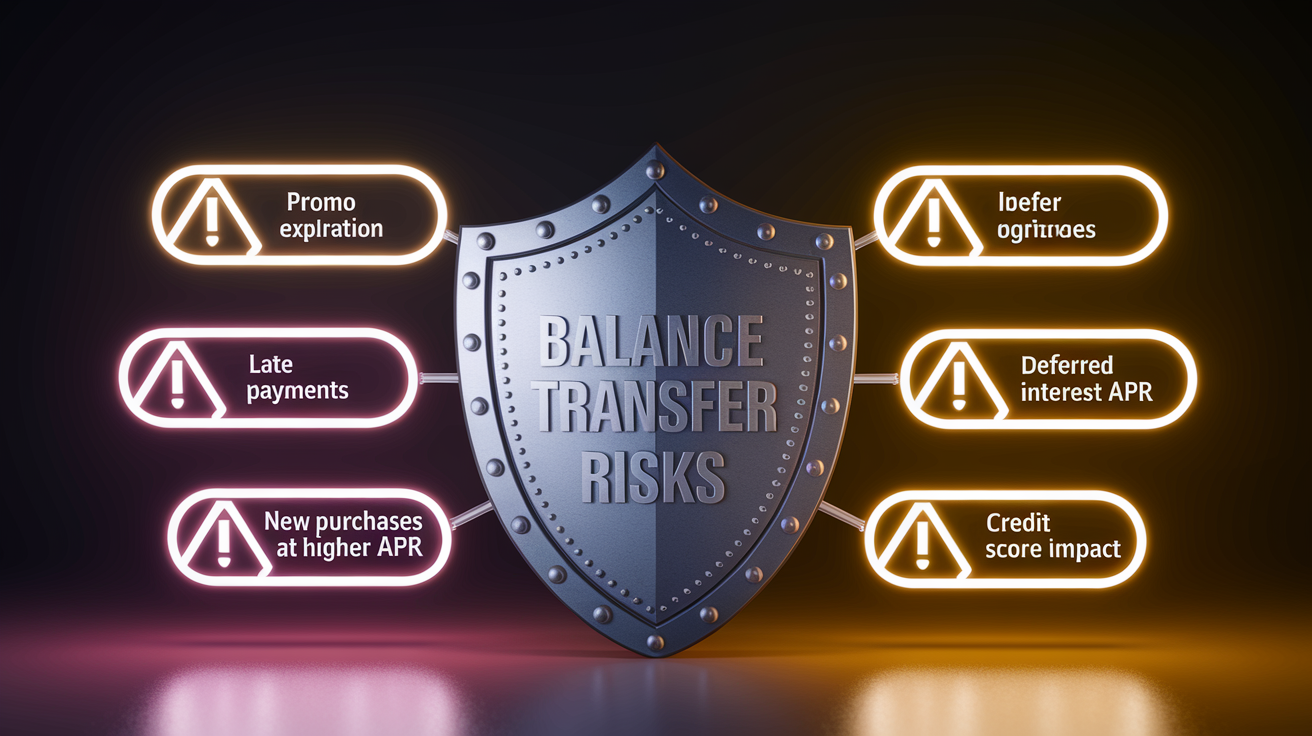
Balance transfers come with rules and traps that can kill your savings or hurt your credit if you’re not paying attention. Knowing these risks before you apply helps you dodge expensive mistakes.
- Promotional period expiration. Once the 0% or low-intro APR window shuts, any leftover balance gets charged the card’s standard APR, usually 18% to 24%. That can be higher than your original card’s rate. Haven’t paid off the balance? You might end up with steeper monthly interest than before the transfer.
- Late or missed payments. Most issuers can yank the promotional APR if you miss a minimum payment or pay late. You get bumped straight to the penalty APR (sometimes 29.99%). That penalty can apply retroactively in some contracts.
- Deferred interest traps. A few cards advertise “0% interest if paid in full” but slap you with deferred interest if even $1 sticks around at the end of the promo. You’ll owe interest backdated to the original transfer date on the entire original balance, not just what’s left. Less common on pure balance-transfer cards but frequent on store cards and some retail financing offers.
- New purchases at higher APRs. Lots of cards only apply the 0% promo to transferred balances. New purchases might carry the standard APR from day one. Issuers often apply your monthly payment to the lowest-APR balance first (the transferred debt), letting purchase balances grow.
- Credit score impact. Opening a new card triggers a hard inquiry (usually -5 to -10 points short term). Transferring a big balance bumps up your credit utilization ratio on the new card, which can knock your score down further. Close your old card right away and you also cut your total available credit and shorten average account age. Both hurt your score.
These pitfalls are avoidable. Read the card agreement, set up autopay for at least the minimum, don’t use the card for new purchases, and plan a payoff schedule that clears the balance well before the promo expires.
Timelines and How Long a Balance Transfer Takes

Balance transfers aren’t instant. From the moment you request a transfer to the day your old card’s paid off, the process usually takes 5 to 14 days. Some issuers say it can stretch to 21 days depending on processing backlogs and how the old creditor handles incoming payments.
During that window, interest keeps piling up on your old card at the original APR. If your statement cycle closes before the transfer posts, you might owe a partial interest charge on the old account. To avoid getting billed twice, keep making at least the minimum payment on the old card until you get confirmation the balance is zero.
Here’s the step-by-step:
- You submit the transfer request (online, by phone, or with a balance-transfer check), handing over the old card’s account number and the amount you want to move. The new issuer reviews and approves the transfer amount up to your approved credit limit.
- The new issuer sends payment to your old creditor, either electronically or by check. This usually takes 3 to 7 business days, though mailed checks can drag longer.
- Your old creditor receives and processes the payment, applying it to your balance. You’ll see a payment post on your old card’s online account within 1 to 3 days after the issuer gets it.
- You verify the transfer’s complete by checking both account balances. Make sure the old balance is paid (or reduced by the transfer amount if you only moved part of it) and the new balance on the transfer card matches the amount moved plus the transfer fee.
During the transfer window, keep records of your request, confirmation emails, and both account statements. If the transfer drags past the issuer’s stated timeline, contact customer service. You might be able to request a goodwill interest credit for any extra interest charges you picked up while waiting. Once the transfer posts, stop using the old card for new purchases and focus all payments on killing the transferred balance before the promotional period ends.
Mistakes to Avoid When Using Balance Transfer Credit Cards
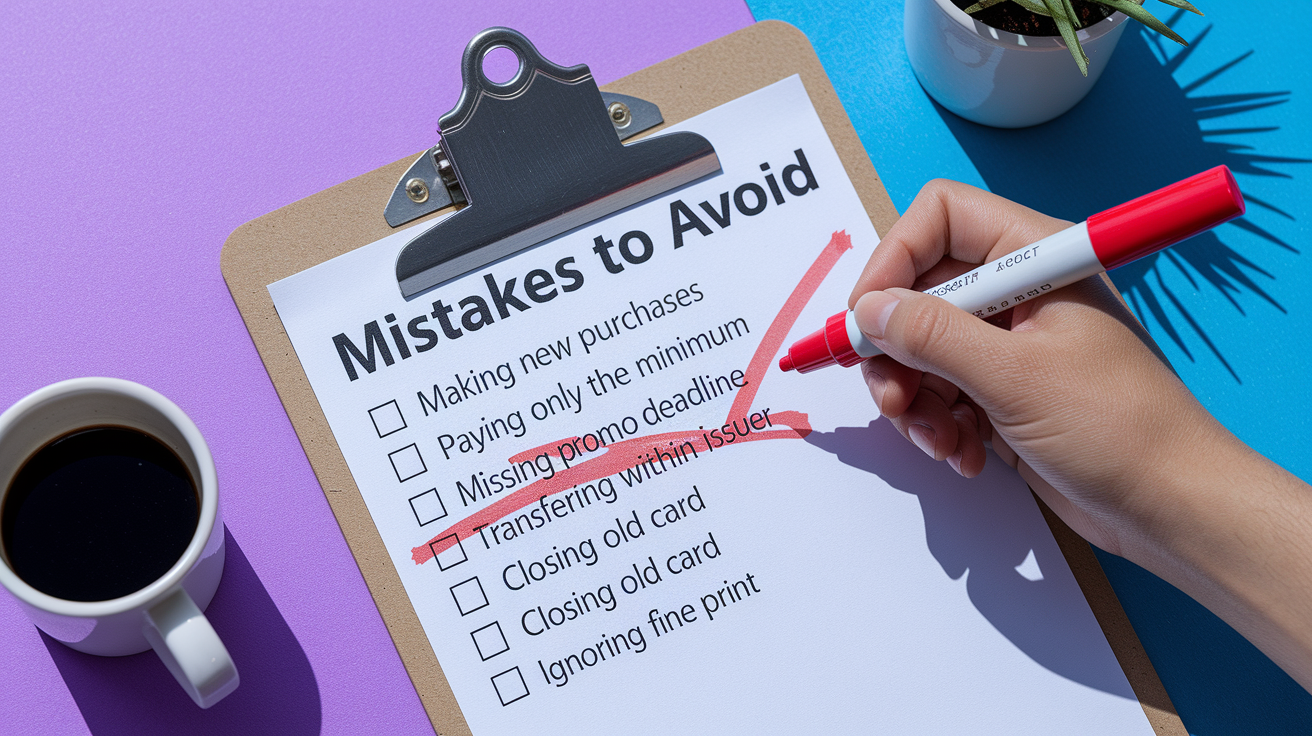
Even when the math’s on your side, execution errors can wipe out your savings or leave you worse off than before. Watch out for these slip-ups:
- Making new purchases on the transfer card. Purchases often carry the standard APR (not the 0% promo) and might rack up interest right away. Issuers usually apply payments to lower-APR balances first, so new purchases sit there and grow while you pay down the transfer.
- Paying only the minimum. Minimum payments on a $5,000 balance are often $100 or less per month. That won’t clear the debt in a 12 or 15-month promo window. You’ll carry a balance into the high-APR period and lose most of your savings.
- Missing the promo deadline. Fail to pay off the full balance before the 0% period ends and the leftover amount gets charged the regular APR immediately. If that rate’s 21% and you’ve got $2,000 left, you’re looking at roughly $35 per month in new interest.
- Transferring between cards from the same issuer. Lots of banks won’t let you move a balance from one of their own cards to another. The request gets denied, wasting time and possibly triggering a hard inquiry.
- Closing the old card right away. Shutting down the original account cuts your total available credit, spikes your utilization ratio, and shortens your credit history. Unless the old card has an annual fee you can’t justify, keep it open with a zero balance.
- Ignoring the card agreement fine print. Some cards cap transfers at a specific dollar amount (like $15,000 max regardless of your credit limit), require transfers within the first 60 or 90 days of account opening, or exclude certain creditor types (like other cards from the same bank family). Missing these rules can get your transfer denied or cost you the promotional rate.
Dodging these mistakes takes discipline. Treat the transfer card as a payoff-only tool, automate payments above the minimum, track your promo expiration date, and read the terms before you apply. Stick to a clear payoff plan and resist the urge to spend, and a balance transfer can save you serious money. Slip into old habits or ignore the rules and you’ll pay more in fees and interest than if you’d never transferred at all.
Final Words
In the action: this post gave a quick, clear way to tell if a balance transfer saves you money. You got a simple example, the exact math steps, a break-even test, common risks, typical timelines, and the top mistakes to avoid.
Now you can plug your numbers into the 5-step math, compare fees and promo length, and spot red flags fast.
By running the numbers and avoiding late payments, using balance transfer credit cards to reduce interest risks and math can lower your total cost and speed payoff. That’s a win you can plan for.
FAQ
Q: Is it smart to transfer credit card balance to lower interest rate?
A: Transferring a credit card balance to a lower rate is smart when the transfer fee is low, the promo period gives time to pay it off, you’ll make steady payments, and you avoid new purchases.
Q: What are the downsides to balance transfers?
A: The downsides to balance transfers include transfer fees, short promo windows, a higher APR after the promo, late-payment penalties that cancel the deal, and potential short-term credit score effects.
Q: Will a credit card balance transfer hurt my credit score?
A: A credit card balance transfer can hurt your credit score temporarily due to the hard inquiry, a new account lowering average age, and higher utilization on the receiving card, but proper payments usually restore it.
Q: What’s the best strategy to avoid paying interest on credit cards?
A: The best strategy to avoid paying interest on credit cards is to pay your full statement balance each month; if you can’t, use a 0% balance transfer and pay it off before the promo ends.