


Want to cut years and tens of thousands off your mortgage without refinancing?
Principal-only payments (extra money applied only to the loan balance) do exactly that.
The earlier and more consistent you are, the bigger the savings, because each extra dollar lowers the balance interest is calculated on and that benefit compounds every month.
Read on for step-by-step math, practical examples, and the timing rules that actually move the needle.
How Extra Principal Payments Change Amortization and Reduce Total Interest

A principal-only payment is anything you pay over your required monthly minimum, with every penny going straight to your loan balance instead of being split between interest and principal. Each dollar you send directly lowers the balance interest gets calculated on, so next month’s interest charge drops. One extra payment early in a 30-year mortgage can save you hundreds or thousands in interest, because standard amortization loads most of the interest up front.
Here’s how it works. You’ve got a $200,000 mortgage at 5% APR over 30 years, monthly payment around $1,074. First month, about $833 goes to interest and $241 to principal. Add a $100 principal-only payment that same month and your balance falls to $199,659 instead of $199,759. Next month’s interest gets calculated on that lower number, saving you roughly 42 cents. That 42 cents compounds over 360 months, and the lower balance speeds up the effect on every payment after.
The impact builds over time. Add $100 per month to principal consistently and you’ll pay off the loan about five years early, saving around $28,000 in total interest. Pay that same $100 only in the final year and you’ll save almost nothing, because there’s hardly any principal left and the interest has already been paid. Timing and consistency matter. The earlier you make principal-only payments, the more amortization bends in your favor.
Understanding Standard Loan Amortization

Amortization spreads a loan into equal monthly payments over a fixed term. Each payment covers accrued interest first, then applies what’s left to principal. Early on, interest dominates because it’s calculated on the full outstanding balance. As you chip away at principal, each month’s interest charge shrinks and more of your fixed payment hits the loan.
On a typical 30-year mortgage, your first payment might be 80% interest and 20% principal. By year 15, the split is close to 50/50. In the final years, the ratio flips and most of each payment reduces principal with minimal interest. That’s why a $1,000 extra payment in year one has a much larger effect than the same $1,000 paid in year 25. The first payment slashes a chunk of balance when interest is highest. The late payment barely changes the math because interest is already low.
Understanding this structure shows why principal-only payments work. The faster you lower the balance, the less interest you’ll pay over the life of the loan, and the more quickly the schedule tilts toward principal reduction instead of interest service.
Step-by-Step Mechanics of a Principal-Only Payment
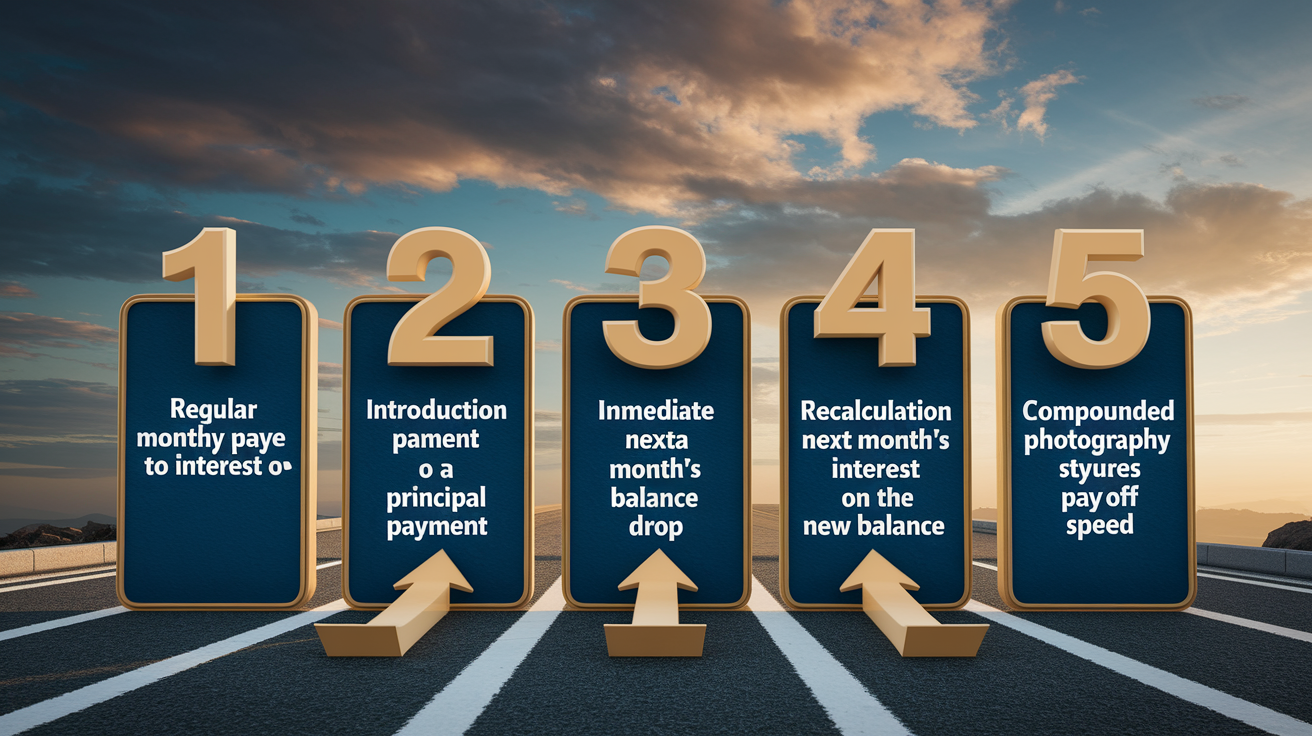
When you make a principal-only payment, the lender applies it differently than your regular monthly payment. Here’s the sequence:
-
Your regular monthly payment gets processed first. The lender calculates the month’s interest based on your current balance, deducts that amount from your payment, and applies the rest to principal.
-
The lender receives your principal-only payment. If you’ve designated it correctly (either through an online option labeled “principal payment” or via written instruction) the lender applies the full amount to your outstanding principal.
-
The loan balance drops by the extra amount immediately. If your balance was $150,000 and you paid $200 extra as principal-only, the new balance becomes $149,800 right away.
-
Next month’s interest is recalculated on the new, lower balance. Instead of calculating interest on $150,000, the lender calculates it on $149,800, so the interest charge is slightly smaller.
-
Each subsequent payment benefits from the lower balance. Because interest is lower, more of your standard monthly payment goes to principal, speeding up payoff. The effect compounds every month for the rest of the loan.
Lenders don’t always default to principal-only application. Some will apply extra funds to next month’s payment or hold them in suspense. Always confirm your lender’s rules and label the payment clearly.
Mathematical Examples Showing Interest Saved

Two common strategies show how principal-only payments reduce interest and shorten the loan. First is a recurring monthly extra payment, and second is a one-time lump sum.
Take a $250,000 mortgage at 6% over 30 years with a monthly payment of about $1,499. Without extra payments, you’ll pay roughly $289,595 in interest over the life of the loan. Add $150 per month as principal-only from day one and you’ll pay off the loan in about 24 years, saving approximately $66,000 in interest. A $300 monthly extra knocks the term down to around 20 years and saves about $104,000.
| Payment Type | Amount | Interest Saved | Time Saved |
|---|---|---|---|
| Standard (no extra) | $1,499/mo | $0 | 0 months |
| Extra $150/month | $1,649/mo | ~$66,000 | ~6 years |
| Extra $300/month | $1,799/mo | ~$104,000 | ~10 years |
| One-time $10,000 (year 1) | $10,000 lump | ~$29,000 | ~2.5 years |
A single $10,000 principal payment made in the first year of the same loan cuts the term by about two and a half years and saves roughly $29,000 in interest. Apply that same $10,000 in year 20 and the interest saved drops to around $4,500 because most of the interest has already been paid.
Comparative Amortization Schedules With and Without Extra Principal
The table below compares the first 12 months of a $200,000 mortgage at 5% APR over 30 years. The standard scenario uses the required monthly payment of approximately $1,074. The extra-principal scenario adds $100 per month starting in month one.
| Month | Standard Balance | Balance With Extra $100 | Interest Paid (Standard) | Interest Paid (Extra) |
|---|---|---|---|---|
| 1 | $199,759 | $199,659 | $833 | $833 |
| 2 | $199,517 | $199,317 | $832 | $831 |
| 3 | $199,274 | $198,974 | $831 | $829 |
| 4 | $199,031 | $198,629 | $829 | $827 |
| 5 | $198,786 | $198,284 | $828 | $826 |
| 6 | $198,541 | $197,937 | $827 | $824 |
| 7 | $198,295 | $197,589 | $826 | $823 |
| 8 | $198,048 | $197,240 | $825 | $822 |
| 9 | $197,800 | $196,889 | $824 | $820 |
| 10 | $197,551 | $196,538 | $823 | $819 |
| 11 | $197,301 | $196,185 | $822 | $817 |
| 12 | $197,050 | $195,831 | $821 | $816 |
After one year, the standard balance is about $197,050 while the extra-principal balance is roughly $195,831. A difference of $1,219. That gap grows every month because each lower balance reduces the next month’s interest, letting more of the fixed payment attack principal. Over 30 years, that compounding effect adds up to tens of thousands of dollars in interest savings and years shaved off the loan term.
Timing Strategies: When Extra Principal Payments Matter Most

The earlier you make principal-only payments, the more interest you save. In the first few years of a long-term loan, interest charges are at their peak because the balance is highest. A $500 extra payment in year one might save $1,200 in interest, while the same $500 paid in year 25 saves only $50 because the balance and interest are already low.
Consistency also multiplies the effect. Even a small monthly extra (like $50 or $100) compounds over hundreds of payments and can cut years off a mortgage. If you can’t commit to monthly extras, annual lump sums still help, especially if you make them early in the loan. Tax refunds, bonuses, or windfalls applied to principal in the first five years of a 30-year mortgage generate outsized savings compared to later years.
Effective timing methods:
Monthly extras from day one. Automate a fixed amount above your minimum to build the habit and maximize compounding.
Biweekly payment plans. Paying half your monthly payment every two weeks results in 26 half-payments per year (equivalent to 13 full payments), effectively adding one extra monthly payment annually.
Annual lump sums in the early years. Use bonuses or tax refunds to make large principal payments when the balance is highest.
Snowball freed-up cash. When you pay off a car loan or other debt, redirect that monthly payment to mortgage principal instead of lifestyle spending.
Formulas and Calculator Guidance

To estimate how much interest you’ll save with principal-only payments, you can use the standard loan payment formula: A = P × r × (1 + r)^n / ((1 + r)^n − 1), where P is the loan amount, r is the monthly interest rate (annual rate divided by 12), n is the number of months, and A is the monthly payment. Once you know A, you can calculate total interest by multiplying A by n and subtracting P.
When you add extra principal, the new payoff time can be found by rearranging the formula: n = ln(A / (A − P × r)) / ln(1 + r), where A is now your higher payment (standard payment plus extra principal). Plug in the new n to find total payments and total interest, then compare to the original scenario to see how much you’ve saved.
Most borrowers find it easier to use an online amortization calculator. Follow these steps:
- Enter your loan details. Principal, interest rate, and term in the calculator’s input fields.
- Run the standard scenario. Note the total interest and payoff date without any extra payments.
- Add your extra principal amount. Enter the monthly or one-time extra payment in the “extra payment” field.
- Compare the outputs. The calculator will show the new payoff date and total interest, and often display a side-by-side amortization schedule so you can see exactly when the loan will be paid off and how much you’ll save.
How Principal-Only Payments Affect Different Loan Types
Mortgages benefit the most from principal-only payments because of their long terms, typically 15 to 30 years. The combination of high starting balances and hundreds of payments means even modest monthly extras can shave years off the term and save tens of thousands in interest. Many mortgage lenders allow unlimited principal-only payments without penalty, but always confirm your specific loan terms before you start. Some mortgages carry prepayment penalties or restrict how extras are applied, especially adjustable-rate or specialized products.
Auto loans run much shorter, usually three to seven years, so the dollar savings from principal-only payments are smaller. Still, adding $50 or $100 per month to a $25,000 auto loan at 6% can cut six months to a year off the term and save a few hundred dollars in interest. Because auto loans amortize faster, the window for high-impact principal payments is narrower. Focus on the first year or two. Some lenders apply extra payments to future installments rather than principal, so double-check the payment instructions and your loan agreement.
Personal loans and other installment loans typically have terms of two to five years, meaning the total interest paid is lower to begin with. Principal-only payments still help, but the impact is more modest than on a 30-year mortgage. A $10,000 personal loan at 9% over three years might only accrue $1,500 in interest, so an extra $50 per month might save $200 and cut a few months off the term. The shorter the loan, the less dramatic the savings, but paying down high-rate personal debt faster can free up cash flow for other goals and reduce your overall debt burden sooner.
Final Words
In the action, we showed what principal-only payments are, how they change amortization, and why early extras cut the most interest. You got a simple numeric example, step-by-step mechanics, timing tips, and calculator guidance so you can test your own numbers.
Try it today: add a small extra monthly amount and compare schedules to see the difference.
Knowing how principal-only payments affect loan amortization and interest saved gives you clear steps to cut years and dollars off your loan, and it’s doable.
FAQ
Q: Do principal only payments reduce interest?
A: Principal-only payments reduce interest by lowering your loan balance faster, so future interest is calculated on a smaller amount. Early extra payments save the most interest over the life of the loan.
Q: What is the 3 7 3 rule in mortgage?
A: The 3-7-3 rule in mortgage is a loose shorthand lenders or advisors sometimes use; meanings vary by context, so ask the lender or source to explain what each number refers to for that product.
Q: What is the 2% rule for mortgage payoff?
A: The 2% rule for mortgage payoff is a rough guideline to pay about 2% extra of your loan balance or monthly payment to speed payoff; exact meaning differs, so verify the context or source.
Q: How to pay off a $500,000 mortgage in 5 years?
A: To pay off a $500,000 mortgage in 5 years, you’ll need about $8,333 a month toward principal (plus interest). Increase payments with extra monthly amounts, lump sums, or refinancing to lower interest.