


Think notarization is just a quick stamp?
It’s not. Mistakes can cost a closing and even open you to fraud.
Notarizing loan documents follows strict rules from lenders and state law.
Before you sign or stamp, confirm IDs, the right certificate type, and that every signature line is filled.
This post walks you step-by-step through the essential checks and actions to notarize loan documents correctly so you avoid funding delays, title problems, and liability.
Core Steps to Notarize Loan Documents Accurately and Legally

Loan document notarization isn’t flexible. It follows a strict sequence because lenders and state laws require accuracy to prevent delays and fraud. Every error can delay funding, create title problems, or expose you to liability. This isn’t a suggestion. It’s a checklist that protects everyone and makes sure the document can be recorded and enforced.
Before you notarize anything, handle these pre-signing requirements. Confirm how many originals and copies you’re expected to notarize and return. “We need three originals and two copies” tells you how many times you’ll stamp. Check that no signature lines are blank and all date fields are there. The borrower’s name on every page needs to match the ID you’ll use. Spelling, middle initials, suffixes, all exact. Confirm which certificate type the lender wants, because some investors require specific acknowledgment language that’s different from your state’s default wording.
Once the document’s ready, follow this nine-step workflow:
-
Verify your commission status, journal availability, and acceptable fee schedule before the appointment. Make sure your commission hasn’t expired and you’ve got a working seal, current journal, and knowledge of your state’s fee caps.
-
Inspect the full document package to locate certificate blocks and signature lines. Don’t accept incomplete documents or blank pages that could be filled in later.
-
Confirm signer identity using acceptable ID. Record the ID type, issuing authority, ID number, and expiration date in your journal before you proceed.
-
Confirm signer capacity and willingness. If the signer appears incapacitated, confused, or coerced, use appropriate mental capacity verification or refuse the notarization.
-
Make sure the signer signs in your physical presence (or follow remote notarization protocol if your state allows RON and the lender permits it).
-
Complete the appropriate notarial certificate. Acknowledgment or jurat, fill in the state, county, date, and signer name exactly as they appear.
-
Affix your signature and notary seal adjacent to the notarial certificate. Don’t stamp blank pages or areas where the stamp could obscure text.
-
Record the notarial act in your journal. Include date/time, document type, signer name and address, ID used, fee charged, travel notes, and your signature.
-
Return notarized originals to the borrower or lender as required. Provide copies only where permitted by statute or lender instruction.
Acknowledgment and jurat wording impact the certificate differently, and each serves a specific legal purpose. An acknowledgment confirms the signer’s identity and that the signature was voluntary. “On [Date], before me, [Notary Name], personally appeared [Signer Name], proved to me on the basis of satisfactory evidence to be the person whose name is subscribed to this instrument.” A jurat requires the signer to swear or affirm that the content is true. “Subscribed and sworn to (or affirmed) before me on [Date] by [Signer Name].” Mortgages and deeds almost always use acknowledgments. Affidavits typically require jurats. Using the wrong one can invalidate the notarization and delay the closing.
Identification Requirements for Proper Loan Document Notarization

State law governs which forms of identification are acceptable for notarization, and you must document the ID type, issuing state, and expiration date in your journal. Most states require one government-issued photographic ID as primary evidence of identity. If the primary ID is questionable (expired, damaged, or the photo doesn’t match), request a second form of ID or use credible witnesses according to your state’s statute. Recording this information isn’t optional. If the county recorder or lender audits the file later, your journal is the proof you verified identity correctly.
Use these fraud prevention checks at every signing:
- Compare the signature on the ID to the signature on the document. If the two don’t match or if the signer hesitates, ask for a second ID or refuse the notarization.
- Confirm the photo on the ID matches the person in front of you. Check for alterations, stickers, or signs of tampering.
- Examine security features like holograms, microprint, and UV elements on driver’s licenses and passports.
- Use credible witnesses when allowed. If you can’t verify the ID yourself, one or two credible witnesses (depending on state rule) who personally know the signer can swear to the signer’s identity. Record their names, addresses, and IDs in your journal.
- Verify corporate authority for business signers. Obtain a corporate resolution, officer’s certificate, or notarized power of attorney that specifically authorizes the signer to execute loan documents on behalf of the entity.
- Watch for signs of coercion or incapacity. If the signer appears confused, frightened, or unable to understand what they’re signing, stop and ask clarifying questions. If you’re not satisfied, refuse the notarization.
Corporate representatives and power of attorney signers require extra verification. For a corporation, you need proof that the signer is authorized. A board resolution, officer’s certificate, or signed consent that names the signer and the specific loan transaction. For a POA, the power of attorney document itself must be notarized and must grant authority to sign loan documents. Record the corporate or POA details in your journal, including the entity name exactly as it appears on the loan documents. If the signer is mentally incapacitated or under duress, you must refuse, even if it delays the closing.
Choosing the Correct Notarial Certificate for Loan Documents
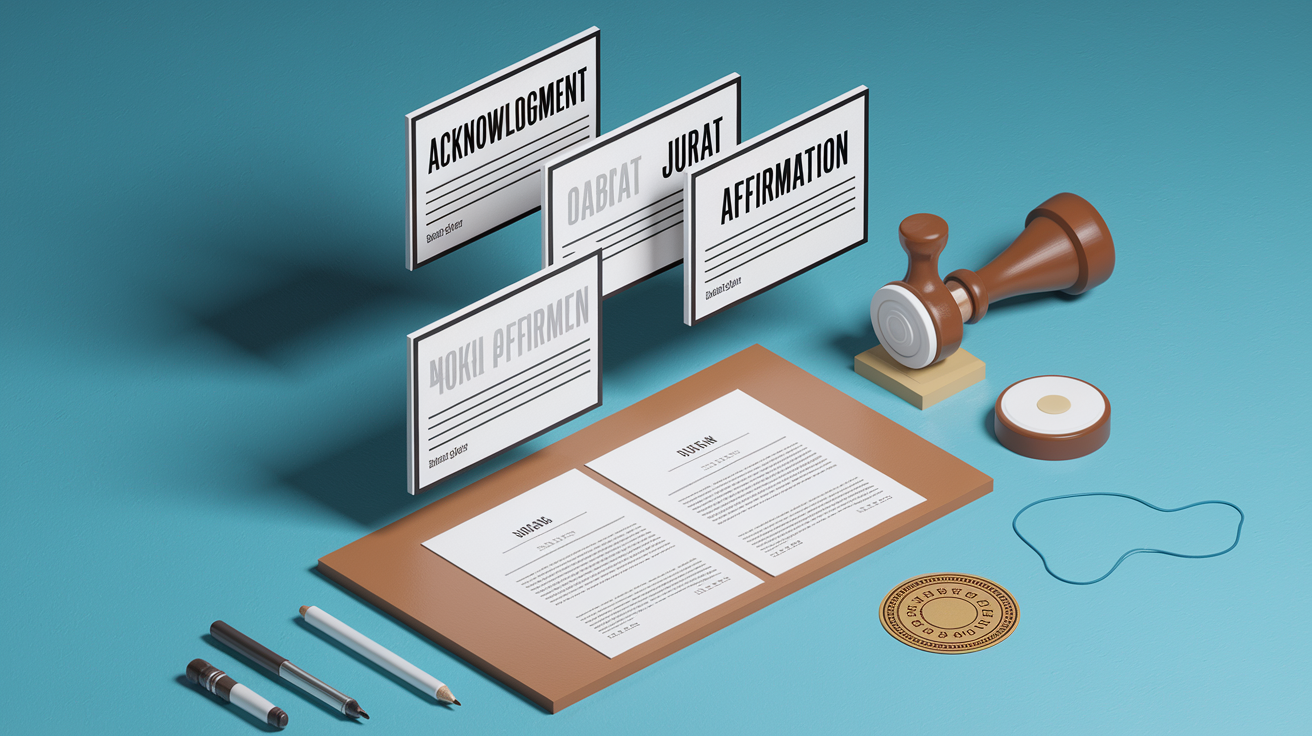
The lender or title company selects the certificate type based on the document’s legal purpose, and using the wrong type can make the notarization invalid. An acknowledgment is used when the signer needs to confirm their identity and that they signed voluntarily. It doesn’t require an oath about the document’s content. A jurat is used when the signer must swear or affirm under penalty of perjury that the facts in the document are true. Most loan documents (mortgages, deeds of trust, quitclaim deeds, general warranty deeds) require acknowledgments because the act of signing is what matters, not the truthfulness of statements inside. Affidavits like the Affidavit of Debts and Liens or Affidavit of Occupancy require jurats because the borrower is swearing to facts.
Every certificate must include the state and county (called the “venue”), the date of notarization, the signer’s full name exactly as it appears on the document, and your name and commission information. Leaving any of these fields blank or incomplete will cause the county recorder to reject the document. Fill in the venue at the top of the certificate. “State of [Your State], County of [County Where Signing Occurred].” Write the date in Month/Day/Year format or follow your state’s required format. Enter the signer’s name with correct spelling, capitalization, and any suffixes like “Jr.” or “III.” Sign your name exactly as it appears on your commission, and affix your seal adjacent to your signature.
| Certificate Type | Purpose | Typical Use Case |
|---|---|---|
| Acknowledgment | Confirms signer identity and voluntary signature | Mortgage, Deed of Trust, Grant Deed, Quitclaim Deed |
| Jurat | Confirms signer swore or affirmed content is true | Affidavit of Occupancy, Owner’s Affidavit, Tax Affidavit |
| Oath/Affirmation (standalone) | Administers verbal oath without written statement | Verbal oaths for witnesses or sworn testimony |
Sample acknowledgment wording looks like this. “State of California, County of Orange. On March 15, 2026, before me, Jane Doe, Notary Public, personally appeared John Smith, proved to me on the basis of satisfactory evidence to be the person whose name is subscribed to this instrument, and acknowledged to me that he executed the same.” Sample jurat wording. “Subscribed and sworn to (or affirmed) before me on March 15, 2026, by John Smith.” Always use your state’s exact prescribed wording when statute requires it, because some states have mandatory certificate language that cannot be altered or shortened.
Seal Placement, Signature Rules, and Page Formatting for Loan Notarizations
Place your notary seal adjacent to the notarial certificate, never covering text, signatures, or other stamps. Most states allow either an ink stamp or an embosser, but many require an ink stamp because embossers don’t photocopy or scan clearly. Use black or blue ink for your stamp and signature. Red and other colored inks can impede scanning and microfilm reproduction at the county recorder’s office. If your state allows embossers, use them as a supplement to the ink stamp, not as a replacement. Never stamp a blank page or a page where the notarization certificate hasn’t been completed, because that creates a pre-signed blank that someone could misuse later.
When a document has multiple loose pages or when the notarial certificate is on a separate page, attach a loose certificate securely and reference the document title, date, and number of pages in the certificate body. Some states require you to initial or stamp every page of a multi-page document to prevent page substitution. Check your state’s rules and the lender’s instructions before you leave the signing. If the signer’s signature is too close to the margin or overlaps other fields, ask them to re-sign in a clearer area. County recorders reject documents with signatures that bleed into margins or cover required text. Prevent rejections by positioning stamps and signatures where they’re readable, permanent, and don’t obscure any pre-printed language or other notary blocks.
Witness Requirements During Loan Document Notarization

State law and document type determine whether witnesses are required, and the number can vary from zero to two. Some states require one witness for deeds and mortgages, others require two, and many require none if a notary is present. Even when your state doesn’t require witnesses, the lender or investor may require them for certain loan products. Reverse mortgages and some commercial loans often come with witness mandates. When witnesses are needed, obtain valid government-issued ID from each witness, have them sign in your physical presence, and document their full names, addresses, and ID details in your journal.
Follow these witness-related compliance points:
- Witnesses can’t be the signer, the notary, or anyone with a financial interest in the transaction.
- Witnesses must be present at the same time as the signer and must watch the signer sign.
- If your state allows credible witnesses to vouch for signer identity, that’s a different role than a document witness. Don’t confuse the two.
- Record witness information in your journal entry for the notarial act, and have each witness sign your journal if state law requires it.
Spousal interest signatures and community property acknowledgments add another layer. In community property states like California, Arizona, and Texas, a non-borrowing spouse may need to sign a consent or quitclaim to release their interest in the property, even though they’re not a borrower. That signature often requires notarization or a separate acknowledgment. Confirm whether the spouse’s signature block includes a notarial certificate. If it does, you must verify the spouse’s identity and complete a separate notarization. If it doesn’t, the spouse still signs as a party but not under oath.
Notary Journal and Record-Keeping Standards for Loan Signings

Your notary journal is the official record of every notarial act you perform, and many states require it by statute. Even if your state doesn’t mandate a journal, lenders and signing companies expect one because it’s the primary defense against fraud claims and liability. Every journal entry must include enough detail to recreate the notarization months or years later. If a dispute arises, your journal proves you verified identity, confirmed willingness, and followed procedure.
Required data elements to enter for each notarial act:
- Date and time of notarization. Include time of day to distinguish multiple signings on the same date.
- Type of notarial act. Acknowledgment, jurat, oath.
- Type of document. Deed of Trust, Affidavit of Occupancy, etc.
- Signer’s full name and address. As shown on ID and document.
- Type of identification, issuing authority, ID number, and expiration date. Example: “California driver’s license, issued by CA DMV, number D1234567, expires 03/15/2028.”
- Fee charged. Including notary fee and any travel fee, broken out separately.
- Signature of the signer. Most states require the signer to sign the journal.
- Witness names and information, if witnesses were used.
- Any special circumstances. Credible witness used, POA signing, corporate resolution verified.
Retain your journal and any copies of notarized documents according to your state’s retention period. Common practice is five to ten years, but some states require longer. California requires ten years for journals, and other states set three to seven years. Store journals in a secure, locked location. If you use an electronic journal, make sure it meets your state’s security and tamper evidence requirements. Never allow anyone else to make entries in your journal or alter entries after the fact.
For remote online notarization, you must also retain the audio-video recording of the entire session and the electronic journal. Typical RON retention requirements are five to ten years, matching or exceeding traditional journal rules. Store recordings on a secure server or approved RON platform with access controls and audit trails. If your state mandates that recordings be available for review by regulators, make sure you can produce them within the required timeframe.
Common Errors That Cause Loan Closing Delays and How to Avoid Them

Loan closings fail or get delayed when notarization errors force re-signing, re-recording, or lender rejection. Even small mistakes (missing initials, wrong dates, incomplete certificates) can hold up funding for days or weeks. Understanding the twelve most common errors helps you prevent them before they happen.
-
Not verifying signer identity sufficiently. Accepting an expired ID without secondary proof, or skipping the ID check entirely, creates liability and violates state law.
-
Not completing the notarial certificate fully. Missing the county, leaving the date blank, or forgetting to fill in the signer’s name makes the notarization invalid.
-
Stamping blank pages or leaving blank lines next to the notarization. This allows someone to add language or move the notarization to a different document later.
-
Allowing a document to be signed outside of the notary’s physical presence. Unless you’re using compliant RON, the signer must sign while you’re watching.
-
Not recording the act in the journal or recording incomplete journal entries. Partial entries won’t protect you in a dispute and may violate state record-keeping laws.
-
Using the wrong notarial certificate type. Using an acknowledgment when the document requires a jurat (or vice versa) invalidates the notarization.
-
Failing to confirm signer authority for corporate signings. Notarizing without verifying a corporate resolution or POA exposes you to fraud liability.
-
Charging more than statutory fee caps or failing to disclose travel fees. Overcharging violates state law and can result in fines or commission suspension.
-
Improper seal use. Using only an embosser when your state requires an ink stamp makes the notarization unenforceable.
-
Not following RON platform or security rules when remote notarizing. Skipping identity proofing, failing to record the session, or using an unapproved platform invalidates the RON.
-
Allowing coerced or mentally incapacitated signings without proper verification. If the signer can’t understand what they’re signing or appears under duress, you must refuse.
-
Failing to verify state-specific witness or thumbprint requirements for real-estate loan documents. Some states require thumbprints in the journal for deeds and powers of attorney. Missing this detail causes rejection.
When an error occurs after the signing, follow your state’s correction rules. Minor errors like a misspelled middle initial or transposed date can sometimes be corrected with a signed and notarized correction affidavit, but you must get lender approval first. Major errors (wrong signer, missing notarization, invalid certificate) require a complete re-notarization with the signer present again. Never alter a completed notarial certificate or journal entry. If re-notarization is needed, create a new journal entry and treat it as a separate notarial act.
Remote Online Notarization (RON) and Electronic Loan Signings

Remote online notarization lets you notarize loan documents over a live video connection when your state authorizes RON and the lender permits it. Not all states allow RON, and not all lenders accept RON closings, so confirm both before scheduling. RON uses technology to verify the signer’s identity, record the entire session, and create a tamper-evident electronic notarial certificate and seal. The legal effect is the same as an in-person notarization, but the compliance requirements are stricter because of fraud risk and technology dependencies.
Identity proofing for RON combines three layers. Knowledge-based authentication (KBA), credential analysis, and multi-factor authentication (MFA). KBA asks the signer multiple choice questions drawn from public records and credit files that only the real person should know. Credential analysis uses software to scan the signer’s ID, check for security features, and detect forgeries or alterations. MFA requires the signer to verify their identity through a second device or one-time code. All three steps must pass before the notarization proceeds. The RON platform records every step, creating an audit trail that includes timestamps, IP addresses, and identity verification results.
| Feature | In-Person Notarization | RON Notarization |
|---|---|---|
| Identity proof | Physical ID inspection | Credential analysis, KBA, MFA |
| Presence | Signer physically present with notary | Signer present via live audio-video |
| Recording | Journal entry only (no video) | Audio-video recording of entire session, electronic journal |
| Seal type | Ink stamp or embosser | Electronic notary seal embedded in document |
Hybrid closings combine in-person and electronic elements. Some documents are signed electronically with e-signatures and others are signed in wet ink and notarized in person. Title companies use hybrid closings when the lender accepts e-notes for the promissory note but requires wet-ink signatures on the mortgage or deed of trust. Follow the lender’s and title company’s instructions exactly, because mixing RON and in-person notarizations in the same package can create recording issues if the county doesn’t accept electronic documents.
Special Circumstances in Loan Document Notarization

Refinance transactions and home equity lines of credit introduce timing and rescission period requirements that affect when you can notarize. For most refinances on a primary residence, federal law gives the borrower three business days to cancel after signing. The notarization happens at signing, but funding doesn’t occur until the rescission period expires. Confirm with the lender whether any documents must be held or re-dated after the rescission window closes. For HELOCs, the rescission rule applies the same way, and some lenders require a separate acknowledgment that the borrower received the rescission notice.
Business loans and commercial real-estate transactions require verifying the signer’s authority to bind the entity. For a corporation, obtain a corporate resolution signed by the board of directors or shareholders that authorizes the specific loan and names the officer or agent permitted to sign. For an LLC, obtain a member or manager resolution or an operating agreement excerpt showing signature authority. For a partnership, verify that the signer is a general partner with signing power or holds a recorded power of attorney. Record these authority documents in your journal and attach copies to your signing file.
Follow these five authority verification steps:
- Request the corporate resolution, operating agreement, or partnership agreement before the signing appointment.
- Confirm the entity’s legal name exactly matches the name on the loan documents.
- Verify the signer’s title or role (President, Managing Member, General Partner) matches the authority granted in the resolution.
- Check that the resolution or authority document is dated before the loan documents and is signed by the appropriate parties.
- Notarize the signer’s personal acknowledgment, not the entity’s, unless statute requires a separate corporate acknowledgment.
Trustee signings for living trusts and irrevocable trusts require the Certificate of Trust or full trust agreement showing the trustee’s name and powers. For loan documents, the trustee signs as “Jane Doe, Trustee of the Jane Doe Living Trust dated March 1, 2020.” Verify the trust name and date exactly, and confirm that the trust grants the trustee authority to borrow and encumber trust property. LLC-member signatures work similarly. The member signs in their individual capacity if they’re guaranteeing the loan, or in their capacity as a member if the LLC is the borrower.
Post-Signing Responsibilities and Recording Requirements for Loan Notarizations

After you complete the notarization, your responsibility shifts to returning the correct, complete package to the lender, title company, or signing service. Most signing companies give you a prepaid shipping label and deadline, commonly 24 hours after signing. Conduct a final quality control check before you seal the package, because errors discovered after shipping can delay funding and cost you future assignments.
Complete these four post-signing QC items:
- Verify every signature line that required a signature is signed and every initial line is initialed.
- Confirm that every notarization block is fully completed. Venue, date, signer name, your signature, and seal are all present.
- Check that no blank pages or unsigned documents are in the package unless specifically required by the lender.
- Confirm the correct number of originals and copies are included and that any documents meant for the borrower are separated.
The title company or closing agent files the notarized mortgage, deed of trust, and any related instruments with the county recorder’s office to create the public record and perfect the lender’s lien. County recorders have strict acceptance standards. Documents with incomplete notarizations, missing seals, illegible stamps, or incorrect venue statements will be rejected and returned. Rejection delays recording, which delays funding and can cause interest rate locks to expire. Most county recorders require black or blue ink, readable stamps, and margins that meet minimum width standards. Confirm these details before you leave the signing to prevent rejection.
Recording timelines vary by county and loan type. In many jurisdictions, documents are recorded within one to three business days if submitted electronically, or three to seven business days if submitted by mail. Some lenders require proof of recording before they release loan funds, so the notary’s accuracy directly impacts the borrower’s closing timeline. After recording, the county returns stamped, recorded copies to the title company, which forwards a copy to the borrower. Your job ends when the package is delivered, but maintaining a notation in your files showing the date and method of return protects you if the package is lost or disputed.
Final Words
Begin by running the pre-signing checklist and move straight into the 9-step notarization workflow. Check IDs, pick the right certificate (acknowledgment vs jurat), place the seal correctly, record the act in your journal, and confirm any witness or RON needs.
Avoid the usual errors by never notarizing blank lines, matching names exactly, and using the lender’s wording. If something’s off, fix it or re-notarize before returning the package.
Follow these steps and you’ll know how to notarize loan documents correctly and reach the closing with confidence.
FAQ
Q: How to notarize a loan document?
A: Notarizing a loan document means following a 9‑step workflow: check your commission, review the original, verify ID and signer capacity, witness the signature, complete the correct certificate, apply the seal, record it in your journal, then return originals.
Q: What is the most common mistake made by a notary?
A: The most common mistake a notary makes is not properly verifying ID or using the wrong certificate (acknowledgment vs jurat), causing funding delays or required re‑notarization.
Q: What are common mistakes in loan agreements?
A: Common mistakes in loan agreements include missing borrower initials, blank signature lines, unclear repayment terms, undisclosed fees, and incorrect party names, which can cause disputes or delay funding.
Q: Should a loan agreement be notarized?
A: Whether a loan agreement should be notarized depends on state law and lender requirements; notarization isn’t always required but helps prove identity and may be required for mortgages or deeds.