


Think a 520 credit score shuts you out of home loans?
Not exactly. You can, but the realistic path is an FHA loan with about 10% down.
FHA will accept scores as low as 500, but most lenders add stricter rules, higher rates, and more paperwork.
This post lays out your real options — FHA rules, VA and USDA limits, portfolio and hard-money choices — and the clear steps you can take to compare offers, cut costs, or decide whether to buy now or rebuild credit first.
Immediate Mortgage Options When You Need a Home Loan With a 520 Credit Score

Yes, you can get a home loan with a 520 credit score. But your realistic path is an FHA loan with 10% down. The FHA program accepts credit scores as low as 500, which makes it one of the only government-backed options that’ll work with a 520 FICO. Approval isn’t automatic, though. You’ll need to meet tighter rules on income, debt, and documentation than someone with a higher score.
Most lenders add overlays, their own stricter rules on top of the FHA minimum. Many won’t originate loans for scores below 580 because they view the risk as too high. So even though FHA technically allows 500–579, you’ll need to shop multiple lenders to find one that’ll actually approve you. Rocket Mortgage, for example, requires a median score of at least 580 and doesn’t offer subprime loans.
Expect higher interest rates, higher mortgage insurance costs, and more scrutiny on every part of your application. Lenders will examine your debt-to-income ratio, your housing payment history over the last 12 months, and your bank statements for overdraft activity. You may need to show several months of cash reserves and provide proof that your income is stable.
FHA eligibility at 500–579: 10% down payment required. Annual mortgage insurance lasts the life of the loan unless you refinance or make 10% down or more.
VA underwriting flexibility: No federal minimum score, but most lenders still require at least 580. No down payment needed if you qualify by service.
USDA difficulty under 640: Rarely approved with scores below 640, and income can’t exceed 115% of area median income.
Conventional minimums around 620: Though Fannie Mae and Freddie Mac removed the hard 620 floor in November 2025, lenders still use risk-based pricing that makes approval at 520 very unlikely.
Hard-money/subprime alternatives and risks: These lenders focus on the property value rather than your credit, but you’ll pay extremely high interest and fees, with loan terms often 12–36 months.
FHA Loan Requirements for Borrowers Near a 520 Credit Score
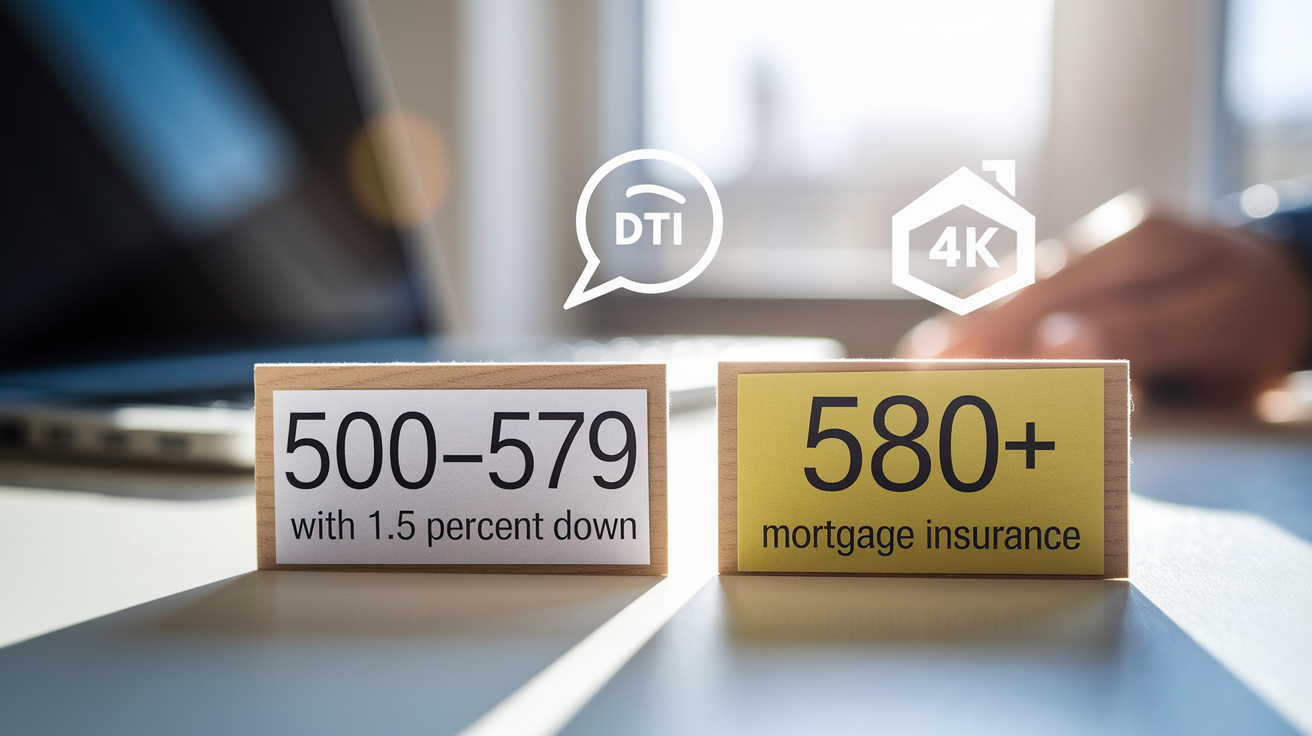
FHA allows credit scores between 500 and 579, but only with 10% down. If you can raise your score to 580 or higher, the required down payment drops to 3.5%. That difference matters. On a $250,000 home, the gap is $16,250 versus $8,750 upfront. FHA loans are only available for primary residences, so you can’t use this program to buy a vacation home or rental property.
FHA requires two mortgage insurance charges: an upfront premium (typically 1.75% of the loan amount, which can be rolled into the loan) and an annual premium paid monthly. If your down payment is less than 10%, the annual premium stays for the entire loan term. You’ll pay it every month until you sell, refinance, or pay off the loan. Your debt-to-income ratio matters too. If your score is between 580 and 619, lenders typically want your housing expense ratio at or below 38% and your total DTI under 45%. Many lenders will also require a clean 12-month housing payment history, no 30-day late payments on rent or mortgage, and limited NSF activity in your bank accounts.
| Program Rule | Requirement |
|---|---|
| Credit score 500–579 | 10% down payment required |
| Credit score 580+ | 3.5% down payment required |
| Debt-to-income (DTI) | ≤45% for scores 580–619; ≤57% for scores 620+ |
| Mortgage insurance (MIP) | 1.75% upfront + annual MIP; annual lasts full term if down payment <10% |
| Occupancy | Primary residence only |
Alternative Mortgage Options When Your Credit Is Around 520

VA loans don’t have a federal minimum credit score, and they allow no down payment for eligible veterans, active-duty service members, and qualifying surviving spouses. Individual lenders almost always impose their own minimums, though. Most prefer a score of at least 580. If you’re a veteran or active military with a 520 score, you may still have a chance with some VA lenders, especially if you have strong income and low debt. You’ll pay a one-time VA funding fee at closing, but there’s no ongoing mortgage insurance.
USDA loans can also offer no down payment, but they’re harder to get with a 520 score. USDA doesn’t set a hard minimum, but in practice, most lenders won’t approve scores below 640. You also need to meet income limits. Your household income can’t exceed 115% of the area median income, and the property must be in a qualifying rural area.
Conventional loans historically required a 620 minimum credit score. Although Fannie Mae and Freddie Mac removed that hard cutoff in November 2025, the new system uses risk-based underwriting. That means lenders look at your full credit profile, and a 520 score typically won’t meet their risk standards unless you bring a massive down payment or other very strong compensating factors. Portfolio lenders and credit unions sometimes offer more flexibility because they keep loans in-house rather than selling them. These lenders may approve you through manual underwriting if you show stable income, low debt, and a solid explanation for your low score. Hard-money lenders will lend to almost anyone, but they care more about the property’s value than your credit. Expect interest rates in the double digits and short loan terms of 12 to 36 months. These are bridge loans, not permanent mortgages.
VA eligibility notes: No down payment. No federal score minimum. Most lenders still require 580+. One-time funding fee applies (exceptions for disability and certain Purple Heart/return-to-duty cases).
USDA rural and income rules: No down payment. Income cap at 115% area median. Most lenders prefer 640+ credit. 1.0% upfront guarantee fee and 0.35% annual fee.
Conventional changes post-2025: No hard 620 floor since November 2025, but risk-based underwriting makes 520 score approvals rare without major compensating factors.
Portfolio lenders’ flexibility: Keep loans on their own books. May use manual underwriting. Approval criteria vary widely by institution.
Credit union manual underwriting: May consider full financial picture rather than just score. Typically require membership and may offer better rates for low-risk borrowers.
Hard-money pros/cons: Fast approval and minimal credit check, but very high interest rates (often 10%–15%), short terms, and high fees. Best used as temporary financing, not permanent housing solution.
How Low Credit Influences Mortgage Rates, Fees, and Monthly Payments

Lenders price risk, and a 520 credit score signals higher default risk. That means you’ll pay interest rates that can be whole percentage points higher than someone with a 670 or 740 score. On a $250,000 loan, a 1% rate difference equals about $150 more per month, $54,000 extra over a 30-year term. FHA mortgage insurance (MIP) is standardized, so your rate for MIP doesn’t change based on your credit score, but it lasts for the life of the loan if you put down less than 10%. Conventional loans use private mortgage insurance (PMI), and PMI rates do increase as your credit score drops. Lenders also charge loan-level price adjustments (LLPAs) on conventional loans, add-on fees based on your credit score and loan-to-value ratio. At a 520 score, those adjustments can add thousands in upfront costs or be rolled into a higher rate.
Closing costs add up fast with bad credit. Typical origination fees run 0.5% to 1% of the loan amount, but lenders may charge more for riskier borrowers. Underwriting fees usually start around $500 and can exceed $1,000. A larger down payment helps offset some of these penalties. The lower your loan-to-value ratio, the less risk the lender takes on, and you may qualify for slightly better terms.
Rate differences by credit tier: A 520 score may result in rates 1–2 percentage points higher than a 740+ score, depending on loan type and lender.
PMI vs MIP behavior at low scores: FHA MIP is standardized by program (not score-dependent). Conventional PMI increases significantly as credit score drops below 680, with steep jumps under 620.
Impact of large down payments: Reducing LTV below 80% eliminates PMI on conventional loans. On FHA, a 10% down payment shortens MIP duration to 11 years instead of the loan’s full term.
Example monthly payment differences: $250,000 loan at 6.5% (good credit) = ~$1,580/month principal and interest. Same loan at 8.0% (520 score) = ~$1,834/month, a $254/month increase, or $91,440 over 30 years.
Strengthening Your Mortgage Application With a 520 Credit Score

Lenders want to see steady income, low debt, and proof you can handle a mortgage payment. You’ll need recent pay stubs (usually the last two months), W-2 forms or tax returns (typically the last two years), and bank statements showing consistent deposits and minimal overdrafts. If you’re self-employed, expect to provide tax returns and possibly a profit-and-loss statement. Your reserves matter too. Some lenders want to see several months’ worth of mortgage payments sitting in the bank after closing.
Compensating factors help offset a low credit score. A larger down payment is the strongest compensating factor because it reduces the lender’s risk. A debt-to-income ratio well below 45% shows you’re not overextended. A clean 12-month housing payment history, no late rent or mortgage payments, proves you can pay on time. Lenders also look at your bank statements for NSF activity. Frequent overdrafts signal money-management problems even if your income is steady.
A co-signer or co-borrower can make the difference between approval and denial. They add their income and credit score to the application, which lowers your DTI and may improve your overall credit profile. But understand that the co-signer is legally responsible for the loan. If you miss payments, their credit takes the hit. Some lenders will use the lower of the two credit scores for pricing, so if your co-signer has a 720 score but you have a 520, the lender may still price the loan based on your 520. Ask the lender how they handle co-signers before you apply.
Quick Credit Improvements to Raise a 520 Score Before Applying

Payment history makes up 35% of your FICO score, and amounts owed (credit utilization) make up another 30%. Those two categories are where you can make the fastest progress. Paying down credit card balances to below 30% of your available credit limit can raise your score within weeks, “within weeks” means the next time your card issuer reports to the credit bureaus, typically once a month. Disputing errors on your credit report can also produce quick gains if the errors are removed.
Most borrowers with a 520 score can see measurable improvement in three to six months if they focus on a few key actions. Fixing errors, paying down high-utilization cards, and setting up autopay to avoid late payments are the fastest moves. Rebuilding a long history of on-time payments takes longer, usually six to twelve months or more, but every month of clean payment history helps.
Pull reports + dispute errors: Use AnnualCreditReport.com to pull free reports from Equifax, Experian, and TransUnion. Dispute any inaccurate late payments, incorrect balances, or accounts that aren’t yours.
Lower utilization below 30%: Pay down credit card balances or increase credit limits. If you have a $1,000 limit and a $500 balance, that’s 50% utilization. Pay it down to $300 or less to hit the 30% target.
Pay collections + request deletion: Negotiate “pay for delete” agreements in writing. Collections can remain on your report for up to seven years, but some creditors will remove them if you settle or pay in full.
Set up autopay for on-time history: Automate at least the minimum payment on every account. Even one 30-day late payment can drop your score by 60–100 points.
Avoid new inquiries: Each hard pull for new credit can drop your score by a few points. When shopping for a mortgage, multiple inquiries within a 14–45 day window count as one inquiry for FICO purposes.
Consider credit-building tools: Secured credit cards and credit-builder loans report positive payment history. These tools are designed for people rebuilding credit.
Ask lender about rapid rescore: If you pay down balances or fix errors, your lender can request a rapid rescore to update your credit report in days instead of waiting for the next billing cycle.
Down Payment Strategies to Improve Approval Odds at a 520 Credit Score
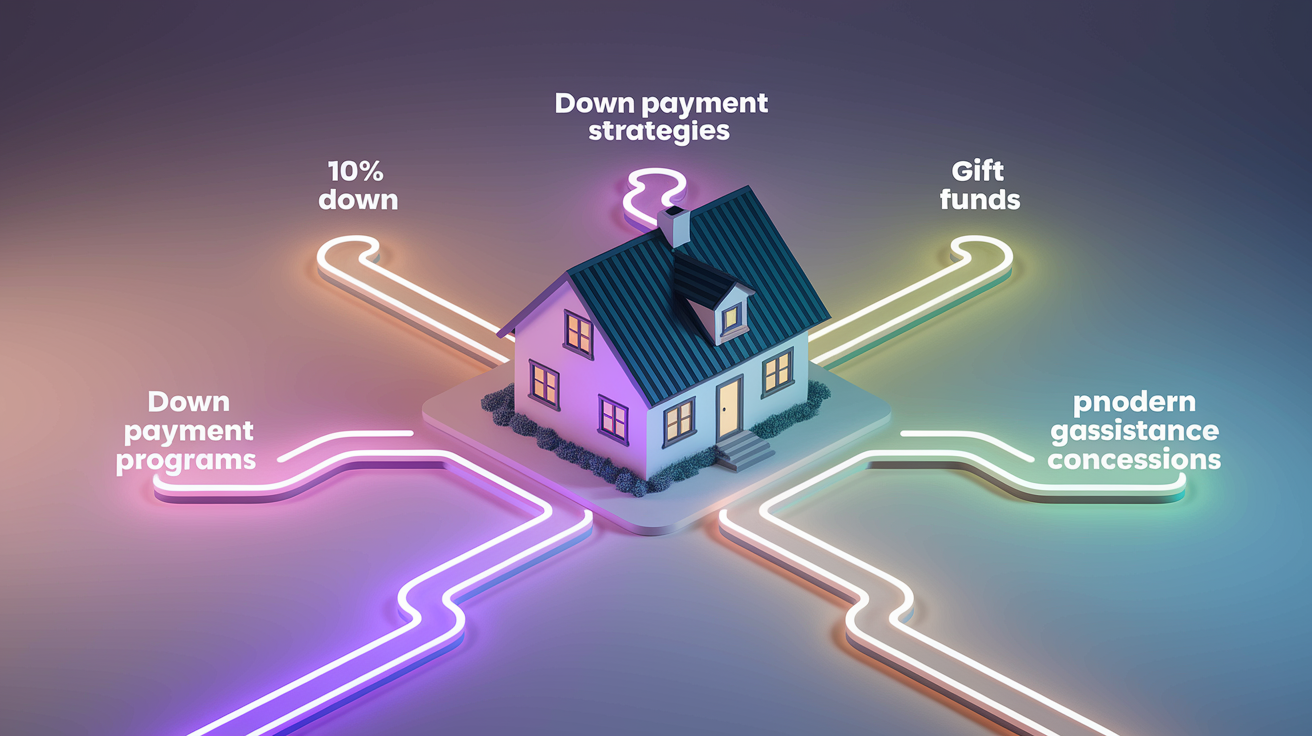
A larger down payment reduces the lender’s risk and can unlock better loan terms or even approval when you’d otherwise be declined. Lowering your loan-to-value (LTV) ratio below 90% makes a meaningful difference. Hitting 80% LTV eliminates private mortgage insurance on conventional loans and can reduce your interest rate. For FHA borrowers with a 520 score, the difference between 10% down and 15% or 20% down may not change your MIP immediately, but it shows financial strength and can ease underwriting concerns.
Down payment assistance (DPA) programs exist in most states, often offering grants or forgivable loans to help cover part of your down payment or closing costs. Some programs have credit score minimums of their own, but many accept scores in the 500s if you’re using an FHA loan. Gift funds from family members are also allowed. You’ll need a signed gift letter stating the money is a gift, not a loan, and you may need to show a paper trail proving where the funds came from. Seller concessions, when the seller agrees to pay part of your closing costs, can also help stretch your cash. In rare cases, seller financing (where the seller acts as the lender) can bypass traditional underwriting entirely, though these deals are harder to find and come with their own risks.
| Down Payment Strategy | Benefit |
|---|---|
| 10% down (FHA minimum for 520 score) | Meets FHA requirement; annual MIP lasts 11 years instead of full loan term |
| 15%–20% down | Shows financial strength; may improve approval odds and slightly reduce interest rate |
| Down payment assistance programs | Grants or forgivable loans reduce out-of-pocket cash; some accept 500+ scores with FHA loans |
| Gift funds from family | Acceptable with documentation (gift letter + paper trail); no repayment required |
| Seller concessions | Seller pays part of closing costs, reducing cash needed at closing; FHA allows up to 6% of sale price |
When to Wait: Setting a Realistic Timeline Before Applying With a 520 Credit Score

Small improvements can happen fast. Fixing errors, paying down a high-balance card, or setting up autopay can produce noticeable score gains in a few weeks to a few months. But bigger rebuilds take time. If you need to establish six to twelve months of consistent on-time payments or wait for old collections to age off your report, you’re looking at a six-to-twelve-month timeline at minimum.
Major derogatory events like bankruptcy or foreclosure have statutory waiting periods that vary by loan type. FHA typically requires at least two years after a Chapter 7 bankruptcy discharge and three years after foreclosure. Conventional loans often require four years post-bankruptcy and seven years post-foreclosure, though some lenders will make exceptions with strong compensating factors. If you’re coming off a recent foreclosure or bankruptcy, waiting and rebuilding credit is usually the only path to a conventional or competitive FHA loan. One important note on rate shopping: mortgage credit inquiries made within a 14-to-45-day window are treated as a single inquiry by FICO, so you can shop multiple lenders without tanking your score.
Common Approval Roadblocks for a 520 Credit Score Borrower

High debt-to-income ratio is the most common underwriting problem. If your total monthly debt payments (including the proposed mortgage, property taxes, insurance, HOA fees, car loans, student loans, credit cards, and personal loans) exceed 45% of your gross monthly income, most lenders will decline you. Recent late payments on housing (rent or mortgage) are another red flag, especially if they happened in the last 12 months. Active collection accounts, judgments, or overdue taxes signal unresolved financial problems.
Strengthen your file by cleaning up documentation and showing reserves. Provide clear, complete pay stubs and bank statements with no missing pages. If you’re self-employed, make sure your tax returns match the income you’re claiming. Show several months of mortgage payments saved in the bank after your down payment and closing costs are accounted for. If you have collections or judgments, pay them off or set up payment plans before applying, and get documentation from the creditor showing the debt is resolved or being paid on time.
High DTI: Total monthly debt payments exceed 45% of gross income. Fix by paying down debt or increasing verifiable income.
Insufficient reserves: Lenders want to see at least two to three months of mortgage payments saved after closing. More reserves improve approval odds with a 520 score.
Recent 30-day late payments: Late housing payments in the last 12 months are especially damaging. Lenders want to see a clean payment history before approving a new mortgage.
Major collections/judgments: Unresolved collections or legal judgments must be paid or in a documented payment plan. Lenders may require full payoff before closing.
Unstable employment documentation: Gaps in employment, frequent job changes, or inconsistent income raise red flags. Provide letters of explanation and proof of current stable employment.
Practical Alternatives If You Cannot Get a Home Loan With a 520 Credit Score Today

Rent-to-own agreements let you move into a home now and apply part of your rent toward a future down payment. These contracts typically lock in a purchase price and give you one to three years to improve your credit and secure financing. The downside is you’re not building equity during the rental period, and if you can’t get financing by the end of the lease, you may lose the option and any rent credits you’ve accumulated.
Lease-purchase agreements work similarly but usually involve a larger upfront option fee that’s credited toward your down payment. Seller financing is another option. The seller acts as the lender and you make payments directly to them instead of a bank. This bypasses traditional underwriting, but sellers who offer financing usually charge higher interest rates and shorter loan terms, and you’ll need to refinance into a traditional mortgage eventually. Hard-money loans and bridge loans are short-term, high-cost options meant to be replaced within months, not years. Rates often exceed 10%, and if you can’t refinance or sell quickly, you risk foreclosure.
Rent-to-own: Move in now. Portion of rent credited to future down payment. No equity until you close. Risk losing credits if financing falls through.
Lease-purchase agreements: Similar to rent-to-own but typically requires larger upfront option fee. Fee is credited at closing if you complete the purchase.
Seller financing: Seller holds the mortgage. Bypasses bank underwriting. Usually requires higher interest and balloon payment or refinance within 3–5 years.
Hard-money/bridge financing: Very high interest (10%–15%+). Short term (12–36 months). Meant as temporary solution until you can qualify for permanent financing or sell.
Final Words
In the action: FHA with a 10% down payment is the most realistic route if your score is 520. Expect more documentation, higher interest, and mortgage insurance that lasts longer.
Also consider VA (if you qualify), portfolio or hard-money lenders, or a co-borrower. Quick wins: lower balances, fix report errors, and save a bigger down payment.
A home loan with 520 credit score is possible with a plan and patience. Take one step today and your options will grow.
FAQ
Q: Can you get a home loan or mortgage with a credit score of 520?
A: You can get a home loan or mortgage with a 520 credit score, but FHA with a 10% down payment is the most realistic path; expect higher rates, more documentation, and fewer lender options.
Q: What credit score is needed for a $400,000 mortgage?
A: The credit score needed for a $400,000 mortgage depends on loan type and lender; conventional often needs 620+, FHA allows 500–579 with 10% down, and VA lenders commonly prefer 580+.
Q: Can I get an FHA loan with a 550 credit score?
A: You can get an FHA loan with a 550 credit score, but you’ll need a 10% down payment; expect upfront plus annual MIP (which can last the loan if down <10%) and stricter underwriting.