


Want to pay thousands less in interest without upping your monthly bill?
It sounds too good to be true, but biweekly payments add one extra full payment each year because 26 half-payments equal 13 full payments.
That extra payment cuts principal sooner, so daily interest is calculated on a smaller balance and your loan shrinks faster.
Bottom line, biweekly schedules usually cut total interest and shorten payoff time more than monthly plans, just confirm your lender applies payments right away.
How Biweekly Payments Reduce Loan Interest Faster

Biweekly payments cut loan interest faster than monthly ones because they sneak in an extra full payment every year that hits your principal balance directly. When you split your monthly payment in half and pay every two weeks, you’re making 26 half-payments annually. That’s 13 full monthly payments instead of 12. The extra payment chips away at your principal faster, so less interest piles up over time.
Here’s how it works: if your monthly payment is $1,200, a monthly schedule means you pay $14,400 per year. With biweekly payments, you pay $600 every two weeks, totaling $15,600 per year. That $1,200 difference? It’s one extra monthly payment applied to your principal each year, and you didn’t have to increase any individual payment to make it happen.
How the two compare:
Interest paid: Monthly payments let interest build longer on your full balance before each payment arrives. Biweekly payments reduce the balance earlier and more often, which lowers total interest charged.
Principal reduction: Monthly schedules chip away 12 times a year. Biweekly schedules apply 26 payments, reducing principal 13 times annually.
Payoff speed: Monthly plans follow the standard loan term. Biweekly plans can shorten a 30-year mortgage to roughly 24 years and save tens of thousands in interest.
The secret is frequency. Every time you reduce your principal, the interest calculation drops for the remaining balance. Biweekly payments just give you more chances each year to knock that principal down faster.
Mathematical Breakdown of Biweekly vs Monthly Payment Structures
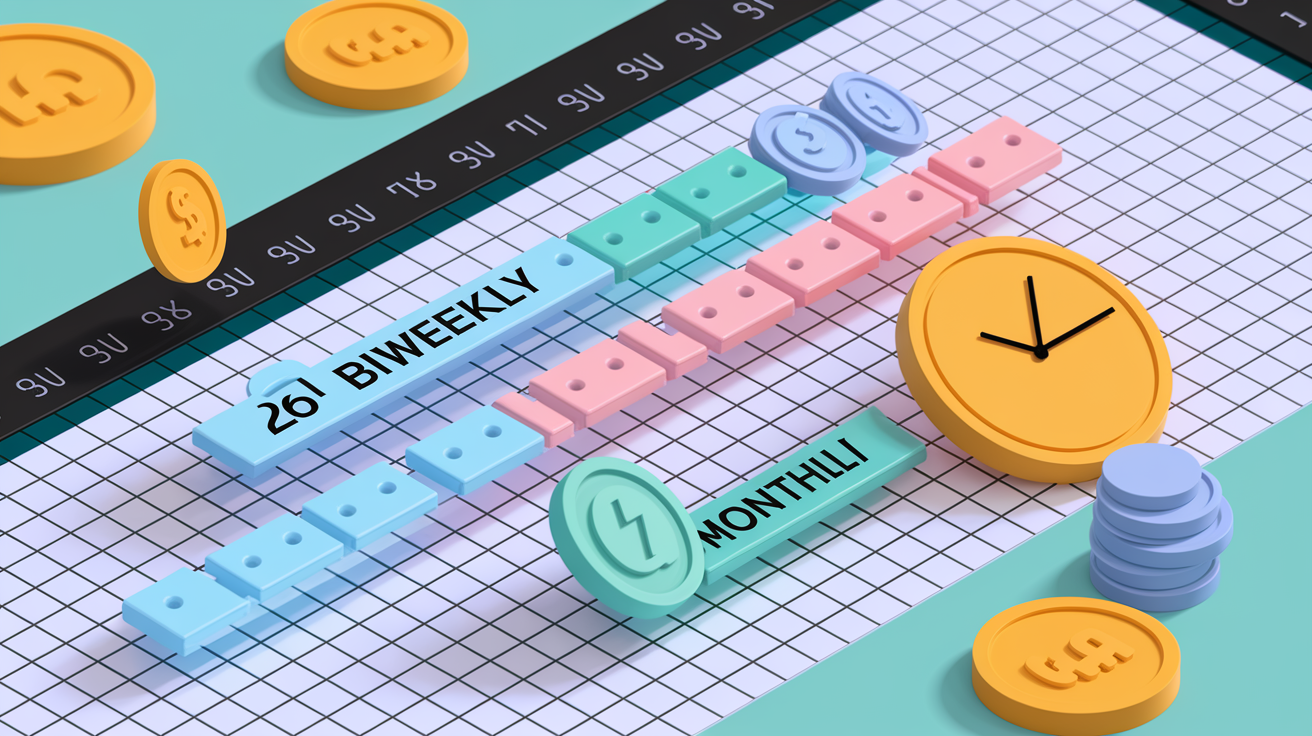
Interest on most loans accrues daily. The longer your principal sits at a higher balance, the more interest compounds. Monthly payments let interest build for about 30 days before your next payment shows up. Biweekly payments cut that wait in half, reducing the balance every 14 days. More frequent payments mean less interest piling up on that shrinking balance, and a faster payoff overall.
How biweekly structures speed things up:
Daily interest calculation: Your lender calculates interest daily based on your outstanding principal. Lower that principal each day, and less interest gets added to your balance.
Payment application: Monthly payments hit once every 30 days. Biweekly payments hit every 14 days, reducing the balance twice as often and cutting the interest window in half.
Annual effect: Over 12 months, biweekly schedules deliver 26 half-payments (13 full payments), while monthly schedules deliver only 12. That extra payment reduces principal right away and shortens the entire timeline.
Compounding savings: The earlier you reduce principal, the more interest you avoid down the road. That first extra payment in year one lowers interest in years two through thirty, creating a compounding effect that stacks savings over the loan’s life.
| Method | Payments per Year | Timing Impact | Interest Effect |
|---|---|---|---|
| Monthly | 12 full payments | Payment every 30 days; balance unchanged between payments | Standard interest accrues over full term |
| Biweekly | 26 half-payments (13 full equivalents) | Payment every 14 days; balance reduced more frequently | Lower daily balance reduces total interest and shortens term |
| Accelerated Biweekly | 26 half-payments plus extra principal | Extra principal each payment; fastest reduction | Maximum interest savings and shortest payoff timeline |
| Semi-Monthly | 24 half-payments (12 full equivalents) | Payment on fixed dates (e.g., 1st and 15th); no extra payment | Same as monthly; no additional interest reduction |
Real Dollar Examples of Interest Savings
On a $200,000 30-year mortgage at 6.5 percent, a monthly payment schedule costs about $253,000 in interest over the life of the loan. Switch to biweekly payments, and that drops to roughly $211,000. That’s more than $42,000 in savings and a payoff about five years earlier. For a $300,000 loan at the same rate, savings jump to around $63,000, and the loan pays off about five and a half years sooner. Larger loans mean bigger dollar impacts because more principal means more interest accruing daily.
Higher interest rates amplify the benefit even more. At 7 percent on a $400,000 loan, monthly payments rack up approximately $558,000 in interest. Biweekly payments cut that to about $465,000, saving over $93,000 and shaving roughly six years off the term. At 8 percent, the difference grows wider. When more interest is scheduled to accrue, reducing principal earlier has a bigger effect on total cost.
| Loan Amount | Monthly Plan Interest (30 years, 6.5%) | Biweekly Plan Interest | Total Savings |
|---|---|---|---|
| $200,000 | $253,000 | $211,000 | $42,000 (5 years shorter) |
| $300,000 | $380,000 | $317,000 | $63,000 (5.5 years shorter) |
| $400,000 | $506,000 | $423,000 | $83,000 (6 years shorter) |
| $500,000 | $633,000 | $528,000 | $105,000 (6 years shorter) |
These examples assume the lender applies biweekly payments correctly. Directly to principal every two weeks, not holding them until the end of the month. If your lender holds payments, you lose the timing advantage and the savings disappear. That’s why it matters to confirm how your lender processes biweekly payments before you switch. The savings come entirely from reducing principal sooner, which lowers the balance on which interest is calculated each day. The faster you chip away at that principal, the less interest you pay overall.
Why Biweekly Payments Equal 13 Full Payments Per Year

There are 52 weeks in a year, so paying every two weeks results in 26 payments. If you split your monthly payment in half and pay that amount biweekly, you’re making 26 half-payments. Simple math: 26 divided by 2 equals 13 full monthly payments. That’s one more payment than the standard 12-month schedule. That extra payment is pure principal reduction because your regular monthly obligation is already covered by the first 12.
This structure is different from simply paying more each month. When you make biweekly payments, the size of each individual payment stays the same as half your monthly amount. No increase required. The extra payment happens naturally because of how the calendar works. If you tried to replicate the effect by increasing your monthly payment, you’d need to divide your monthly payment by 12 and add that amount to each monthly payment to match the biweekly outcome.
The extra payment hits your principal early in the year and immediately reduces the balance on which interest accrues for the remaining months. That’s why the savings compound over time. You’re not just making one extra payment at the end of the year. You’re speeding up principal reduction throughout the year, which cuts the interest calculation on every payment after.
Lender Policies and Biweekly Payment Restrictions

Not every lender accepts true biweekly payments. Some lenders only accept monthly payments and will hold any biweekly funds until the full monthly amount is received, then apply them all at once. That kills the timing advantage and wipes out the interest savings. Other lenders require you to enroll in a formal biweekly program, and some charge setup or processing fees that can run $300 to $400 upfront plus a few dollars per transaction. If you’re paying fees, you need to calculate whether the interest savings outweigh the cost of the program.
Third-party payment processors offer biweekly services, but they often hold your funds in a separate account and then forward one full monthly payment to your lender. You’re still paying biweekly out of your own account, but the lender only sees a monthly payment, so you lose the early principal reduction benefit. Some of these services charge enrollment fees or monthly fees, which eat into any potential savings. Always ask how and when payments are applied before signing up.
Common lender restrictions:
Prepayment penalties: Some loans charge a fee if you pay off principal early, especially within the first three to five years. Check your loan documents for prepayment clauses before switching to biweekly payments.
Application timing: Lenders may apply biweekly payments only once per month instead of every two weeks, which kills the benefit. Confirm in writing how your lender processes biweekly payments.
Minimum payment requirements: A few lenders require minimum payment amounts or only accept payments on specific dates, which can block biweekly setups entirely.
If your lender doesn’t support biweekly payments or charges high fees, you can create the same effect yourself. Divide your monthly payment by 12 and add that amount to each monthly payment, or make one extra full payment per year. Both methods deliver the same principal reduction without needing lender approval or paying processor fees.
Budget Planning for Switching to Biweekly Payments

Biweekly payments work best if you’re paid every two weeks because your loan payment aligns with your paycheck. Each time you get paid, a portion goes straight to your mortgage, which simplifies budgeting and reduces the temptation to spend that money elsewhere. If you’re paid monthly or twice a month on fixed dates, biweekly payments can feel awkward because your payment schedule doesn’t match your income schedule. You’ll need to set aside extra cash to cover the months when three biweekly payments fall within your pay period.
Most months have four weeks, so you’ll make two biweekly payments per month most of the time. But twice a year, a month will include three biweekly payments because of how the calendar lines up. If you’re paid monthly, you need to budget for that third payment in advance or risk a cash crunch. The simplest approach is to divide your total annual payment increase (one extra monthly payment) by 12 and set that amount aside each month in a separate savings account.
Simple budgeting tips for biweekly payments:
Align with paycheck timing: If you’re paid biweekly, schedule your loan payment for the day after payday so the money is available and you don’t accidentally spend it.
Build a one-month buffer: Save one full monthly payment in a separate account before switching to biweekly. This cushion covers any timing mismatches and gives you flexibility during tight months.
Track payment dates: Mark your calendar for months when three payments will occur and plan ahead to make sure you have enough cash on hand.
Start small: If biweekly feels too aggressive, try adding 1/12 of your monthly payment to each monthly payment instead. You’ll get the same annual result without changing your payment frequency.
If your income is irregular or you’re self-employed, biweekly payments may create unnecessary stress. In that case, stick with monthly payments and make one extra principal payment per year when cash flow allows. Tax refund season, bonus time, or any month with surplus income.
Tools and Calculators for Comparing Payment Options

Online mortgage calculators and amortization tools let you model the exact savings for your loan. Input your loan amount, interest rate, and current monthly payment, then compare the results for a standard monthly schedule versus a biweekly schedule. Most calculators will show you the new payoff date, total interest paid under each plan, and how much you save by switching. Make sure the calculator you use applies biweekly payments correctly (every two weeks, not twice a month) because the timing difference changes the outcome.
Look for calculators that break down the amortization schedule year by year so you can see how much principal and interest you pay in each period. This breakdown shows you when the extra payments start making a visible dent in your balance and helps you decide if the effort is worth it. Some calculators also let you add extra principal payments manually, so you can test different strategies. One extra payment per year, rounding up each month, or increasing your payment by a fixed dollar amount. Compare the results side by side.
What to check when using a calculator:
Payment frequency accuracy: Confirm the tool treats biweekly as 26 payments per year, not 24. Semi-monthly (twice per month) doesn’t create an extra payment and won’t reduce interest faster.
Loan details: Enter your exact principal balance, interest rate, remaining term, and current monthly payment (principal and interest only, not taxes or insurance) for an accurate comparison.
Total cost outputs: Look for total interest paid, final payoff date, and years saved. These three numbers tell you whether the switch makes financial sense for your situation.
Final Words
Biweekly payments actually save more interest than monthly ones by turning 26 half-payments into 13 full payments a year, which knocks down principal faster and lowers total interest.
This post showed the math, gave real-dollar examples, covered lender rules, and offered budgeting steps and tools so you can compare options clearly.
Ask the key question – biweekly vs monthly payments which reduces loan interest faster – then run the numbers for your loan. Done right, biweekly cuts years and thousands off your loan. It’s a small change that pays.
FAQ
Q: Is it better to pay a loan biweekly or monthly?
A: Paying a loan biweekly is generally better than monthly because biweekly schedules create 26 half-payments (13 full ones) a year, cutting principal faster and lowering total interest paid over the loan.
Q: What is the 3 7 3 rule in mortgage?
A: The 3 7 3 rule in mortgage is not a single, standard rule; its meaning varies by lender or context. Ask your lender what they mean and get the guideline in writing before relying on it.
Q: Do you pay off loans faster with biweekly payments?
A: You pay off loans faster with biweekly payments because 26 half-payments equal 13 full monthly payments yearly, producing an extra payment that reduces principal sooner and shortens the loan term.
Q: How to take 10 years off a 30 year mortgage?
A: To take 10 years off a 30-year mortgage, use biweekly payments, make one extra monthly payment each year, add regular extra principal payments, or refinance to a shorter term after checking total costs.