

Don’t pick the lowest rate—pick the loan that fits your cash flow and goals.
Pick the wrong one and you could pay thousands more or be stuck with a loan that doesn’t help.
This post compares SBA loans, bank term loans, and lines of credit—how fast they fund, typical costs and sizes, and the real-world uses for each.
Read on to learn which option suits a big purchase, a growth project, or short-term cash flow, so you can apply with confidence and avoid costly surprises.
Comprehensive Comparison of SBA Loans, Term Loans, and Lines of Credit
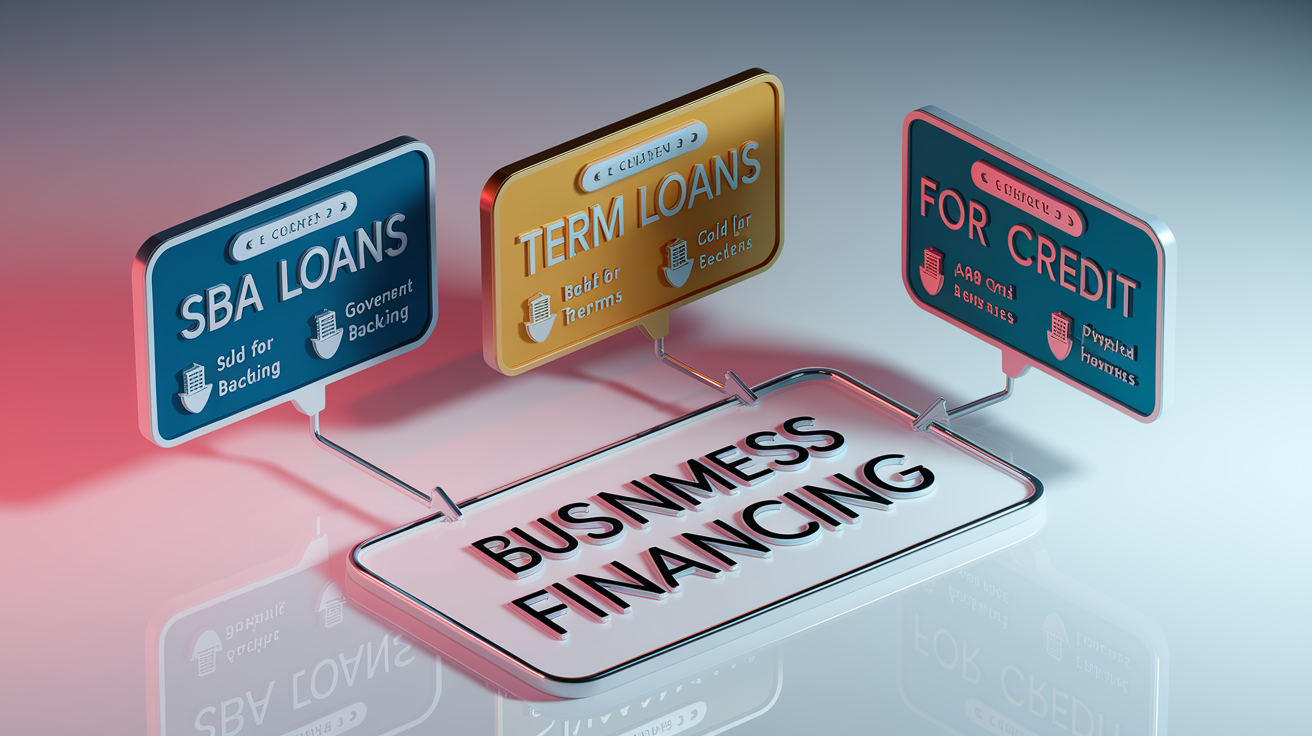
Small business financing breaks down into three main paths: government-backed SBA loans, traditional bank term loans, and revolving lines of credit. Each one serves different needs, costs different amounts, and moves at a different speed. Understanding which one matches your cash flow, timeline, and purpose can save you thousands in interest and keep you from getting stuck with the wrong financing structure.
SBA loans offer the longest repayment windows and largest loan amounts, typically up to $5,000,000, with APRs ranging from roughly 6% to 13%. Term loans from banks usually fall between $50,000 and $2,000,000, with APRs around 4% to 12% for strong borrowers, and you’ll see funding in one to four weeks. Lines of credit give you revolving access to $10,000 up to $500,000 or more, with APRs from 6% all the way to 25%, and funding can happen in as little as one day or take up to three weeks depending on collateral and lender type.
Here’s where each loan type fits:
Funding speed: Lines of credit are fastest (1 to 21 days), term loans sit in the middle (1 to 4 weeks), and SBA loans take the longest (2 to 8+ weeks or more for complex deals).
Overall borrowing cost: SBA loans spread payments over 10 to 25 years, which lowers the monthly hit but racks up total interest. Term loans compress repayment into 1 to 10 years with moderate total cost. Lines of credit charge interest only on what you use, but the APR is usually the highest of the three.
Primary use cases: SBA loans work for big purchases like real estate, business acquisitions, or major equipment. Term loans suit predictable capital expenditures and growth projects. Lines of credit handle short-term working capital, payroll gaps, and seasonal inventory swings.
| Loan Type | APR Range | Funding Speed | Typical Loan Amount | Repayment Terms | Collateral Requirements | Fees | Best Use Case |
|---|---|---|---|---|---|---|---|
| SBA Loans | 6% to 13% | 2 to 8+ weeks | Up to $5,000,000 | 10 to 25 years | Secured when available; personal guarantees for 20%+ owners | Origination 0.5% to 3% + SBA guarantee fees | Real estate, acquisitions, long-term fixed assets |
| Bank Term Loans | 4% to 12% | 1 to 4 weeks | $50,000 to $2,000,000+ | 1 to 10 years | Often secured; depends on borrower credit and asset value | Origination 0.5% to 3%; prepayment penalties vary | Equipment, expansion, capex, debt consolidation |
| Business Line of Credit | 6% to 25% | 1 to 21 days | $10,000 to $500,000+ (secured lines higher) | Revolving 6 months to 3 years; interest-only draw periods common | Unsecured for smaller limits; secured by receivables/inventory for larger | Annual/unused 0.25% to 1.5%; draw fees $25 to $200 | Working capital, seasonal gaps, payroll, short-term inventory |
If you need more than $250,000 for a purchase that’ll pay off over years (real estate, a major expansion, or buying another business), an SBA loan gives you the lowest monthly payment and the longest runway. If you’ve got strong financials and need a lump sum for a defined project like new equipment or a buildout, and you can handle higher monthly payments over a shorter period, a bank term loan gets you funded faster with competitive rates.
If your cash flow swings month to month, or you need a financial cushion to cover payroll during slow weeks or stock up inventory before peak season, a line of credit lets you borrow exactly what you need when you need it and pay interest only on the portion you use.
In-Depth Look at SBA Loans for Choosing the Right Small Business Financing
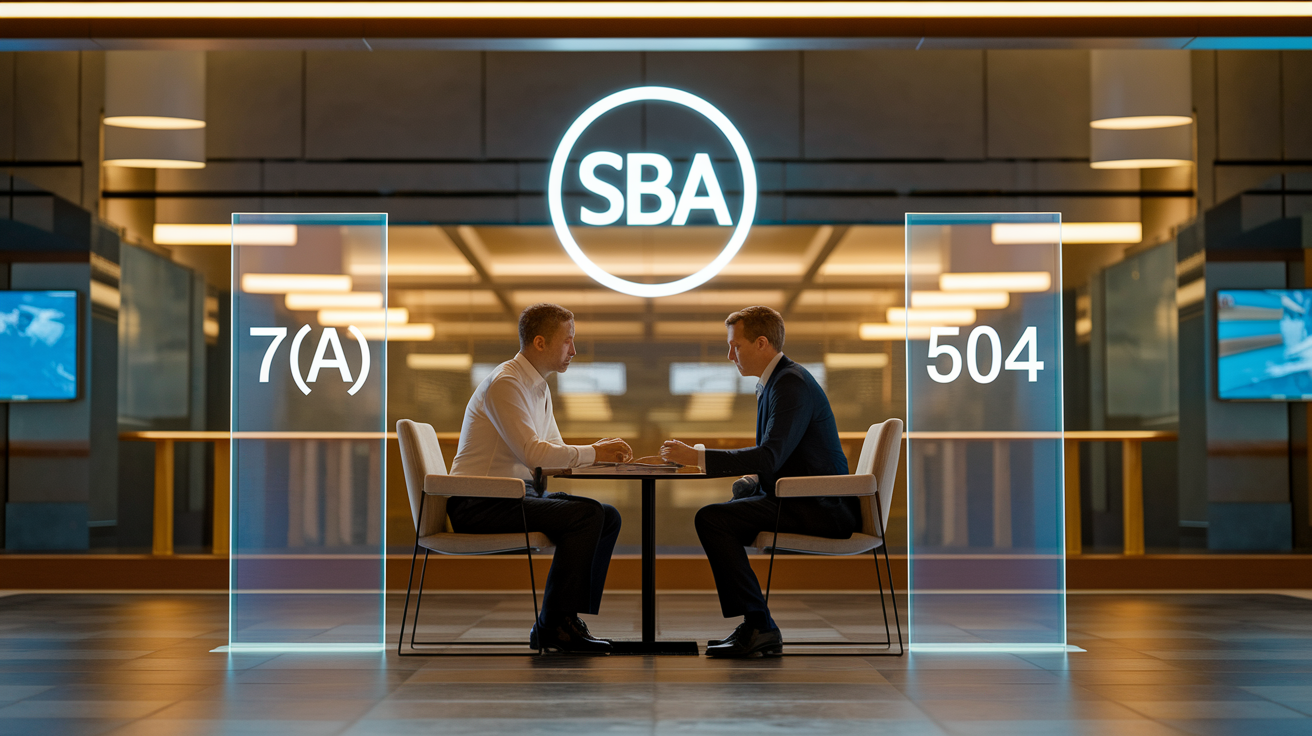
SBA loans are term loans partially guaranteed by the U.S. Small Business Administration, which reduces the lender’s risk and opens the door to lower rates and longer repayment periods than you’d typically get from a bank alone. The government doesn’t hand you the money directly. A bank or credit union originates the loan, and the SBA backs a portion of it.
SBA Loan Types and Uses
The two most common SBA programs are the 7(a) and the 504. The 7(a) program goes up to $5,000,000 and covers almost anything: working capital, equipment purchases, real estate acquisition, business acquisitions, refinancing existing debt, or general expansion. It’s the flexible option.
The 504 program is built specifically for fixed assets (buying land, buildings, or heavy machinery), and the SBA-backed debenture portion commonly reaches around $5,500,000 for qualified projects when combined with a conventional first mortgage and borrower equity. If you’re buying a warehouse, a retail storefront, or a production facility, the 504 structure delivers a long-term, fixed-rate loan on the real estate portion.
There’s also SBA Express, which caps at $500,000 and offers faster approval in exchange for a smaller guarantee. It’s useful for equipment or moderate working capital needs when time matters.
Eligibility, Credit, Guarantees, and Collateral
SBA lenders commonly look for at least two years in business, though startups with strong owner experience can sometimes qualify. Credit scores around 650 are often the floor, but compensating factors like cash flow or collateral can help. Lenders calculate a Debt Service Coverage Ratio (DSCR), which is your cash available to pay debt divided by your total debt payments, and generally want to see 1.0 or higher, with 1.25 being more comfortable.
Any owner with 20% or more of the business will sign a personal guarantee, and the lender will take collateral when it’s available. The SBA doesn’t require you to pledge your house if you don’t have business assets, but if you own equipment or property, expect it to be listed.
The SBA guarantee itself ranges based on loan size. For loans up to $150,000, the SBA typically guarantees 85%. For loans above that, the guarantee drops to 75%. This guarantee is why lenders are willing to approve deals they’d otherwise pass on.
Costs, Fees, and Timeline
Interest rates on SBA loans are pegged to the prime rate or LIBOR, with lender-specific spreads. Total APRs for borrowers commonly fall between 6% and 13%, depending on loan size, credit strength, and the lender’s pricing. Rates for working capital and equipment loans are often higher than for real estate. Repayment terms stretch up to 10 years for working capital and equipment, and up to 25 years for commercial real estate, which keeps monthly payments lower than a typical bank term loan.
Fees include origination or packaging fees from the lender (usually 0.5% to 3% of the loan) and an SBA guarantee fee that varies by loan size. Small loans under $150,000 pay a lower percentage, while loans between $1,000,000 and $5,000,000 can see guarantee fees around 3.5% to 3.75% of the guaranteed portion. These fees are often rolled into the loan balance.
Funding timelines range from two weeks on the low end to eight weeks or more, especially for larger or more complicated deals. The application process involves more documentation than a standard bank loan (business plans, tax returns, financial statements, and personal background), which is why the clock ticks longer.
Ideal SBA borrower profiles:
You need more than $250,000 for a long-term purchase. You’re buying commercial real estate or acquiring another business. You want the lowest possible monthly payment and can wait for approval. You’ve been turned down for conventional financing due to limited collateral or short credit history. You require a 10- to 25-year amortization to make cash flow work.
Detailed Breakdown of Term Loans When Choosing the Right Financing Option

A term loan from a bank gives you a lump sum upfront, and you pay it back in fixed monthly installments over a set period. It’s the most straightforward financing structure: borrow once, repay on schedule, done.
Mechanics and Repayment Structure
Term loans typically run from one year to ten years, though loans backed by real estate can stretch longer. You receive the full amount at closing, and you start making equal monthly payments that include both principal and interest. The predictability is the main appeal. You know exactly what you owe each month, and the loan balance decreases on a fixed schedule. Shorter terms mean higher monthly payments but less total interest paid. Longer terms lower the monthly cost but increase the total you’ll repay.
Most bank term loans carry a fixed interest rate, though some lenders offer variable rates tied to an index. Fixed-rate loans lock in your cost, which protects you if rates rise but means you won’t benefit if they fall.
Eligibility and Underwriting
Banks typically want to see at least two years of revenue history, and they’re more comfortable with businesses that have been operating profitably. Credit scores around 680 or higher get the best rates. Borrowers below that threshold may still qualify but will pay more. Lenders calculate your DSCR and usually want 1.25 or better, meaning you generate $1.25 in cash for every $1.00 of debt service. If your ratio is tight, expect the lender to ask for more collateral or a larger down payment.
Collateral can include the asset you’re buying (equipment, vehicles, real estate) or other business assets like inventory or receivables. Unsecured term loans exist for smaller amounts and strong borrowers, but they carry higher rates to offset the lender’s risk.
Use Cases and Funding Timelines
Term loans work well for equipment purchases, facility improvements, business expansions, debt consolidation, or acquisitions. If you’re buying a $150,000 piece of machinery, a five-year term loan at 7% gives you a predictable monthly payment and matches the loan life to the useful life of the asset.
Funding typically takes one to four weeks. If you already bank with the lender and they have your financials on file, you can sometimes close in under two weeks. New relationships or complex credit situations push the timeline toward the four-week mark.
Pros:
Predictable monthly payments and clear payoff date. Lower interest rates than lines of credit for qualified borrowers. Can be secured or unsecured depending on credit and collateral. Faster approval than SBA loans.
Cons:
Fixed payment obligation even if revenue dips. Prepayment penalties possible (depends on lender). Harder to qualify than a line of credit if cash flow is variable. Less flexibility than revolving credit.
Understanding Lines of Credit for Choosing the Right Small Business Loan

A business line of credit works like a credit card for your company. You get approved for a maximum limit, draw what you need when you need it, pay interest only on the amount you borrow, and you can reuse the credit as you pay it down.
How a Line of Credit Works
Once approved, you can draw funds up to your limit anytime during the draw period, which typically lasts six months to three years. Some lines let you write checks, others give you a debit card or ACH transfer access. During the draw period, many lenders allow interest-only payments, meaning you pay only the interest accrued on your outstanding balance each month without reducing the principal.
After the draw period ends, the line either renews (if you reapply and qualify) or converts to a repayment period, usually structured as a three- to five-year installment loan on whatever balance remains.
Interest rates are almost always variable, tied to the prime rate plus a margin set by the lender. Rates range widely. Secured lines backed by receivables or inventory might charge prime plus 1% to 3% (roughly 6% to 10% APR), while unsecured lines or fintech lenders can charge 15% to 25% or more. The APR depends on your credit, your banking relationship, and whether you pledge collateral.
Eligibility and Typical Requirements
Lenders generally want one to two years of operating history, though some fintech lenders will work with newer businesses. For larger credit limits (say $100,000 and up), many banks require annual revenue of at least $100,000 and strong cash flow. Unsecured lines for smaller amounts (under $50,000) may be available with lighter documentation, but expect higher rates.
Credit underwriting often focuses on your accounts receivable aging, bank account activity, and recent profit trends. If you have $200,000 in solid receivables and steady deposits, lenders see predictable cash flow to support repayment. Secured lines require an ongoing collateral report (receivables schedules or inventory counts) so the lender can monitor the asset base backing the credit.
Best Use Cases
Lines of credit shine when your needs are short-term, variable, or unpredictable. Common scenarios: covering payroll during a slow month, buying inventory ahead of a busy season, managing the gap between paying suppliers and getting paid by customers, or keeping a cushion for emergency repairs or opportunities. You pay interest only on what you use, so if you draw $30,000 one month and pay it back the next, you’re only charged interest for that one month on $30,000.
A line of credit isn’t a good fit for financing a long-term purchase like real estate or equipment. The variable rate and short draw period mean the cost can climb fast if you carry a balance long-term.
Warning signs that a line of credit may not be the right choice:
You need the full amount for a single, one-time purchase. You plan to keep the balance drawn for more than 12 months. Your cash flow is too tight to handle variable monthly payments. You’re using the line to cover operating losses instead of temporary gaps. The lender’s renewal terms are uncertain and you can’t afford to lose access.
Decision Framework: How to Choose Between SBA, Term Loan, and Line of Credit
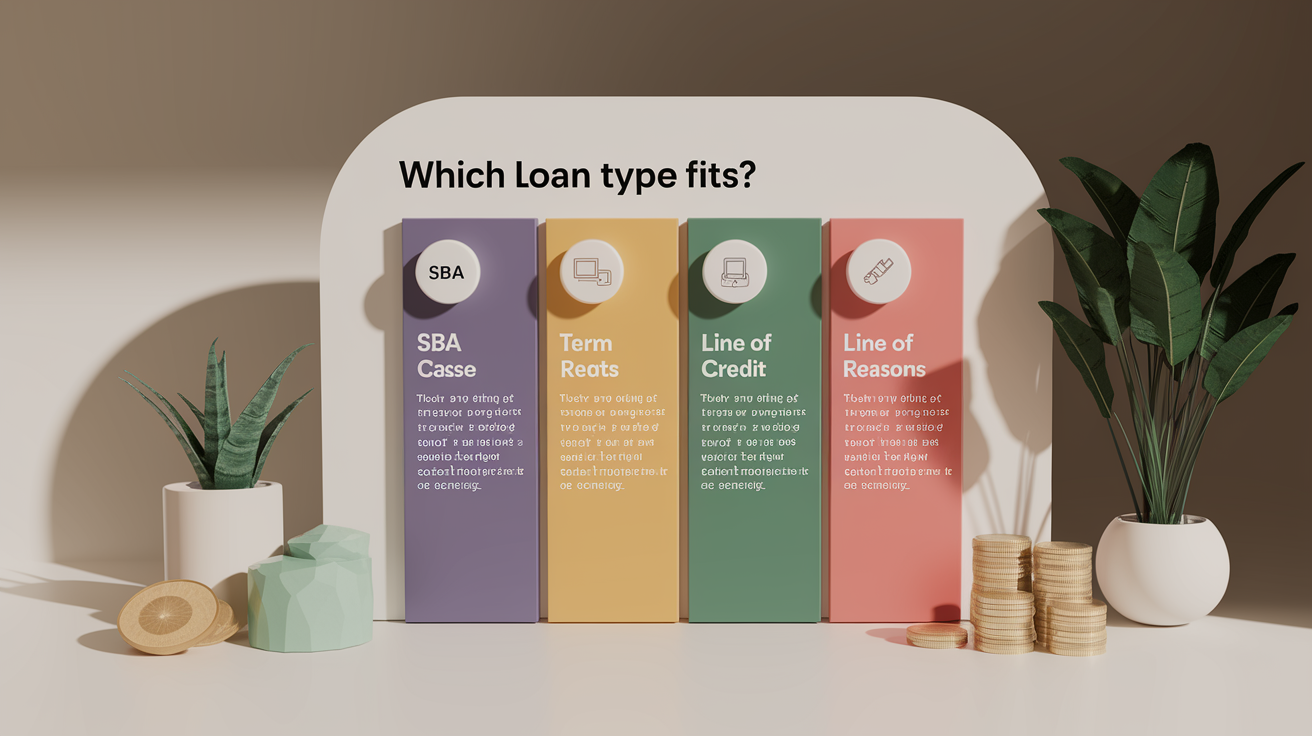
Picking the right loan type starts with matching your business situation to the product’s strengths.
| Business Situation | Best Loan Type | Reason |
|---|---|---|
| Buying commercial real estate or land | SBA 7(a) or 504 | Long-term amortization (up to 25 years) and lower down payment requirements |
| Purchasing equipment or vehicles ($50k to $500k) | Bank term loan | Faster funding, predictable payments, and loan term matches asset life |
| Managing seasonal cash flow or inventory swings | Line of credit | Revolving access, pay interest only on used portion, flexible draws |
| Starting a new business or franchise | SBA 7(a) or SBA Express | Government backing helps when conventional lenders decline due to limited history |
| Expanding operations or opening a second location | SBA 7(a) or bank term loan | SBA if funding need exceeds $250k or credit is moderate; term loan if strong financials and faster close needed |
| Acquiring another business | SBA 7(a) | Large loan limits, long amortization, and favorable terms for acquisition deals |
Matching Needs to Loan Types
If your financing need is a one-time purchase with a clear payoff horizon (new machinery, a buildout, debt consolidation), a term loan or SBA loan makes sense. The choice between those two depends on size, speed, and your ability to qualify. For amounts under $250,000 and strong credit, a bank term loan usually wins on speed and simplicity. Above that threshold, or if your credit or collateral is thinner, an SBA loan opens the door and stretches the payments to fit your cash flow.
If your need is ongoing and flexible (covering short-term gaps, managing unpredictable expenses, or keeping working capital ready), a line of credit is the right tool. Don’t use a line of credit to finance a $500,000 equipment purchase. The variable rate and short draw period will cost you more than a term loan, and you’ll risk losing access if the lender tightens terms at renewal.
Questions to help finalize your decision:
How much do you need, and is it a one-time lump sum or ongoing access? What’s the shortest repayment period your cash flow can handle? Do you have collateral to secure the loan, and does that collateral match the loan type? How quickly do you need the funds, weeks or months? Does your business have predictable revenue, or does it swing seasonally? What’s your current credit score and DSCR, and which loan type will approve you at the best rate?
Application Requirements for Each Small Business Loan Option

Lenders want proof you can repay, documentation of what you’ll use the money for, and a clear picture of your business and personal finances.
SBA Loan Documentation
Last three years of business tax returns (all schedules) and last three years of personal tax returns for all owners with 20% or more equity.
Profit and loss statement and balance sheet for the current year-to-date, prepared by your accountant or bookkeeper.
Business plan or use-of-funds letter explaining the purpose, the amount requested, and how the loan will be repaid.
Last 12 to 24 months of business bank statements showing deposit and withdrawal activity.
Schedule of business debts (existing loans, lines of credit, leases) with balances, monthly payments, and lender names. List of collateral with estimated values. Personal financial statement for each guarantor. Business licenses, articles of incorporation or organization, and lease agreements.
Term Loan Documentation
Last two to three years of business tax returns and last two years of personal tax returns for owners.
Year-to-date profit and loss and balance sheet.
Last 12 months of business bank statements.
Details on the asset being financed (equipment quote, purchase agreement, vehicle VIN) or project scope if financing a buildout or expansion.
Personal financial statement and business debt schedule. Existing lender contact information if refinancing or consolidating debt.
Line of Credit Documentation
Last 12 to 24 months of business bank statements.
Current profit and loss and balance sheet (last fiscal year-end plus year-to-date).
Accounts receivable aging report (if requesting a secured line based on receivables) and inventory list (if pledging inventory).
Business tax returns for the last one to two years.
Personal credit authorization and personal financial statement for guarantors.
Having everything ready before you apply cuts weeks off the timeline. Lenders don’t start underwriting until they have a complete file, and chasing missing documents is the number-one reason approvals drag.
Cost, APR, and Repayment Analysis for Choosing the Right Loan

Comparing loans means looking at the total dollars you’ll pay back, not just the interest rate or the monthly payment in isolation. A lower monthly payment sounds good until you realize you’re paying interest for 20 years instead of five.
Here’s a $250,000 loan across three products. An SBA 7(a) loan at 8% APR over 10 years results in a monthly payment of about $3,036. Over the full term, you’ll pay roughly $116,344 in interest on top of the $250,000 principal, for a total repayment around $366,344.
A bank term loan at 7% APR over five years means a monthly payment near $4,956, but total interest drops to about $47,360 because you’re done in half the time. Total repayment around $297,360.
A line of credit works differently because you only pay interest on what you draw. If you maintain an average balance of $125,000 (50% utilization) at 9% APR, you’d pay roughly $11,250 in interest over one year. If you carry that balance for five years without paying it down, total interest would be around $56,250. But most businesses don’t use a line that way. The appeal is drawing $125,000 one month, paying it back three months later, and only paying interest for those three months.
The SBA loan has the lowest monthly obligation, which protects cash flow, but you pay the most interest over time. The term loan has a higher monthly payment but saves you nearly $70,000 in interest compared to the SBA option. The line of credit is cheapest if you use it short-term and pay it off quickly, but becomes the most expensive if you treat it like a long-term loan.
Common borrower miscalculations:
Comparing monthly payments without looking at total interest paid over the full term.
Ignoring fees (origination charges, guarantee fees, unused-line fees) that aren’t part of the APR but add to your cost.
Assuming a line of credit is “cheaper” because the rate looks lower, without factoring in how long you’ll carry the balance and whether the rate is variable.
Timeline Expectations and Funding Speed Across SBA, Term Loans, and Lines of Credit
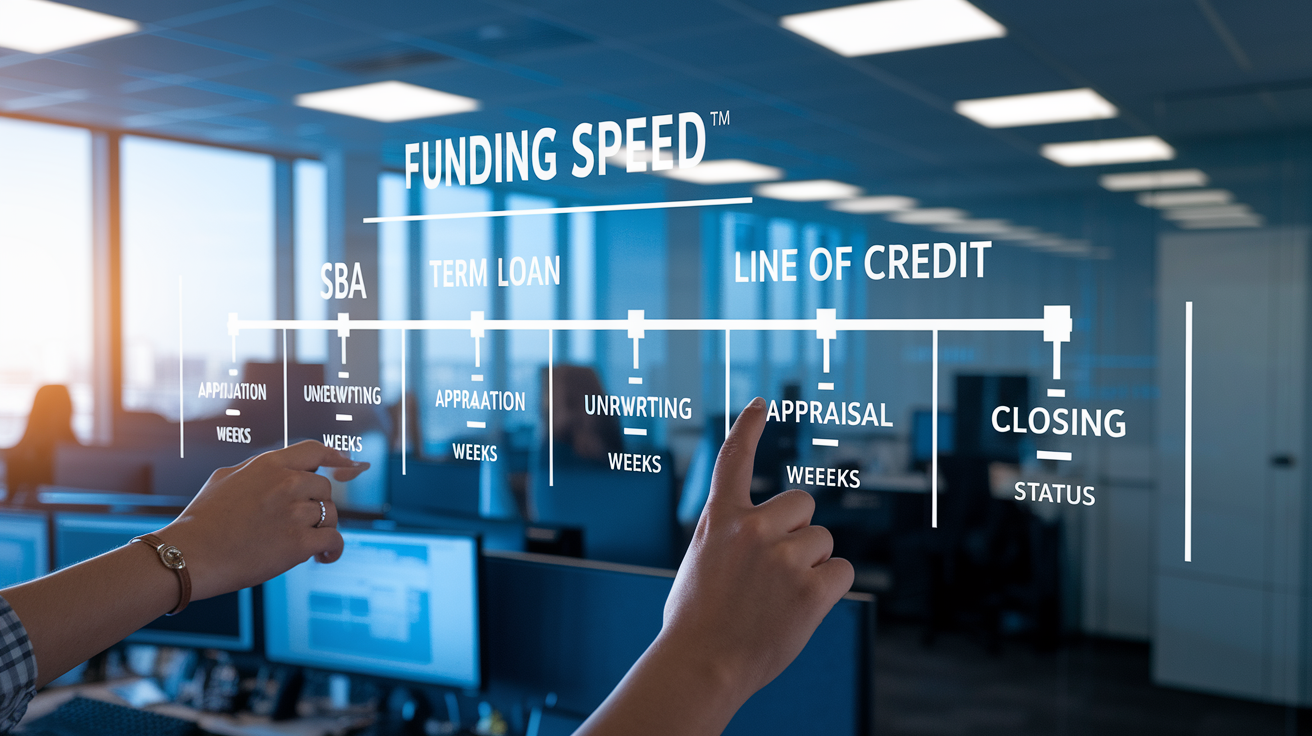
Knowing how long approval takes helps you plan around deadlines like a purchase closing or a project start date.
Application submission: You provide completed forms and supporting documents. Lenders won’t move forward until the file is complete.
Initial underwriting review: The lender checks your credit, calculates DSCR, reviews tax returns and financials, and verifies your cash flow. Takes a few days to two weeks depending on lender workload and complexity.
Collateral and appraisal (if applicable): Real estate purchases require an appraisal, which can add one to three weeks. Equipment or inventory appraisals are faster.
Credit committee or SBA submission: Banks present the loan to their credit committee for approval. SBA loans go to the SBA for guarantee review, which adds time.
Closing and funding: Once approved, you sign loan documents and the lender disburses funds. Usually takes a few days, though wire transfers can happen same-day after signing.
SBA loans typically take two to eight weeks or longer. Straightforward 7(a) loans with strong borrowers and simple use-of-funds can close in two to four weeks. Larger deals, 504 loans, or complex projects stretch to eight weeks or more.
Bank term loans usually close in one to four weeks. Faster if you have an existing relationship and clean financials, slower if the lender needs appraisals or additional underwriting.
Lines of credit can fund in as little as one day for unsecured fintech products with light documentation, or take up to three weeks for secured lines that require receivables audits and collateral verification.
The line of credit is the fastest option when you need money now, especially if you already have a banking relationship. SBA loans are the slowest but offer the best terms for large, long-term needs. Term loans split the difference.
Sample Scenarios Showing How to Choose the Right Small Business Loan

A landscaping company needs $50,000 to cover payroll and materials during the slow winter months. Revenue picks up every spring, and the owner expects to repay the full amount within six months. A line of credit fits. Draw $50,000 in December, make interest-only payments through February, then pay down the balance in April and May as cash comes in. At 10% APR, six months of interest on $50,000 is roughly $2,500, and the line stays open for future seasonal needs.
A bakery is expanding into catering and needs $250,000 to buy commercial kitchen equipment and a delivery van. The business has been profitable for four years, the owner has a 720 credit score, and cash flow supports a $5,000 monthly payment. A five-year bank term loan at 7% delivers the lump sum at closing, monthly payments around $4,956, and total interest near $47,360. The loan is secured by the equipment and vehicle, and funding closes in three weeks.
A retail business is buying the building it currently leases for $1,500,000. The company has strong financials but limited liquid assets for a large down payment. An SBA 504 loan structures the deal with 10% down from the borrower ($150,000), a 50% first mortgage from a conventional lender ($750,000), and a 40% SBA-backed debenture ($600,000) at a fixed rate over 20 years. The blended monthly payment is lower than a conventional commercial mortgage, and the business keeps more cash on hand for operations. Closing takes about eight weeks due to appraisal, SBA approval, and coordination between lenders.
Why each loan fits its scenario:
The line of credit matched short-term, predictable repayment with no need to borrow the full amount for the full year.
The term loan provided a lump sum for a defined purchase with a clear payoff schedule and competitive rate for a strong borrower.
The SBA loan enabled a large real estate acquisition with a low down payment and long amortization that kept monthly obligations manageable.
Final Words
You can now compare SBA loans, term loans, and lines of credit by funding speed, APR, typical amounts, and best uses.
Use the decision framework: match need to loan, like big long-term property for an SBA loan, predictable equipment costs for a term loan, or short cash gaps for a line of credit.
When choosing the right small business loan SBA vs term loan vs line of credit, run the numbers, gather documents, and ask about fees. Do that and you’ll move forward with more confidence.
FAQ
Q: Is an SBA loan or line of credit better?
A: An SBA loan or line of credit is better depending on your need: pick an SBA loan for larger, lower-cost, long-term purchases and a line of credit for quick, short-term working capital or seasonal gaps.
Q: What is the 20% rule for SBA?
A: The 20% rule for SBA means borrowers generally need to show an owner injection or down payment around 10–20%, with 20% commonly expected for real estate or major fixed-asset purchases; exact rules vary by program.
Q: What is the best loan option for a small business?
A: The best loan option for a small business depends on purpose: SBA for big, long-term funding with lower APR; term loans for predictable projects; lines of credit for short-term cash or seasonal needs.
Q: What kills credit scores fastest?
A: Late payments and high credit utilization kill credit scores fastest, especially missed payments, maxed cards, collections, defaults, or bankruptcy—these cause big, quick drops and take years to rebuild.