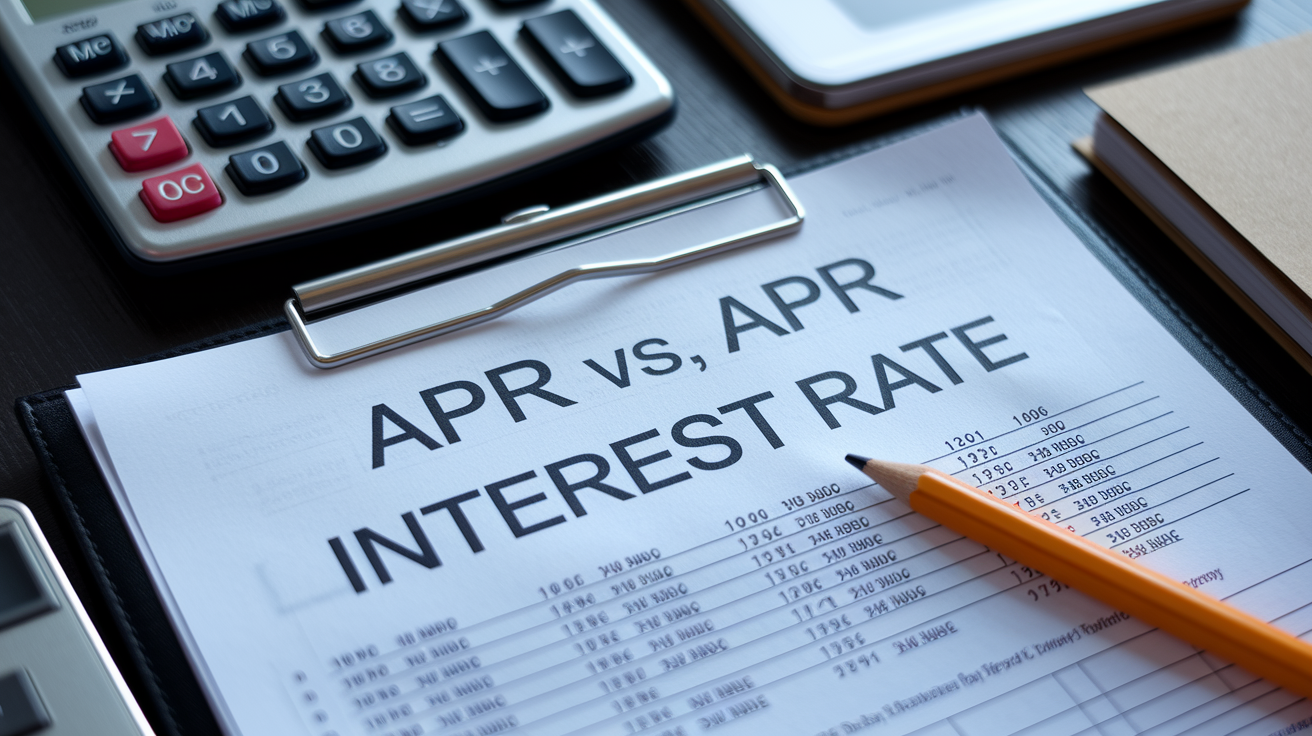

Think the lowest interest rate is always the best deal?
Not usually.
The interest rate is what you pay to borrow the principal and what sets your monthly payment.
APR (annual percentage rate) takes that rate and adds most lender fees (origination, closing costs, points) and gives an annualized number you can use to compare true cost.
So when you’re shopping, APR usually reveals the truer loan cost.
But if a loan has no fees, is very short term, or is adjustable, the interest rate matters more for your monthly budget and future payments.
Key Differences Between APR and Interest Rate
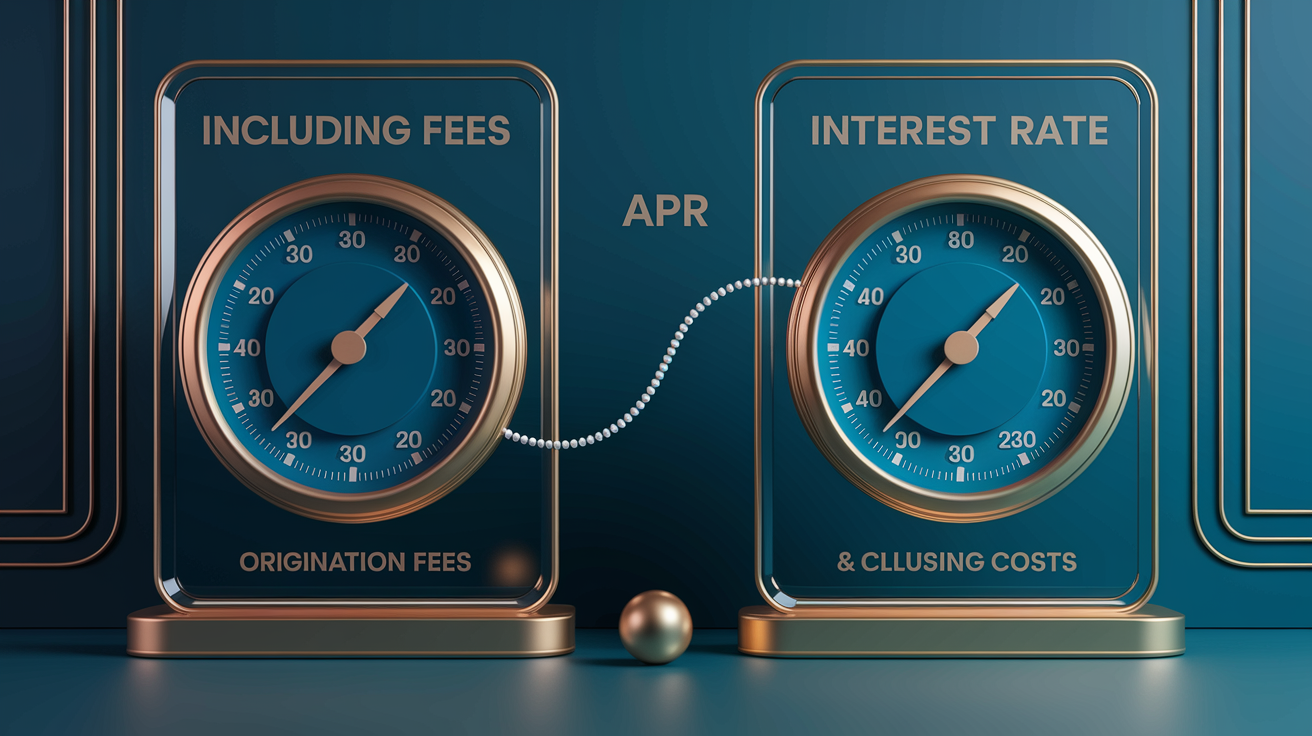
The interest rate is what a lender charges on the money you borrow. APR is bigger. It takes that rate and adds in most of the fees the lender sticks on the loan. So when you’re comparing offers, APR shows you what borrowing actually costs per year because it includes origination fees, closing costs, mortgage insurance, discount points, and broker charges all rolled into one number.
Interest rate only tells you what you’re paying to borrow the principal. Let’s say you take out a $30,000 car loan at 8% for five years. That 8% is your interest rate. It decides how much interest you owe each month as the loan pays down, which adds up to around $6,498 in total interest. But if the lender charges a $500 processing fee, that fee doesn’t show up in the 8%. APR captures both the 8% and the $500, giving you a higher percentage, closer to 8.3%. That’s the real yearly cost.
Here’s the quick version:
- Interest rate = what it costs to borrow the principal; used to figure out your monthly payment and track how interest drops as you pay down the balance.
- APR = interest rate plus fees, shown as an annualized percentage; the best number for comparing total cost across lenders.
- Why it matters = Two loans can have identical interest rates but totally different APRs if one lender piles on fees and the other doesn’t.
How APR and Interest Rate Affect Monthly Payments

Your monthly payment gets calculated using the interest rate, the loan amount, and how long you’re taking to pay it back. Not the APR. Lenders take the principal, apply the interest rate, and spread payments across however many months you picked. So if you borrow $10,000 at 7% for three years, the monthly payment formula uses that 7% to figure out what you owe each month, which comes to about $308. APR doesn’t change that $308.
APR still matters for total cost, even if it doesn’t touch the monthly payment. When a lender tacks on a $500 origination fee to that same $10,000 loan, you either pay it upfront or it gets rolled into what you’re financing, pushing your real borrowing closer to $10,500. The monthly payment stays tied to the 7% rate applied to whatever balance you’re carrying. But the APR, which might jump to 9.2% once the fee is included, tells you the annualized cost of that extra $500. You pay it back over time through slightly higher total interest or a bigger starting balance. That’s why APR is better for apples to apples comparison even though your payment is driven by the rate.
| Loan Amount | Interest Rate | APR | Monthly Payment | Total Cost |
|---|---|---|---|---|
| $10,000 | 7.0% | 7.0% | $308 | $11,088 |
| $10,000 | 7.0% | 9.2% | $308 | $11,588 |
When APR Matters More Than Interest Rate

APR is what you need when you’re shopping for loans that come with serious upfront or ongoing fees. Mortgages, personal loans, and auto loans often include origination charges, closing costs, discount points, or insurance premiums that don’t appear in the advertised interest rate. If you only compare rates, you might pick a 6.5% mortgage and miss that the lender is charging two discount points and $3,000 in fees, pushing the real APR to 7.1%. Meanwhile, a competitor’s 6.7% rate with minimal fees might deliver a 6.8% APR and cost you less over the life of the loan.
The gap between interest rate and APR tells you how much the lender is padding the deal with fees. A small spread, say 6.7% interest and a 6.9% APR, usually means low or no origination charges. Good sign. A wide spread, 6.7% interest jumping to 7.8% APR, signals that fees are eating into your wallet. Use that gap to spot misleading “low rate” offers that hide costs in fine print.
APR matters most when:
- You’re comparing loans with different fee structures and need to know which one is cheaper overall
- The loan type typically includes origination fees, closing costs, mortgage insurance, or discount points
- You’re planning to hold the loan for several years, giving those upfront fees time to compound into real cost
- You want a single number that accounts for both interest and lender charges so you can rank offers quickly
When Interest Rate Matters More Than APR

For short term loans or products with few or zero fees, the interest rate gives you the clearest picture of what you’ll pay. Credit cards, promotional financing deals, and some fee free personal loans often show an APR that equals the interest rate because no extra charges are baked in. In those cases, the rate itself is the cost. There’s nothing hidden to adjust for. You can focus on the percentage and the monthly payment it produces.
The interest rate also matters more when you’re dealing with adjustable rate products. If you take out a variable rate mortgage or a home equity line of credit, the APR is calculated using the initial rate and doesn’t capture how much your rate might climb when it resets in a year or two. You need to ask the lender what index they use, what margin they add, and how often the rate can change. That future variability drives your real cost more than the snapshot APR on the disclosure.
Rely on the interest rate when:
- The loan has no origination fee, no closing costs, and minimal or identical fees across all offers you’re comparing
- You’re evaluating a variable rate or adjustable rate product where future rate changes are the main cost driver
- You need precise monthly payment estimates for budgeting, and the rate plus amortization schedule gives you that clarity
Real World Examples Comparing APR and Interest Rate

If you’re shopping for a $5,000 personal loan and Lender A advertises a 6.5% interest rate with a $250 origination fee, that fee pushes the APR to about 7.0% over a 12 month term. Lender B offers a 6.75% rate with no origination fee, so the APR stays at 6.75%. Even though Lender A’s interest rate is lower, Lender B is the cheaper option when you measure total cost. Over one year, you’d pay roughly $175 in interest to Lender A plus the $250 fee, $425 total. Lender B costs around $185 in interest and no fee, totaling $185. The APR made it obvious which deal wins.
For a $300,000 mortgage, small differences in APR translate into thousands of dollars. A 30 year fixed mortgage at 6.5% with one discount point ($3,000) and $2,000 in closing costs might carry an APR of 6.72%. A competing lender offers 6.6% with no points and $1,500 in fees, resulting in a 6.67% APR. The second lender’s slightly higher rate is actually less expensive because the APR accounts for the lower fees. Over 30 years, you could save $8,000 to $12,000 by choosing the loan with the lower APR, even though the interest rate looks higher at first glance.
Auto loans work the same way. A dealership might promote 5.9% financing on a $25,000 car, but after you add a $500 documentation fee and a $300 processing charge, the APR climbs to 6.4%. A credit union down the street offers 6.1% with zero fees, so the APR is also 6.1%. The credit union’s deal saves you about $200 in total interest over a five year term because the APR captures the real difference in what you’ll repay.
| Loan Type | Interest Rate | APR | Total Fees | Total Cost Over Term |
|---|---|---|---|---|
| Personal Loan (12 months, $5,000) | 6.5% | 7.0% | $250 | $5,425 |
| Mortgage (30 years, $300,000) | 6.5% | 6.72% | $5,000 | ~$684,000 |
| Auto Loan (5 years, $25,000) | 5.9% | 6.4% | $800 | $29,100 |
APR and Interest Rate Differences by Loan Type
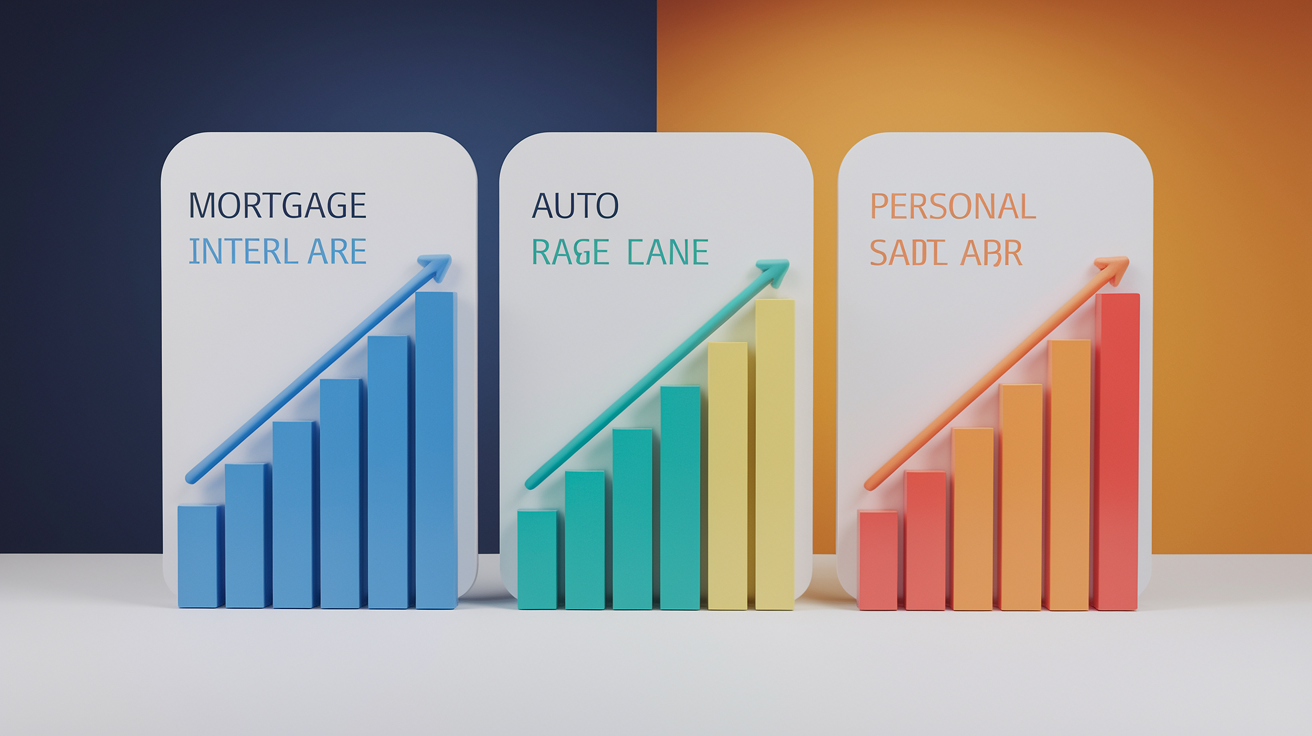
Mortgage APR calculations bundle the interest rate with discount points, origination fees, mortgage insurance premiums, and most closing costs that the lender controls. If you buy discount points to lower your rate from 7% to 6.75%, those points get rolled into the APR, which might still land at 7.1% because you paid upfront for the rate reduction. Private mortgage insurance (PMI) also goes into the APR if it’s required, so two lenders offering the same 6.8% rate can show different APRs depending on how much PMI they charge and what their closing fees look like. When you’re comparing mortgage offers, always line up the APRs on page three of the loan estimate. That’s where you see the real cost after all the lender’s fees are included.
Credit card APR works differently because most cards don’t charge origination fees or closing costs, so the APR and the interest rate are usually the same number. The APR on a credit card represents the annualized interest you’ll pay on any balance you carry month to month, calculated by dividing the annual rate by 365 and applying it to your average daily balance. If a card advertises 18.99% APR, that’s the interest rate too. The exception is when cards charge annual fees or balance transfer fees. Those costs affect your total borrowing expense but don’t get baked into the APR the way mortgage fees do, so you have to account for them separately when you compare cards.
Auto loans sit somewhere in the middle. Dealers and lenders often tack on documentation fees, processing charges, or dealer prep fees that increase the APR above the advertised interest rate. A 5.5% auto loan might come with a $400 doc fee and a $200 processing charge, pushing the APR to 5.9% or 6.0% depending on the loan term. Shorter terms make fees hit the APR harder because you’re spreading that $600 over fewer months. If you’re financing $20,000 for three years instead of five, the same $600 in fees drives a bigger percentage increase in APR because the total interest you pay is smaller to begin with.
Personal loan APRs vary widely based on lender imposed origination fees, which can run from zero up to 8% of the loan amount. A $10,000 personal loan at 16% with a 5% origination fee ($500) over three years translates to an APR around 19.5%, while the same 16% rate with no fee keeps the APR at 16%. Online lenders and credit unions tend to show smaller gaps between rate and APR because they charge lower or no origination fees. Some traditional banks and marketplace lenders load fees into the loan and advertise the lower interest rate to pull you in. Always ask for the APR and an itemized fee breakdown before you sign, especially with personal loans, because the spread between rate and APR tells you exactly how much the lender is charging beyond interest.
Final Words
You now know the difference: the interest rate sets your monthly payment, while APR adds lender fees so you see the true cost.
Use the interest rate when fees are tiny or the loan is short. Use APR to compare loans with big fees, like mortgages, personal loans, or auto loans.
Run the numbers, ask for a written loan estimate, and watch for extra charges. To pick wisely, compare APR vs interest rate which matters more and choose the option that lowers your total cost. You’re set to make a smarter choice.
FAQ
Q: Is APR more important than interest rate?
A: APR is more useful than the interest rate for comparing total loan cost because APR includes interest plus lender fees; use APR to compare loans with different fees and match the loan term.
Q: Can a 70 year old woman get a 30 year mortgage?
A: A 70-year-old woman can get a 30-year mortgage; lenders focus on income, credit, and repayment ability, not age. Expect checks on retirement income and consider a co-signer or shorter term if needed.
Q: What is the 3 7 3 rule in mortgage?
A: The 3-7-3 rule in mortgages isn’t a universal term; when it’s used lenders may mean product limits or underwriting steps. If you hear it, ask the lender what each number means and how it affects costs.
Q: Is 29.99 APR good or bad?
A: A 29.99% APR is very high for most loans and usually signals costly, high-risk credit; look for lower APR options, improve your credit, or consider secured loans or credit unions as alternatives.