

Think that “pre-approved” loan in your inbox is a real offer?
Scammers dress up urgent messages to look official, then ask for money or personal info.
This post shows real scam email examples and the key red flags, including generic greetings, upfront fees, fake domains, and the push to pay with gift cards, so you can spot fraud fast.
Follow the simple checks here and you’ll know what to ignore, what to report, and how to protect your money and identity.
Common Scam Loan Email Example and Key Warning Signs
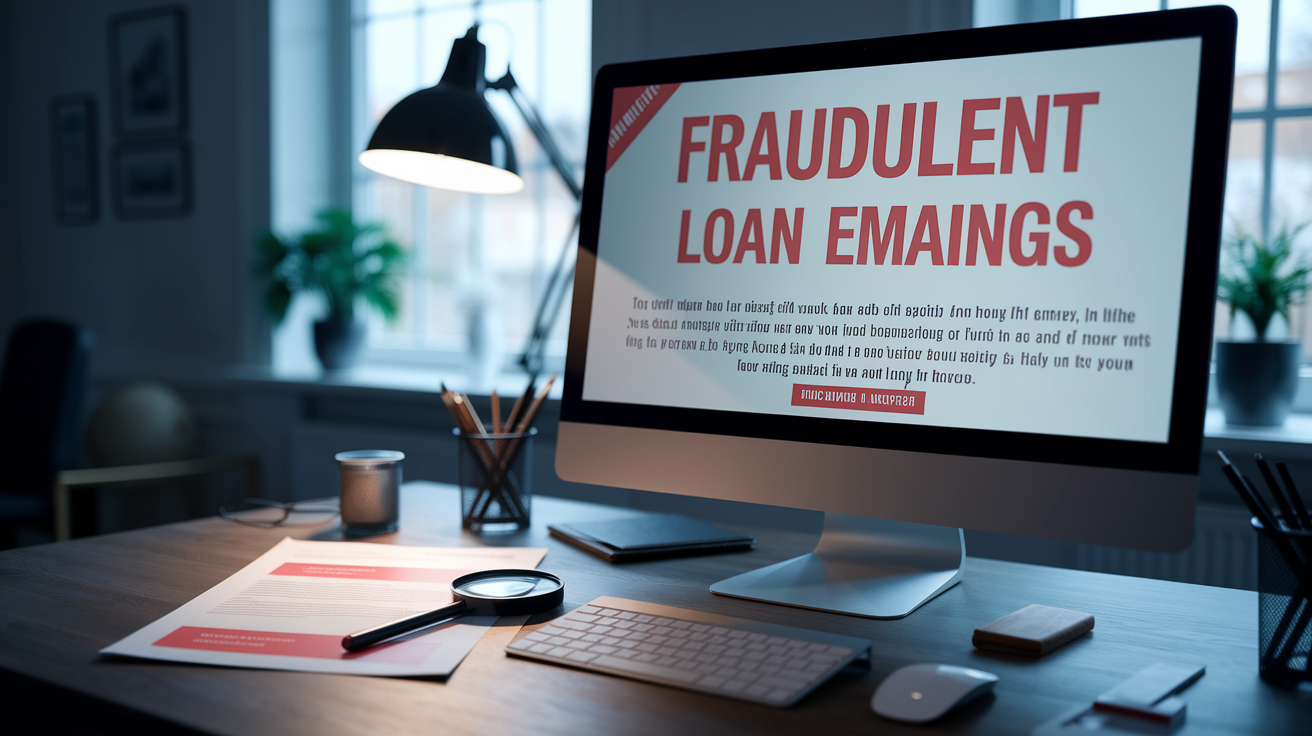
Here’s what a fraudulent loan email actually looks like.
Subject: URGENT: Your $15,000 Personal Loan Pre-Approval Expires Today
From: Financial.Services.Team@freemail.com
Message:
Dear Valued Customer,
CONGRATULATIONS! You have been pre-approved for a $15,000 personal loan at an incredible 2.9% APR with NO credit check required. This exclusive offer is available for the next 24 HOURS ONLY.
To release your funds immediately, we need you to pay a one-time processing fee of $399. This can be paid via wire transfer or gift cards (Amazon, Visa prepaid accepted).
Click here to claim your loan now: http://bit.ly/urgentloanapproval2026
If you do not respond within 24 hours, your approval will be CANCELED FOREVER and given to the next applicant.
Act fast! Financial freedom is one click away.
Best Regards,
Loan Approval Department
Trusted Finance Group
Here are seven red flags you’ll find in this message:
Generic greeting. “Dear Valued Customer” means the sender doesn’t actually have your name or any real record of you applying.
Free email address. Real lenders don’t send offers from freemail.com. They use corporate domains tied to their actual business name.
Upfront fee demand. Asking for $399 before you get a dime is textbook advance-fee fraud. Legit lenders deduct fees from your loan or roll them into repayment.
Payment via wire or gift cards. No real financial company accepts Amazon gift cards as a processing fee. These methods can’t be traced or reversed.
Unrealistic approval terms. You can’t get 2.9% APR on an unsecured personal loan with zero credit check and instant approval. That’s not how lending works.
Extreme urgency. The 24-hour deadline and “CANCELED FOREVER” language are designed to shut down your ability to think clearly.
Shortened tracking link. That bit.ly URL hides where you’re actually going. Hover before you click. If the real destination doesn’t match the lender’s official site, it’s a scam.
When you see multiple flags in one email, especially upfront payment demands mixed with artificial urgency, you’re looking at fraud. Delete it.
Types of Loan Scam Emails and How They Operate

Scammers test different approaches to see what gets people to click, reply, or send money.
Knowing the main categories helps you recognize patterns even when the wording changes.
Here are the four most common types:
Advance-fee scams. These promise a guaranteed loan but demand an upfront “processing fee,” “insurance deposit,” or “verification charge” before releasing funds. You pay. The scammer vanishes. No loan exists. Fees usually run $50 to $1,500, and they’ll ask for payment through wire transfer, prepaid cards, or crypto to avoid being traced.
Identity-theft phishing. Instead of asking for money right away, these emails request your Social Security number, bank login, driver’s license scans, or account passwords to “verify your identity” or “complete your application.” Scammers use this info to open accounts in your name, drain your existing ones, or sell your data. They often include fake application forms or links to sites designed to steal credentials.
Fake approval notifications. You get an unsolicited email saying you’ve been “pre-approved” or “selected” for a loan you never applied for. The message creates urgency with tight expiration windows and asks you to confirm by clicking a link, calling a number, or replying with personal details. Scammers use these to build lists of people who respond, then follow up with more targeted scams.
Lender impersonation. Scammers copy the branding, logos, and language of real banks or online lenders, then send emails from lookalike domains. Think “wellsfargo-loans.com” instead of “wellsfargo.com.” These messages may reference real loan products but send you to fraudulent sites designed to steal login credentials or collect fake fees. Always hover over sender addresses and links to spot domain mismatches.
Scammers often blend tactics. They’ll combine urgency from fake approvals with identity requests or advance fees. Treat any unsolicited loan offer as suspicious until you verify the sender independently through official channels you already know.
Legitimate Loan Offers vs Scam Emails: Key Differences

Understanding how real lenders communicate makes filtering out fraud much faster.
Here’s a side-by-side comparison:
| Real Lender Behavior | Scam Email Behavior |
|---|---|
| Sends from a corporate domain matching the company name (e.g., @lendername.com) | Uses free email providers (Gmail, Yahoo, Outlook) or misspelled/extra-character domains (e.g., lendername-loans.com) |
| Addresses you by your full name and references your application or account number | Uses generic greetings like “Dear Customer,” “Hello Friend,” or no personalization at all |
| Never asks for upfront fees before disbursing funds; legitimate fees are deducted from loan proceeds or disclosed in the loan agreement | Demands payment via wire transfer, gift cards, prepaid debit cards, or cryptocurrency before releasing any money |
| Directs you to a secure portal (https://) on their official website for document upload and communication | Asks you to email Social Security numbers, bank login credentials, or scanned IDs directly or via unsecured links |
| Provides a verifiable physical address, phone number, and state registration or licensing information | Lists only a P.O. box, no address, or an address that doesn’t match any real office when checked online |
| Gives you time to review terms, compare offers, and ask questions—typically weeks, not hours | Creates artificial urgency with 24- to 72-hour deadlines, “offer expires today,” or threats that your approval will be canceled |
Use this as a quick checklist. If the message shows even two or three behaviors from the scam column, especially requests for upfront payment or credentials sent via email, stop. Verify the sender independently by visiting the lender’s official site or calling a number from your own research. Don’t click any links in the suspicious email.
Real lenders operate transparently and never rush you into decisions that benefit them more than you.
What To Do If You Receive a Suspicious Loan Email
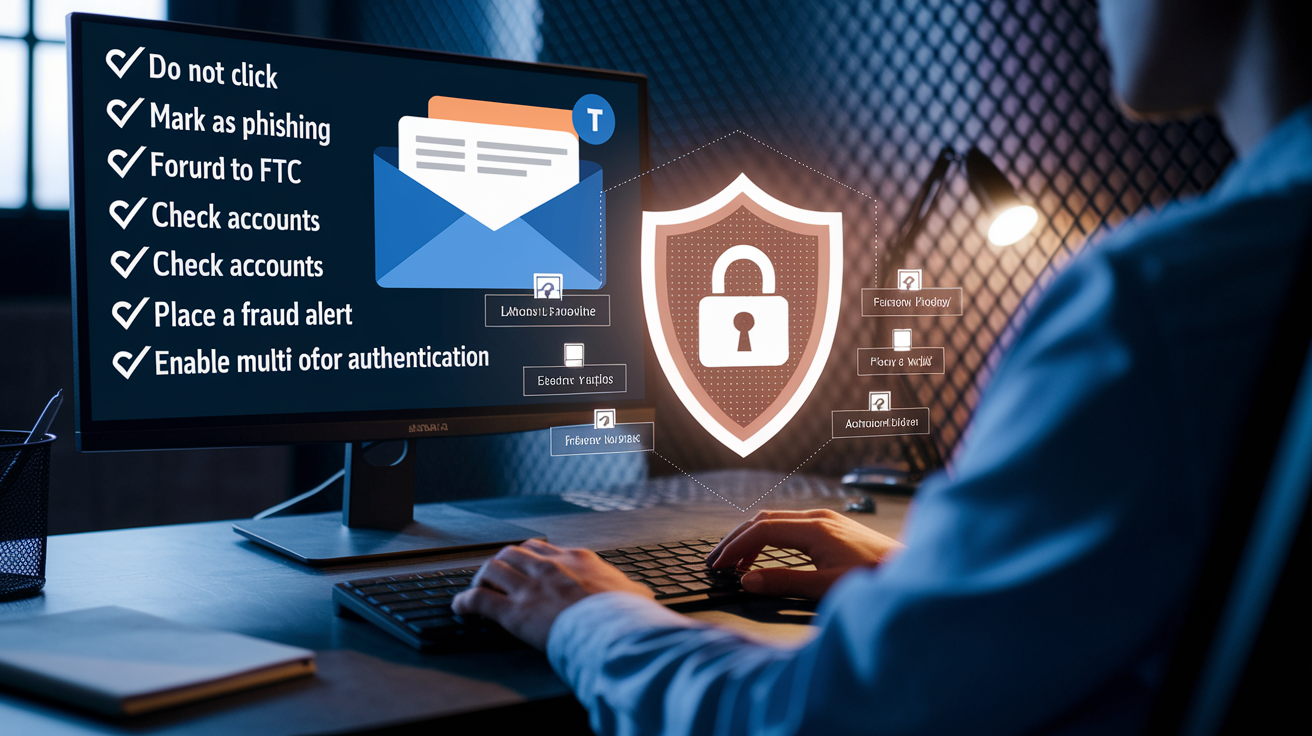
Don’t engage with the sender or click anything in the message.
Your first priority is protecting your information and helping prevent the scammer from reaching others. Follow these six steps:
Do not reply, click links, or download attachments. Any interaction confirms to the scammer that your email address is active, which leads to more targeted attacks. Clicking links may install malware or take you to credential-harvesting sites.
Mark the email as phishing and delete it. Most email providers (Gmail, Outlook, Yahoo) have a “Report phishing” or “Report spam” option. Use it. This helps the provider’s filters catch similar messages before they reach other inboxes.
Forward the scam to the FTC at spam@uce.gov. The Federal Trade Commission tracks fraud patterns and uses reports to investigate and shut down scam operations. Include the full email with headers if possible.
Check your accounts for unauthorized activity. If you clicked a link or shared any information, log in to your bank and credit card accounts immediately (using addresses you know, not links from the email) and look for unexpected charges or login attempts.
Place a fraud alert or credit freeze. Contact one of the three major credit bureaus (Equifax, TransUnion, Experian) to add a fraud alert to your credit file. This makes it harder for scammers to open new accounts in your name. A freeze blocks all new credit applications until you lift it.
Change passwords and enable multi-factor authentication. If you entered login credentials on any site linked from the scam email, change your passwords immediately and turn on two-factor authentication for your email, bank, and loan accounts.
Reporting scams doesn’t just protect you. It builds the data that law enforcement and consumer protection agencies use to warn others, block fraudulent domains, and pursue scammers. Every report adds to a larger picture that can stop these operations before more people lose money.
How Scammers Use Psychology to Manipulate Borrowers

Scammers don’t just rely on fake websites and spoofed emails. They craft messages to trigger emotional responses that override careful thinking.
The most effective loan scam emails exploit urgency and financial stress. Messages use countdown timers, “offer expires in 24 hours,” or “last chance” language to make you feel like you’ll miss out if you don’t act right now. That urgency short-circuits the part of your brain that would normally pause and verify.
Scammers also appeal to desperation. If you’re searching for fast cash to cover an emergency, a promise of “instant approval” and “no credit check” feels like relief, even when the terms are impossible.
Fake empathy is another common tactic. Scam emails often include phrases like “We understand how hard it is to get approved,” “You deserve this loan,” or “We’re here to help when banks won’t.” This language builds false trust and makes you feel seen, which lowers your defenses and increases the likelihood you’ll share personal information or pay an upfront fee.
Recognizing these emotional levers helps you stay objective. When an email makes you feel rushed, desperate, or unusually grateful, that’s the moment to slow down and ask: Did I apply for this? Does the sender check out when I verify independently? Would a real lender use this language or demand payment this way?
Scammers count on emotional reactions. Your best defense is treating unsolicited loan offers with suspicion first and verifying facts second, never the other way around.
Final Words
In the action, you saw a full fake loan email, a clear list of red flags, the main scam types, side-by-side differences from real lender behavior, and steps to take if a message looks fishy. We also showed how scammers use urgency and emotion to rush you.
Use the quick checklist: watch for upfront fee requests, free email addresses, bad grammar, pressure, strange links, and unverifiable credentials. Don’t reply. Report and lock down your info.
Save examples of loan scam emails and how to spot them and share the list with someone you trust. You’ll be more prepared and calmer next time.
FAQ
Q: How do I know if a loan email is legit?
A: A loan email is legit if it comes from a secure company domain, lists verifiable contact info, never asks for upfront fees or full sensitive data, uses clear terms, and matches the lender’s official phone number.
Q: What is an example of a loan scam?
A: An example of a loan scam is an unsolicited email promising guaranteed approval that asks you to pay an upfront “processing fee” by gift card or wire before any funds are released.
Q: How to spot a loan scam?
A: You spot a loan scam by watching for urgent pressure, requests for upfront payment or early personal data, free-email senders, bad grammar, fake links or logos, and unverifiable company details.
Q: What are common scammer phrases?
A: Common scammer phrases include “guaranteed approval,” “no credit check,” “limited-time low rate,” “verify your account,” “pay processing fee,” “wire funds now,” and “act fast.”