


Think having only one credit card won’t hurt your mortgage rate?
Credit mix, the types of accounts you have like credit cards (revolving) and loans (installment), is about 10% of your FICO score, and that small share can still push you across a rate tier.
Lenders use your mix to judge whether you can handle a long mortgage payment or an unsecured personal loan, and missing types can raise your rate by points that add up to hundreds or thousands over the life of the loan.
This post shows how mix changes approval and pricing, and what to fix first.
How Credit Mix Influences Loan Rates and Approval Decisions

Credit mix is the variety of account types you hold. Revolving credit (credit cards, lines of credit) and installment loans (mortgages, auto loans, personal loans, student loans) are the two most weighted categories. According to the FICO scoring model, credit mix makes up about 10% of your total credit score. That’s a smaller slice than payment history, which typically accounts for around 35%, or amounts owed, which usually weighs in at about 30%. Even though 10% sounds modest, hitting a rate tier cutoff by a few points can mean hundreds or thousands of dollars over the life of a loan.
Lenders feed your credit mix data into automated underwriting systems that assign you to a rate tier. If your file shows only a single credit card and no installment history, the lender has limited evidence that you can handle fixed monthly payments on a 15 to 30 year mortgage or a multi year personal loan. Conversely, a borrower who responsibly manages a mortgage, an auto loan, and a credit card demonstrates experience across payment structures. That diversified profile translates to lower perceived risk, which can unlock tighter pricing bands. Mortgage rate spreads between high and low credit score borrowers often fall between 0.25 and 1.0 percentage points, or more in stressed markets. Personal loan APR spreads are wider. Prime borrowers often receive single digit to low teens APRs, while subprime borrowers may face APRs from the high teens to 30% or above.
Credit mix plays a supporting role rather than a leading one. Payment history and credit utilization have larger direct effects on your score, so fixing late payments or bringing revolving balances below 30% (ideally 10 to 20%) will deliver bigger rate gains than adding a new account type. That said, if your mix is genuinely missing, say you have installment loans but no revolving credit, or vice versa, closing that gap can be the nudge that lifts you into the next credit score tier and qualifies you for better pricing.
The main ways credit mix influences approval and rate outcomes are:
Diversified profile equals lower perceived risk: lenders see proof you can juggle different repayment structures without missing due dates.
Single credit type equals limited data: relying on only one account category offers fewer data points on long term payment behavior.
Missing installment history limits mortgage confidence: if you’ve never had an auto or installment loan, lenders have less insight into how you’ll handle a 15 to 30 year fixed payment.
Missing revolving history signals thin credit depth: no credit card or line of credit means the lender can’t evaluate how you manage open, flexible borrowing.
Weak mix can keep you out of the best rate tiers: even if your score sits just below a cutoff, a one dimensional credit file may prevent the bump needed to cross into top pricing.
Key Credit Account Types That Shape Your Credit Mix
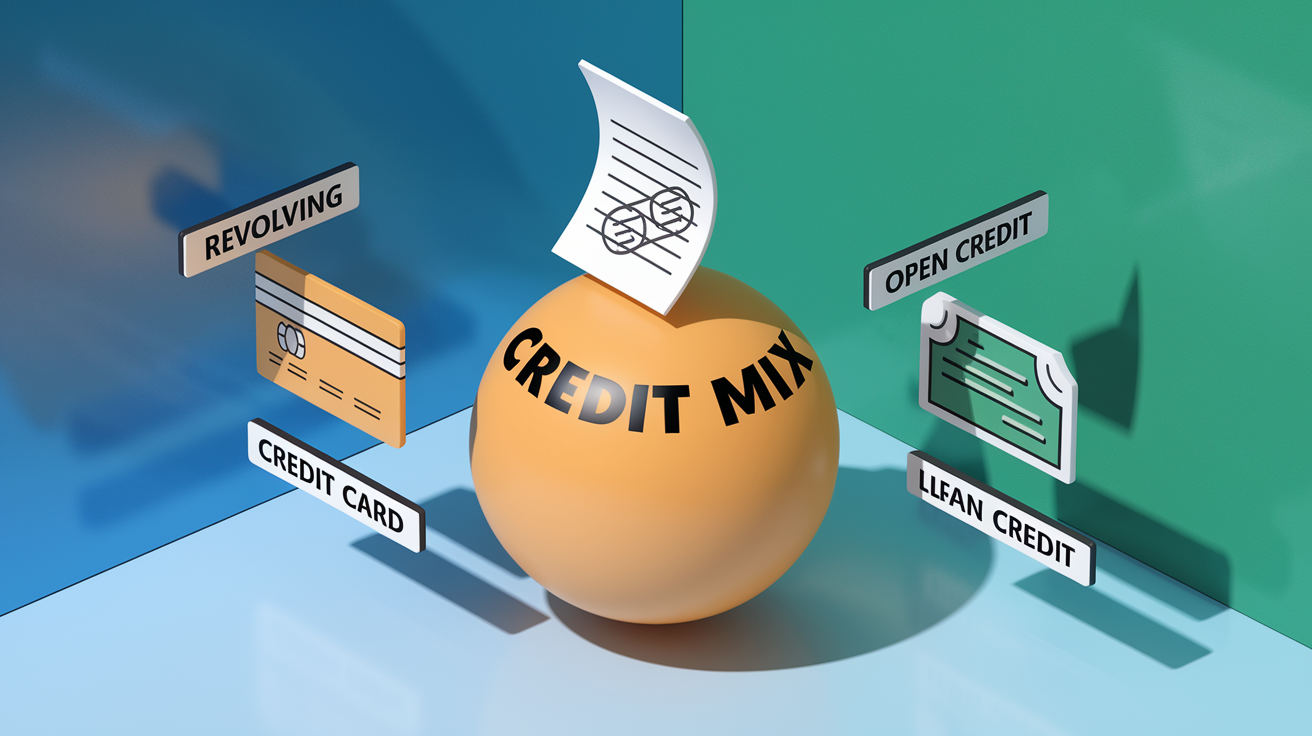
Credit accounts fall into three main categories that lenders evaluate when pricing loans. The first is revolving credit, accounts with a credit limit that you can borrow against, repay, and borrow again. The second is installment credit, loans with a fixed principal that you pay down over a set term. The third is open credit, accounts that must be paid in full each billing cycle. Each category signals different aspects of your money management, and lenders prefer to see at least two types represented in your file.
Your credit mix makes up about 10% of a FICO score. But the variety matters because it shows you can handle both ongoing monthly installment obligations and responsible use of open lines. Mortgage lenders look for evidence that you’ve managed installment payments over years, while personal loan underwriters want to see that you don’t max out revolving accounts. Having a balanced mix doesn’t guarantee approval or the lowest rate, but lacking variety can limit your score ceiling and keep you out of premium pricing brackets.
Revolving Credit
Revolving credit gives you a spending limit and lets you carry a balance from month to month, charging interest on the unpaid portion. The most common examples are credit cards, home equity lines of credit (HELOCs), personal lines of credit, business lines of credit, and retail store cards. Because the balance and payment fluctuate, revolving accounts show lenders whether you can manage flexible borrowing without running up debt. Responsible use means keeping utilization low (ideally under 30%, better still under 10 to 20%) and paying at least the minimum on time every month.
Installment Credit
Installment credit is a loan with a fixed principal amount that you repay in equal (or nearly equal) monthly payments over a set term. Examples include mortgages (which typically span 15 to 30 years and can carry fixed or adjustable rates), personal loans, auto loans, student loans, and traditional business term loans. Each payment reduces the principal, and the account closes once the balance hits zero. Installment loans demonstrate long term payment reliability, which is why lenders view a clean installment history as strong evidence that you’ll handle a mortgage or personal loan responsibly.
Open Credit
Open credit requires you to pay the full balance each billing cycle. There’s no option to carry debt forward. Common examples are utility bills (electricity, water, gas), charge cards (like certain American Express cards), subscription services, and various charge accounts from hotels, medical providers, or campus stores. Most open credit accounts don’t report to consumer credit bureaus unless you miss a payment and the account goes to collections, so they contribute less to your mix than revolving or installment accounts. When they do appear on your report, they show that you meet recurring obligations on time, but they don’t carry the same weight as a mortgage or credit card in the eyes of underwriting systems.
How Credit Mix Affects Mortgage Rate Tiers and Pricing Bands

Mortgage lenders plug your credit data into automated underwriting engines (like Fannie Mae’s Desktop Underwriter or Freddie Mac’s Loan Product Advisor) that score your application and assign a risk tier. Credit mix feeds into the FICO score those systems read, and even a few points can shift you from one pricing band to the next. If your file contains only revolving accounts, say, two credit cards, the underwriting engine sees no evidence you’ve managed a long term installment payment. That gap doesn’t automatically disqualify you. But it can prevent your score from reaching the threshold required for the tightest rate spreads. Mortgage rate differences between high and low credit score borrowers often range from 0.25 to 1.0 percentage points or more, depending on market conditions and loan type.
A weak or missing credit mix can hold your score just below a key cutoff. For example, conventional loans often reserve the best rates for borrowers above 740 or 760 FICO, and FHA loans tier pricing around 580, 620, and 680. If you sit at 738 with no installment history, adding a small auto or personal loan and making on time payments for several months might lift you to 742, unlocking a lower rate tier. Because mortgages are installment loans lasting 15 to 30 years, lenders care whether you’ve demonstrated the discipline to handle fixed monthly payments over time. A borrower who has successfully carried an auto loan or student loan alongside a credit card looks less risky than someone who has only ever swiped plastic.
Here’s how different scenarios play out. Imagine two applicants with identical income, debt ratios, and down payments. Applicant A has a mortgage, an auto loan, and two credit cards, all paid on time for five years. Applicant B has only one credit card with a two year history. Applicant A’s diversified mix shows experience across payment structures, so underwriting assigns a lower risk grade and a tighter rate. Applicant B’s thin installment history leaves the lender uncertain whether the borrower can sustain a 30 year fixed payment, so the system assigns a slightly higher rate or requires additional compensating factors like a larger down payment.
| Loan Type | Typical Score Threshold for Best Rates | Rate Sensitivity to Mix |
|---|---|---|
| Conventional Mortgage | 740–760+ | Moderate. Missing mix may cost 0.125–0.25 percentage points if score sits near cutoff |
| FHA Mortgage | 580 (minimum), 620–680 (better tiers) | Low to Moderate. FHA pricing is less granular, but weak mix can still drag score below tier break |
| Jumbo Mortgage | 700–740+ | Higher. Jumbo lenders demand strong credit profiles; thin mix increases perceived risk |
| VA Mortgage | No hard minimum, but 620+ preferred | Low. VA pricing is less score dependent, though very weak mix can still limit rate options |
How Credit Mix Influences Personal Loan APRs and Risk Based Pricing

Personal loans are unsecured installment products, so lenders face higher default risk than with a home or car securing the debt. To compensate, they use risk based pricing that assigns APRs based on your perceived creditworthiness. Credit mix plays into that evaluation because it signals whether you’ve handled both revolving and installment obligations responsibly. Prime borrowers with strong payment history, low utilization, and a diversified mix may qualify for APRs in the single digits or low teens. Subprime borrowers missing installment history or carrying only maxed out credit cards can see APRs from the high teens to 30% or above. That spread is much wider than mortgage pricing, so small improvements in credit mix can translate to meaningful APR reductions.
Lenders evaluate repayment reliability by looking at your track record across account types. If your credit report shows only revolving accounts with high balances and no installment loans, the lender worries you may struggle with a fixed monthly payment on a three to five year personal loan. Conversely, a borrower who has paid down an auto loan and manages credit cards at low utilization demonstrates capacity to juggle different structures. Even though credit mix represents about 10% of the FICO model, the presence or absence of certain account types can influence placement in a lender’s APR tier, especially when your score sits near a bracket boundary.
The steps lenders use in risk based pricing for personal loans are:
- Review of FICO score components: the underwriting system pulls your credit report and generates a FICO score, breaking down payment history, amounts owed, length of credit, new credit, and credit mix.
- Assessment of existing mix: the system flags whether you have both revolving and installment accounts, or if one category is missing entirely.
- Analysis of repayment patterns: the lender reviews on time payment percentages, any past delinquencies, and current utilization to gauge reliability.
- Placement into APR bracket: based on the combined risk signals, the system assigns you to a pricing tier (for example, Tier A at 7.99%, Tier B at 11.99%, Tier C at 18.99%).
- Final underwriting adjustments: a human underwriter may adjust the rate based on debt to income ratio, employment stability, or other compensating factors not fully captured by the score.
Optimizing Credit Mix Before Applying for a Loan

Start by pulling your credit report from all three bureaus (Equifax, Experian, TransUnion) and inventory your existing accounts. Count how many revolving accounts you hold (credit cards, lines of credit) and how many installment loans (auto, student, personal, mortgage). If you see only revolving accounts, you’re missing installment history. If you have only installment loans, you lack revolving credit. Spotting that gap is the first step. Don’t assume the lender will overlook it, because automated underwriting systems explicitly factor mix into your score.
Once you’ve identified a missing category, decide which account type makes sense to add. If you have no revolving credit, apply for a credit card (including secured cards if your score is rebuilding). If mainstream cards decline you, retail or gas cards are easier to obtain but usually carry higher interest, so pay the balance in full each month. If you have no installment history, consider a small personal loan or an auto loan, even if you could pay cash. The goal is to establish a payment record over several months, not to carry unnecessary debt, so choose the smallest loan amount and shortest term that still reports as an installment account. New accounts typically report to credit bureaus within 30 to 60 days, and measurable score improvements often take three to six months of on time payments.
Timing matters. Avoid opening new accounts in the 60 to 90 days immediately before your mortgage or personal loan application, because each new account can temporarily lower your average account age and trigger a hard inquiry. Instead, add the missing account type at least six months before you plan to apply, giving it time to season and for your score to stabilize. During that window, keep utilization on all revolving accounts below 30% (ideally 10 to 20%), make every payment on time, and avoid applying for additional credit. Fixing any errors on your credit report (incorrect balances, accounts that aren’t yours, or outdated delinquencies) can also deliver quick score gains that complement your improved mix.
Six tactical steps to strengthen credit mix before applying:
Pull and review your credit report: use AnnualCreditReport.com to get free reports from all three bureaus and identify missing account types.
Dispute inaccurate tradelines: if you find errors, file disputes online with each bureau; corrections can raise your score within 30 days.
Lower utilization on revolving accounts: pay down balances to 30% or less of each card’s limit; aim for under 10% on your highest limit card for maximum impact.
Add the missing account type thoughtfully: open one targeted account (secured card, small personal loan, retail card) rather than multiple new lines at once.
Let new accounts season: wait at least three to six months of on time payments before applying for a major loan, so the positive payment history offsets any initial inquiry ding.
Avoid new hard inquiries in the 60 to 90 days before applying: each inquiry can cost a few points; lenders see multiple recent inquiries as elevated risk.
Sample Scenarios Showing Credit Mix Impact on Loan Rates
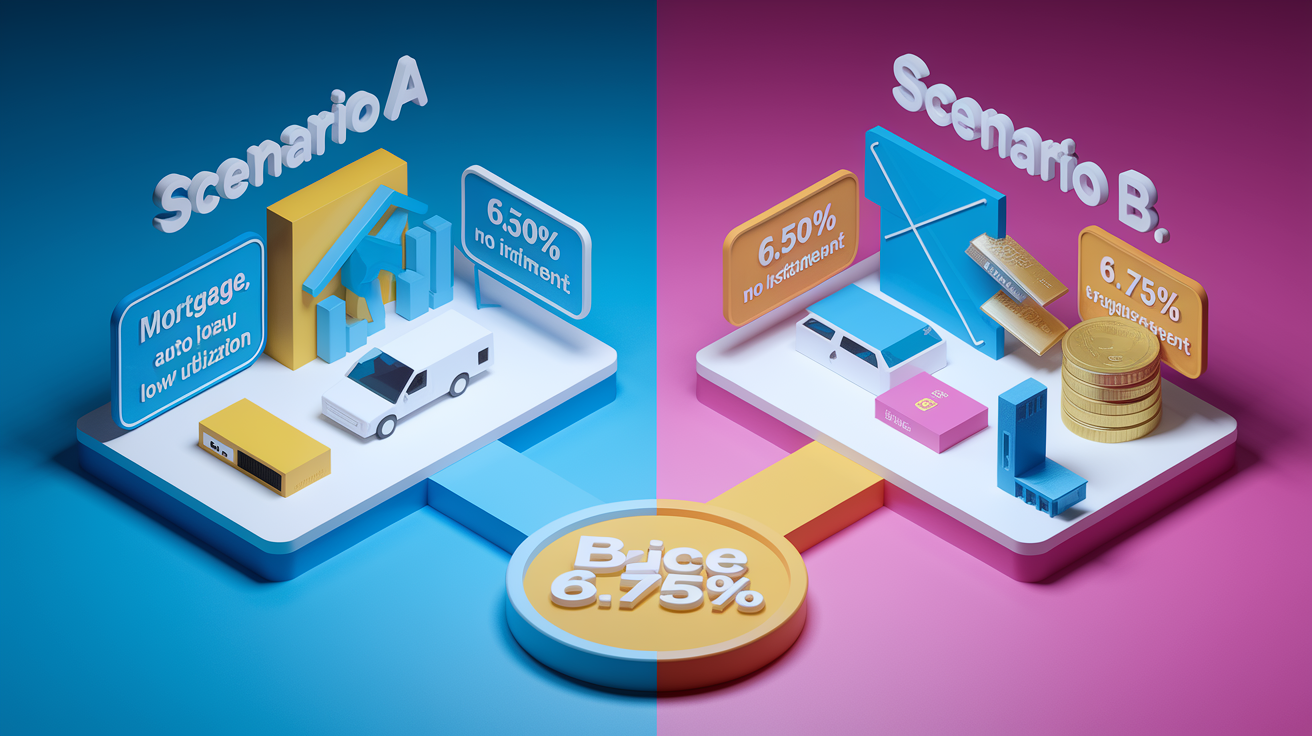
Imagine two mortgage applicants applying for a 300,000 conventional 30 year fixed loan. Applicant A has a 758 FICO, manages a mortgage, an auto loan, and two credit cards with 15% utilization, and has never missed a payment. Applicant B has a 738 FICO, holds only two credit cards (one at 40% utilization), and no installment history. Applicant A’s strong credit mix and overall profile qualify for a 6.50% rate. Applicant B’s thin installment history and higher utilization land a 6.75% rate. Over 30 years, that 0.25 percentage point difference costs Applicant B roughly 15,000 more in interest. If Applicant B had opened a small installment loan six months earlier and paid it on time, the added mix and lower utilization might have lifted the score to 742 or higher, unlocking the better tier.
For personal loans, the spread is even wider. Consider two borrowers seeking a 20,000 five year personal loan. Borrower C has a 720 FICO, a mortgage, an auto loan, and one credit card at 10% utilization. Borrower D has a 680 FICO with only one credit card at 60% utilization and no installment accounts. Lender risk based pricing assigns Borrower C an 8.99% APR and Borrower D an 18.99% APR. Over five years, Borrower C pays roughly 4,700 in interest, while Borrower D pays about 10,500, nearly 5,800 more for the same principal. Adding an installment loan and lowering utilization could move Borrower D into a mid tier APR around 12.99%, saving thousands.
| Profile | Credit Mix Status | Approx Score Impact | Possible Rate Outcome |
|---|---|---|---|
| Mortgage applicant, diverse mix (installment + revolving), low utilization | Strong. Multiple account types, seasoned tradelines | +10 to +20 points vs thin mix | Top tier: 6.50% (30 year fixed, example market) |
| Mortgage applicant, revolving only, moderate utilization | Weak. No installment history | Score held 10 to 20 points lower | Mid tier: 6.75% to 7.00% (higher interest cost over life of loan) |
| Personal loan applicant, installment + revolving, low utilization | Strong. Balanced profile | Mix supports higher score band | Prime APR: 7.99% to 9.99% (5 year term) |
| Personal loan applicant, single credit card, high utilization | Very weak. One dimensional, high risk signals | Score depressed 20 to 40 points | Subprime APR: 18.99% to 24.99% (or decline) |
Credit Mix Checklist and Timeline Before Applying

Use this eight item checklist to prepare your credit profile in the months before you apply for a mortgage or personal loan. Start at least six months out if you need to add a new account type, or 90 days out if your mix is already balanced and you’re fine tuning utilization and payment timing. Working through each step in order gives your score time to reflect the improvements and minimizes last minute surprises during underwriting.
- Review your credit report from all three bureaus (90 to 180 days before applying): pull free reports at AnnualCreditReport.com and list every revolving and installment account.
- Dispute any errors immediately (90 to 180 days out): incorrect balances, duplicate accounts, or outdated delinquencies can drag your score; file disputes online and follow up within 30 days.
- Calculate current utilization on each revolving account (90 to 180 days out): divide balance by credit limit; if any card is above 30%, pay it down before your statement closes.
- Identify missing account type (90 to 180 days out): if you have no installment loans, plan to add a small personal or auto loan; if you have no revolving credit, apply for a secured or starter credit card.
- Open one targeted new account if needed (120 to 180 days out): give the account time to report and season; avoid opening multiple new lines in a short window.
- Make all payments on time for at least three months (60 to 90 days out): even one 30 day late can cost 60 to 110 points; set autopay to prevent missed due dates.
- Stop applying for new credit 60 to 90 days before your loan application: each hard inquiry can cost a few points and signals higher risk to underwriting systems.
- Recheck your FICO score 30 days before applying: confirm you’ve crossed into the target tier (for example, 740+ for best mortgage rates); if you’re close but not there, consider paying down another card or waiting another billing cycle.
This checklist works because it sequences actions from diagnosis (pulling reports, finding errors) to correction (adding accounts, lowering utilization) to stabilization (letting new tradelines season, avoiding new inquiries). Skipping steps or rushing the timeline can backfire. Opening a new account two weeks before applying will trigger a hard inquiry and lower average account age without giving you the benefit of seasoned payment history.
Common timing mistakes include opening multiple new accounts at once (which tanks average age and racks up inquiries), closing old accounts to “simplify” your file (which reduces available credit and can spike utilization), and applying for a bunch of credit cards right before a mortgage application to boost limits (each inquiry hurts, and underwriters see the new accounts as red flags). Stick to the six month lead time if you’re adding a missing account type, and use the 90 day mark to lock in low utilization and stop all new credit activity.
Final Words
In the action, we showed what credit mix is, the three account types, and how lenders use that mix in mortgage and personal loan pricing. We covered rate tiers, sample scenarios, and a checklist to improve your mix.
Credit mix is about 10% of a FICO score, so it matters but doesn’t beat payment history or utilization. Still, missing account types can keep you out of the best rate bands.
Use the checklist, time new accounts, and fix errors to give underwriters a clearer view. Understanding how credit mix affects mortgage and personal loan rates puts you in control, a good place to be.
FAQ
Q: What percentage of your credit score is based on your credit mix?
A: The percentage of your credit score based on your credit mix is about 10% in FICO models. It helps your score, but payment history and utilization matter more for best loan rates.
Q: Do personal loans have higher interest rates than credit cards?
A: Whether personal loans have higher interest rates than credit cards depends on your credit. For prime borrowers, personal loans often have lower fixed APRs. For subprime borrowers, personal loan APRs can be as high or higher than cards.
Q: How does your credit score affect your mortgage interest rate?
A: Your credit score affects your mortgage interest rate by placing you into lender rate tiers; higher scores usually get lower rates, often a 0.25–1.0+ percentage-point spread between bands. Improve your score to access better rates.
Q: What affects personal loan interest rates?
A: Personal loan interest rates are affected by your credit score, credit mix (about 10% of FICO), payment history, credit utilization, income and DTI (debt compared to income), loan term, and overall market rates.