


Think refinancing always saves you money? Think again.
The break-even point tells you when your monthly savings cover the upfront fees.
You only need three numbers: total closing costs, your current full monthly payment, and the new full monthly payment.
In this post I’ll show the simple formula, a four-step method, and real examples (like $5,000 ÷ $200 = 25 months) so you can plug in your own numbers, compare offers, and decide if refinancing actually makes sense for your plan.
Core Formula and Step-by-Step Method to Calculate the Mortgage Refinance Break-Even Point

The break-even point is how many months it takes before your savings catch up to what you paid upfront. Stay past that point and you’re ahead. Leave before it and you’ve spent money for nothing.
You need three numbers. Total closing costs, your current monthly payment (everything: principal, interest, insurance, escrow), and what you’ll pay after refinancing. Subtract the new payment from the old one. That’s your monthly savings. Now divide closing costs by that number. You’ll see how many months it takes to get your money back. Say closing costs run $5,000 and you’re saving $200 each month. That’s 25 months, or a little over two years.
Refinance closing costs usually fall between 2% and 6% of what you still owe. If you’ve got $150,000 left on your loan, you’re looking at somewhere between $3,000 and $9,000. Let’s say your old payment is $2,300 and your new one is $2,100. You’re saving $200 a month. Using $5,000 in closing costs, the math is simple: $5,000 ÷ $200 = 25 months. That’s two years and change.
Here’s how to do it in four steps:
-
Add up every fee. Origination, appraisal, title, escrow, attorney, credit report, discount points if you’re buying down the rate.
-
Figure out your monthly savings. Take the new payment and subtract it from the old one. Use the Loan Estimate for the new number. Make sure it includes principal, interest, mortgage insurance if you’re still paying it, and escrow.
-
Run the formula: Total closing costs ÷ Monthly savings = Break-even months.
-
Turn that into years and months, then compare it to how long you’re planning to stay. If you’ll be there longer than the break-even, refinancing works. If not, don’t do it.
Breakdown of Mortgage Refinance Closing Costs That Affect the Break-Even Point
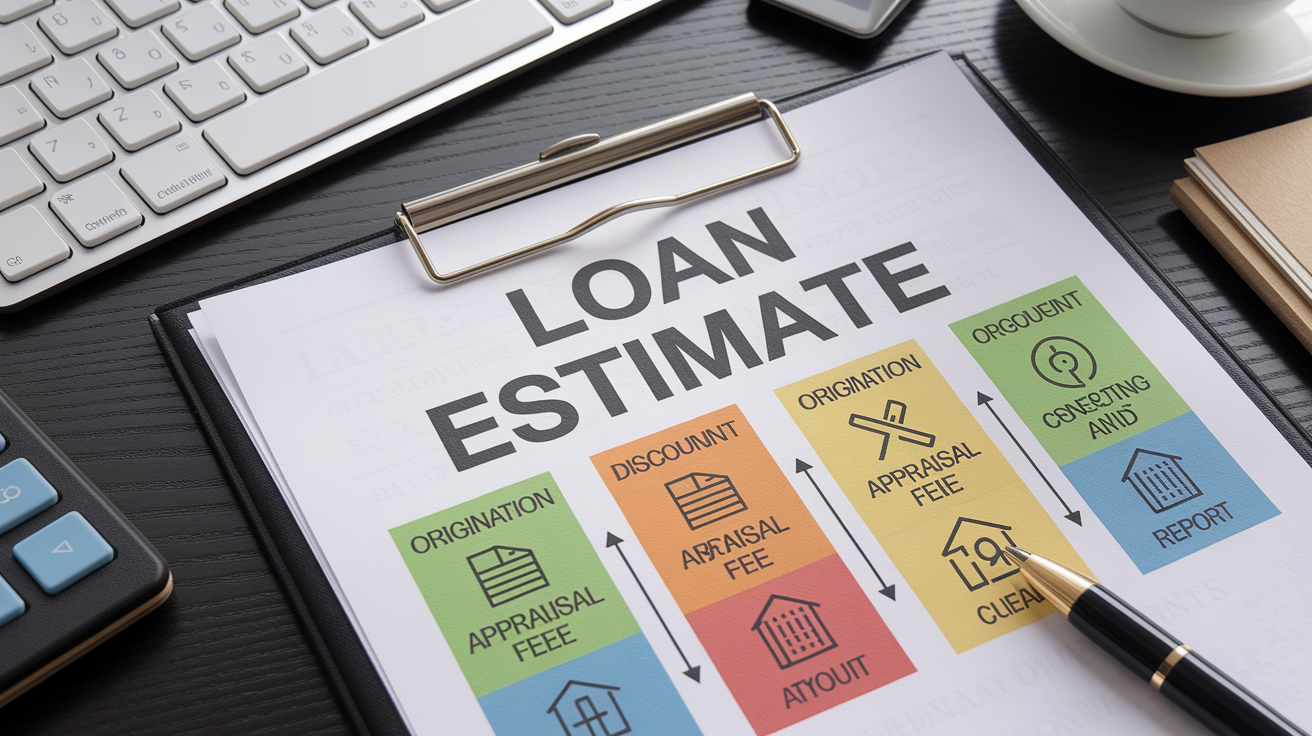
Miss a fee and your break-even looks better than it really is. That’s how people end up refinancing when they shouldn’t. Lenders don’t always hand you one clean number up front, so you’ve got to go through the Loan Estimate line by line and ask about anything that looks fuzzy.
Common refinance closing costs you’ll see:
Origination or application fee. What the lender charges to process your loan. Usually 0.5% to 1% of the amount you’re borrowing.
Discount points. Optional. You pay upfront to lower your rate. One point typically costs 1% of the loan and drops your rate by around 0.25%.
Appraisal fee. Third party checks your home’s value. Usually $300 to $600.
Title search and title insurance. Verifies ownership and protects the lender. Often $700 to $1,200 together.
Attorney or settlement fees. Legal review and closing. Common in some states, typically $500 to $1,000.
Credit report, escrow setup, recording fees. Smaller stuff that adds up. Often $100 to $400 total.
Costs depend on your loan size, where you live, and whether your lender tacks on extra charges for underwriting or processing. One lender might include discount points in the total. Another quotes without them and brings them up later. Always get a complete Loan Estimate in writing. If you’re shopping lenders, compare every line.
Comparing Old vs. New Mortgage Payments to Determine Monthly Refinance Savings

Monthly savings is just the gap between what you’re paying now and what you’ll pay after refinancing. But you’ve got to compare the whole thing. Principal and interest by itself doesn’t cut it. Add mortgage insurance if your loan-to-value is above 80%. Include the monthly escrow for property taxes and homeowners insurance.
Here’s how to line up the two payments:
| Payment Type | Old Payment | New Payment |
|---|---|---|
| Principal & Interest | $1,850 | $1,630 |
| Mortgage Insurance | $120 | $0 |
| Escrow (taxes, insurance) | $330 | $330 |
| Total Monthly Payment | $2,300 | $1,960 |
In this example, you’re saving $340 a month. That’s $2,300 minus $1,960. That’s the number you plug into the break-even formula. If escrow or insurance costs shift when you refinance, make sure both columns show what you’ll actually be paying. Your Loan Estimate shows all of this on page 1 under the monthly payment section.
Worked Real-World Examples of Mortgage Refinance Break-Even Calculations
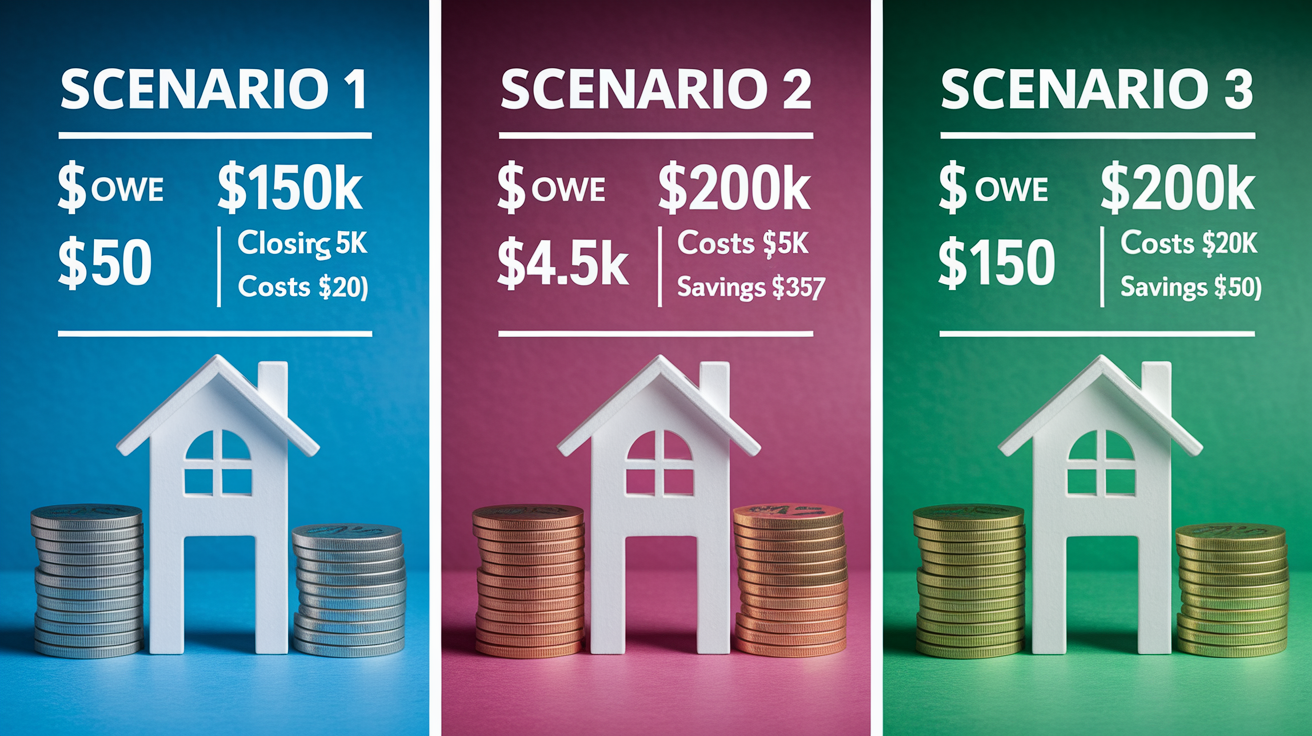
Running a few realistic scenarios helps. Small changes in costs or savings can push the break-even timeline by months or years. These examples use numbers from typical refinance situations in 2024 and 2025.
Scenario 1: You owe $150,000. Closing costs are $5,000. Your monthly payment drops from $2,300 to $2,100, saving $200 each month. Break-even: $5,000 ÷ $200 = 25 months. A little over two years.
Scenario 2: You owe $200,000. Closing costs are $4,500. Your payment drops from $1,800 to $1,443, saving $357 per month. Break-even: $4,500 ÷ $357 = 12.6 months. About one year and one month.
Scenario 3: You owe $200,000. Closing costs are $10,000. Your payment drops from $1,800 to $1,550, saving $250 each month. Break-even: $10,000 ÷ $250 = 40 months. Three years and four months.
Rate changes drive the difference. In Scenario 2, the homeowner caught a 1.5-percentage-point drop in rate, which created bigger savings and a faster payoff. In Scenario 3, the borrower paid higher closing costs, maybe including discount points, so even with solid monthly savings, the break-even stretched past three years.
When you’re deciding whether to refinance, convert break-even months into years. Twenty-five months feels abstract. “About two years” is easier to measure against your plans.
Key Factors That Influence the Mortgage Refinance Break-Even Timeline
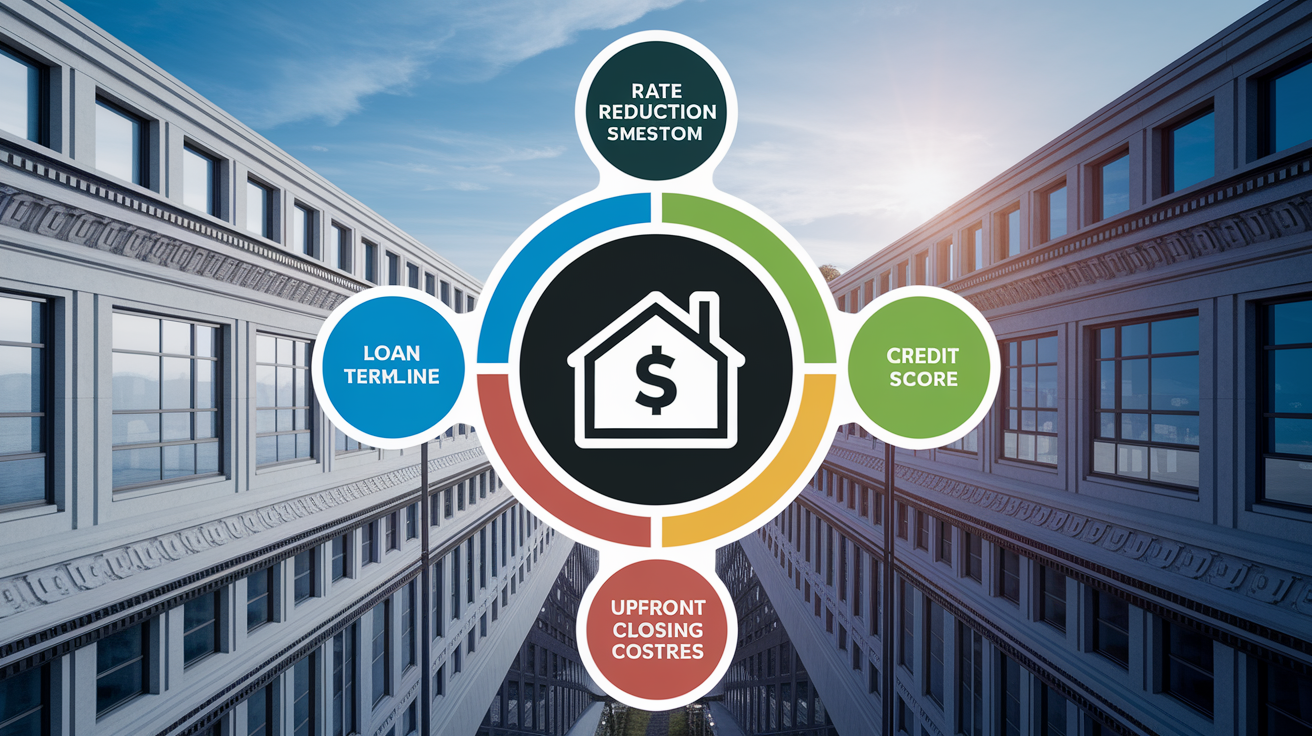
The size of your rate drop has the biggest impact on monthly savings. A one-percentage-point reduction on a $200,000 loan might save you around $120 per month. A two-point drop could save closer to $240. The bigger the rate gap between your current loan and the new one, the faster you recover your costs.
Loan term changes mess with the picture. If you’ve been paying a 30-year mortgage for eight years and refinance into a new 30-year loan, you restart the clock. Your monthly payment might drop, but you’ll pay interest for another 30 years instead of the 22 you had left. That can add tens of thousands in total interest, even if the monthly savings look good. Refinancing into a shorter term, say 20 or 15 years, can save serious interest over the life of the loan. But the monthly payment usually goes up.
Your credit score when you refinance directly affects the rate lenders offer. If your score has dropped since you took out the original loan, you might not qualify for a rate low enough to create real savings. If your score’s improved, you may be able to lock in a rate below the advertised averages, shortening your break-even period.
The most important factor? How long you’re planning to stay in the home. Move or sell before hitting the break-even month and the refinance costs more than it saves. Break-even math is useless unless you’ve got a realistic timeline for ownership.
Five factors that most commonly change your break-even outcome:
-
The size of the interest rate reduction. Bigger drop equals faster break-even.
-
Whether you extend, shorten, or keep the same loan term.
-
Credit score changes that affect your new rate.
-
How high your upfront closing costs are. More fees means longer payoff.
-
Whether you stay in the house long enough to pass the break-even point.
Spreadsheet and Calculator Methods for Computing Your Refinance Break-Even Point
If you want to run your own numbers without relying on an online calculator, a simple spreadsheet works. Set up six columns: loan balance, total closing costs, old monthly payment, new monthly payment, monthly savings, and break-even months. Add formulas to calculate savings and break-even automatically.
Here’s a basic setup:
| Column Name | Example Value |
|---|---|
| Loan Balance | $200,000 |
| Closing Costs | $8,000 |
| Old Payment | $1,800 |
| New Payment | $1,550 |
| Monthly Savings | $250 |
| Break-Even Months | 32 |
In the Monthly Savings cell, enter the formula: Old Payment minus New Payment. For this example, that’s $1,800 − $1,550 = $250. In the Break-Even Months cell, divide Closing Costs by Monthly Savings: $8,000 ÷ $250 = 32 months. If you want to see break-even in years, add another column and divide break-even months by 12. Thirty-two months becomes 2.67 years, or about two years and eight months.
Once the formulas are in place, you can change any input. New rate, different closing costs, a shorter term. The break-even recalculates instantly. That makes it easy to compare multiple refinance offers side by side or test what happens if you pay discount points upfront to lower your rate.
Visualizing Mortgage Refinance Break-Even Results for Better Decision-Making

Charts make it easier to see whether refinancing is worth it, especially when you’re comparing offers or explaining the math to someone else. The most useful visual is a cumulative line chart showing costs versus savings over time. On one line, plot the total closing costs as a flat amount. On the second line, show cumulative monthly savings growing each month. The point where the two lines cross is your break-even.
Three types of visuals that clarify the refinance decision:
A line chart showing cumulative costs (flat) and cumulative savings (rising) over 60 months. The intersection marks the break-even month. Everything after that is net savings.
A bar chart comparing your old monthly payment and new monthly payment side by side. This makes the dollar difference obvious at a glance.
A timeline marking key milestones. Month 0 (refinance closes), break-even month, and the end of your expected ownership period. If the break-even point lands before you plan to move, the refinance works. If it lands after, it doesn’t.
You don’t need fancy software. A simple spreadsheet chart or even a hand-drawn timeline helps you think through whether the numbers make sense. If you’re applying to multiple lenders, create a separate chart for each offer so you can compare break-even timelines before you commit.
When Refinancing Makes Financial Sense Based on Break-Even Results

Refinancing pays off when you stay in the home long enough to recover every dollar you spent upfront. If your break-even is 25 months and you’re planning to move in 18 months, you’ll lose money. If you’re staying five years, you’ll save for three years after breaking even. That can add up to thousands.
Watch out for term extensions. If you refinance a 30-year loan after 10 years into a new 30-year loan, you restart the amortization schedule. Your monthly payment might drop, but you’ll pay interest for 30 more years instead of the 20 you had left. That can cost you more in total interest than you save on monthly payments. If you can afford it, refinancing into a shorter term, 20 or 15 years, will save serious interest over the life of the loan and build equity faster. Even if the monthly payment goes up slightly.
Market timing matters. Between mid-January and November 2025, the average 30-year fixed rate dropped from over 7% to around 6.2%, according to Freddie Mac. When rates fall that much, refinancing becomes attractive for millions of homeowners. But if rates are rising or holding steady, the savings shrink and break-even periods stretch out.
Four key decision rules:
-
Compare your break-even months to your expected time in the home. If you’ll be there longer, refinance. If not, skip it.
-
Check whether extending your loan term offsets the monthly savings with higher lifetime interest. Run the math on total interest paid, not just the monthly payment.
-
If you can afford a higher payment, refinance to a shorter term to cut years off your mortgage and save tens of thousands in interest.
-
Get Loan Estimates from at least three lenders and compare closing costs, rates, and break-even periods side by side before you commit.
Final Words
Once you know how to calculate refinance break-even point for mortgages, the math becomes your reality check.
Add up closing costs, subtract your new payment from the old one, and divide. The result tells you exactly how many months you need to stay in the home for the refinance to pay off.
If you’re planning to move before that break-even date, the numbers don’t work. If you’re staying longer, you start banking real savings every month after.
Run the calculation with your actual Loan Estimate, not guesses. That’s how you decide with confidence instead of hope.
FAQ
Q: What is the refinance break-even point?
A: The refinance break-even point is when your accumulated savings from lower monthly payments equal the total costs you paid to refinance, showing the month you start gaining net savings.
Q: How do I calculate the refinance break-even point?
A: You calculate the break-even by dividing total refinance costs by monthly savings: Break-Even Months = Closing Costs ÷ (Old Payment − New Payment). Convert months to years by dividing by 12.
Q: What inputs do I need to calculate the break-even?
A: You need total refinance costs (closing fees, points), your old monthly payment, and your new monthly payment. Use loan estimate numbers for accuracy and include escrow and mortgage insurance.
Q: How do closing costs affect the break-even point and what fees should I count?
A: Closing costs raise the break-even because higher upfront fees take longer to recoup. Count origination, discount points, appraisal, title insurance, attorney fees, and escrow/taxes/insurance setup.
Q: How do I calculate monthly savings from refinancing?
A: Monthly savings from refinancing equal your old monthly payment minus your new monthly payment. Include principal and interest, mortgage insurance, and escrow for a true comparison.
Q: Can you give a simple refinance break-even example?
A: A simple example: $5,000 total closing costs divided by $200 monthly savings gives 25 months to break even. That means about two years and one month before net savings begin.
Q: When does refinancing make financial sense based on break-even results?
A: Refinancing makes sense if you expect to stay in the home longer than the break-even months and if total lifetime interest or monthly payment fits your goals.
Q: What key factors change the break-even timeline?
A: Key factors changing break-even include the size of the rate drop, changing the loan term, your credit score, paying points, and whether you plan to sell or move before break-even.
Q: Can I compute break-even in a spreadsheet or with a calculator?
A: You can compute break-even with a spreadsheet using these formulas: MonthlySavings = OldPayment − NewPayment. BreakEvenMonths = ClosingCosts ÷ MonthlySavings. BreakEvenYears = BreakEvenMonths ÷ 12.
Q: How should I visualize break-even results to decide?
A: Visualize break-even with a cumulative savings vs cumulative costs line chart, a bar chart comparing old vs new payments, or a timeline marking the break-even month for quick clarity.