

Think dealer financing is always faster and better?
Think again. That extra convenience can cost you hundreds or even thousands.
Dealers can approve you the same day and sometimes offer 0% deals, but they often mark up rates and push add-ons.
Banks and credit unions usually give lower APR (the all-in interest rate) and clearer terms, but they take longer and expect preapproval.
This post shows the trade-offs—cost, speed, and negotiation power—and gives a simple checklist to compare offers apples-to-apples.
Comparing Dealer Financing and Bank Loans

Dealer financing and bank loans work differently when it comes to approval, cost, and control. Dealers arrange financing on the spot, pulling from networks of captive lenders (the automaker’s finance arm) or third-party lenders, sometimes within minutes. Banks require you to apply ahead of time, get preapproved, then bring that approval to the dealer. That extra step buys you negotiation leverage. You arrive knowing your APR, your max loan amount, and what monthly payment you can afford.
Interest rates tell a big part of the story. Credit unions averaged around 5.75% APR on 60-month new-car loans in mid-2025. Large banks came in closer to 7.49%. Dealers can mark up the lender’s base rate (the “buy rate”) and keep the difference as profit. If the lender approves you at 6% but the dealer quotes 7%, that extra point goes into the dealer’s pocket. Banks and credit unions typically quote you the actual rate without markup. The number you see is the number you get.
Speed matters when you need a car today. Dealers can approve, finalize paperwork, and hand you keys in a single afternoon. Banks may take a day or two to underwrite. Some still require a branch visit or mailed documents. But that convenience at the dealer can cost you. Same-day financing often comes with less transparency, more pressure to accept add-ons, and a higher APR if you didn’t shop around first.
Here’s the quick comparison:
Interest rates: Banks and credit unions usually beat dealer rates, except when the dealer offers a manufacturer promotion like 0% APR.
Approval speed: Dealers approve within minutes to hours. Banks may take one to three business days.
Negotiation leverage: Bringing a preapproved bank loan gives you the power to walk away or demand the dealer match or beat your rate.
Term flexibility: Dealers often push 72 or 84-month terms to lower monthly payments. Banks and credit unions may cap terms at 60 or 72 months to protect you from paying thousands more in interest.
Credit score impact: Both perform hard credit pulls once you apply, but prequalification from banks typically uses a soft inquiry that doesn’t ding your score.
Understanding Interest Rates and Loan Terms

Dealers earn money on financing in two ways: marking up the interest rate above the lender’s buy rate and selling add-on products. When a lender approves you at 5.5% and the dealer quotes 6.5%, that one-point markup generates dealer profit (sometimes called “dealer reserve”) which you pay over the life of the loan. Banks and credit unions don’t mark up their own rates because you’re borrowing directly from them. That difference can mean hundreds or even thousands of dollars over a 60 or 72-month loan.
Promotional offers like 0% APR sound perfect. They can be, if you qualify. Manufacturer captive lenders (Ford Credit, Toyota Financial Services, GM Financial) reserve those deals for buyers with credit scores above 750 and for specific new models. You’ll rarely see 0% on used cars. Even then, accepting 0% financing sometimes means giving up a cash rebate, so you need to calculate which option saves more money. For example, a $2,000 rebate plus a 4% loan may cost less in total than 0% financing with no rebate.
| Interest Factor | Dealer Financing | Bank Loan |
|---|---|---|
| Rate markup | Common; dealer adds 0.5–2+ percentage points above buy rate | No markup; you get the bank’s actual approved rate |
| Promotional rates | Possible (0% APR or cash back) for new cars and excellent credit | Rare; banks compete on standard rates, not promos |
| Loan term flexibility | Often offers up to 84 or 96 months to lower payments | Typically caps at 60 or 72 months to limit interest |
| Total loan cost | Higher if rate is marked up or term is extended | Usually lower due to transparent rates and shorter terms |
Pros and Cons of Dealer Financing and Bank Loans

Every financing path has trade-offs. Understanding what you gain and what you give up helps you match the option to your priorities, whether that’s speed, cost, or flexibility.
Dealer financing:
Convenience. Apply, approve, and drive home the same day without visiting a second institution.
One-stop shopping. Negotiate price and financing in one place, sometimes simplifying paperwork.
Subprime access. Dealers work with lenders that approve buyers with fair or poor credit, expanding your options if banks say no.
Manufacturer incentives. Captive lenders can offer 0% APR or rebates that beat outside financing for qualifying buyers.
Possible rate matching. If you bring a preapproved bank offer, the dealer may match or beat it to close the sale.
But watch out for these downsides:
Rate markups. Dealers commonly add profit to your APR, costing you more over the loan term.
Pressure tactics. Finance managers may push long loan terms or bundled add-ons to increase their profit.
Less transparency. You may not know the lender’s base rate unless you ask for it in writing.
Add-on sales. Extended warranties, GAP insurance, and protection packages inflate the financed amount and monthly payment.
Yo-yo financing risk. Rare but serious. Dealer lets you drive off before final approval, then demands new terms or the car back if the loan falls through.
Bank and credit-union loans:
Lower rates. No dealer markup means you pay the institution’s actual APR, often 1 to 2 points below dealer quotes.
Preapproval leverage. Knowing your max amount and APR before shopping lets you negotiate like a cash buyer.
Transparent terms. Contracts clearly state APR, term, fees, and total interest without hidden markups.
Relationship discounts. Existing customers may qualify for autopay rate reductions or loyalty APR cuts of 0.25 to 0.50 percentage points.
Flexibility to refinance. Credit unions especially make it easy to refinance a dealer loan later to lower your rate.
The drawbacks:
Extra steps. You apply separately, wait for approval, and coordinate funding with the dealer at purchase.
Longer processing. Some banks take days to finalize, and branch visits may be required.
Stricter eligibility. Banks often require higher credit scores and stable income. Subprime borrowers may be declined.
Lender network limits. Some banks only fund purchases from dealers in their approved network, restricting your vehicle choices.
No promotional incentives. Banks rarely offer 0% APR or cash-back deals tied to specific car models.
Approval Speed and Credit Requirements

Dealers prioritize speed because closing the sale today matters more than perfect paperwork. Finance managers submit your application to multiple lenders at once (sometimes five or ten) and present the best approval within minutes. That network approach works especially well if your credit is imperfect. Subprime lenders in the dealer’s pool may approve loans that a single bank would reject. The trade-off is less control. You won’t choose which lenders see your information, and the dealer picks the offer that balances your approval with their profit.
Banks move more deliberately. You fill out an application online or in a branch. The underwriter reviews your income and credit. Approval typically arrives within one to three business days. Some banks still require you to bring proof of income, a driver’s license, and vehicle details to a branch, adding time. Credit unions often combine bank-like thoroughness with more flexibility. They’ll consider your full financial picture, including your history with the credit union. They may approve borrowers that big banks turn down. But even credit unions need time to verify information, so same-day approval is rare unless you’ve prequalified earlier.
Credit score thresholds differ sharply. Banks targeting prime borrowers often require scores of 680 or higher to qualify for their best rates. Anything below 620 may result in a decline or a referral to a subprime specialist. Dealers, by contrast, work with lenders across the credit spectrum. If your score is 580, a dealer-arranged loan through a subprime lender may be your only realistic path. But expect APRs in the double digits, sometimes above 15%. Credit unions sit in the middle. Many will work with scores in the 600 to 650 range and offer rates lower than subprime dealer lenders, especially if you’ve been a member for a while or can explain past credit problems.
Hidden Costs to Watch For
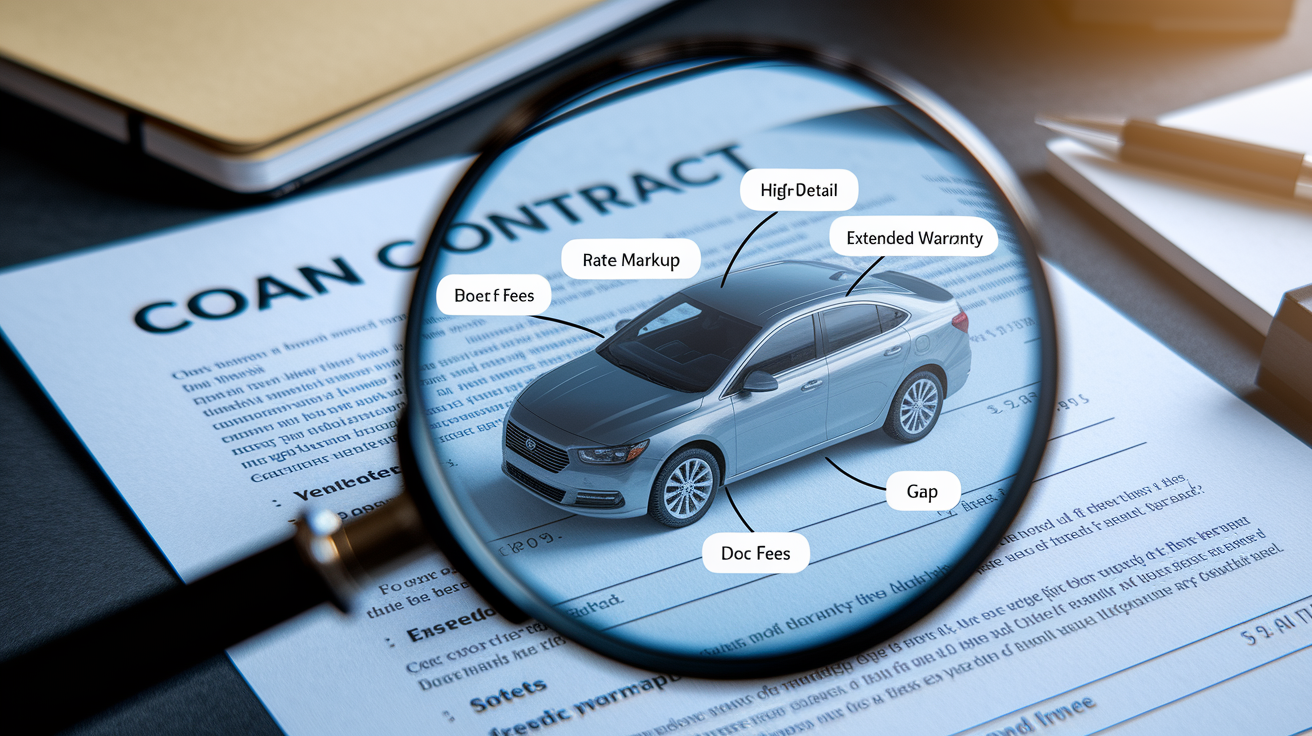
Beyond the APR you see on the contract, dealer financing can layer on charges that quietly inflate your total cost. The most common is the rate markup itself, the spread between what the lender actually approved and what the dealer quotes you. If you don’t ask for the buy rate in writing, you won’t know how much profit the dealer added.
Add-ons show up in the finance office, usually presented as “protection” or “peace of mind.” They sound reasonable in the moment, but each one increases the amount you finance and the interest you’ll pay.
Extended warranty or vehicle service contract can add $1,500 to $3,000 to the loan. Often duplicates coverage you already have or covers repairs you’ll never need.
GAP insurance pays the difference if the car is totaled and you owe more than it’s worth. Useful in some cases but frequently overpriced at dealers. Your own insurer may sell it for half the cost.
Paint protection, fabric protection, or rust-proofing: dealer-installed coatings that add $500 to $1,200 but deliver minimal value.
Theft-recovery systems or VIN etching are inexpensive to install, expensive to finance. These are often pure profit for the dealer.
Prepayment penalties: some subprime loans charge a fee if you pay off the loan early. Less common but worth checking.
Origination or documentation fees: banks may charge $50 to $200. Dealers may bundle “doc fees” of $300 to $800 that vary by state and dealership.
Negotiate or decline these extras before you sign. Ask the finance manager to remove each add-on from the contract and show you the monthly payment without it. If the manager insists an item is “required,” it’s usually not. Only state registration, title, and taxes are mandatory. Compare the financed amount on the contract to the vehicle price you agreed on. Any large difference signals add-ons you didn’t approve. For bank or credit-union loans, review the Truth in Lending disclosure for origination fees and confirm there are no prepayment penalties in the terms.
How to Decide: A Step-by-Step Framework
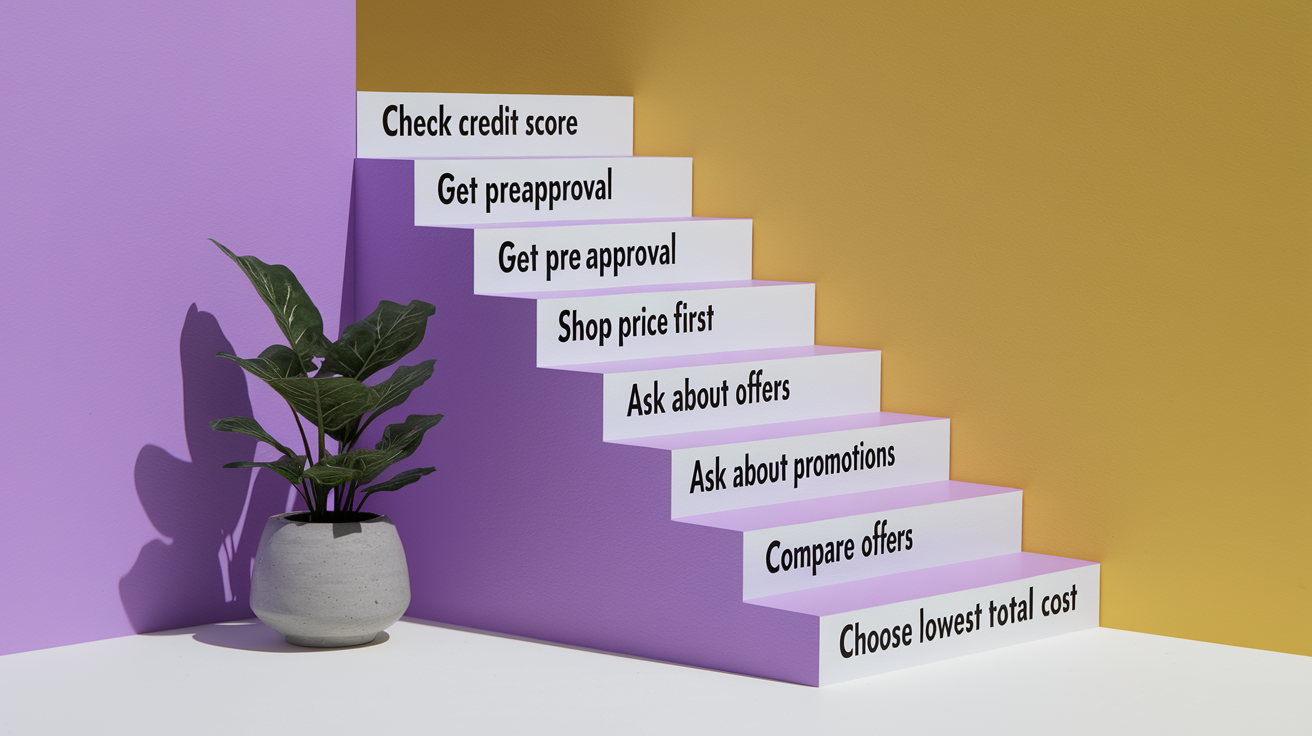
Choosing between dealer financing and a bank loan comes down to comparing total cost, approval odds, and how much time you have. Follow these steps to make the decision clear and measurable.
1. Check your credit score and set your budget. Pull your score from a free source or your bank. Know what monthly payment you can afford and calculate the maximum loan amount that fits. Factor in insurance, registration, gas, and maintenance so you don’t overextend.
2. Get prequalified or preapproved from at least two outside lenders. Apply to one bank and one credit union. Online applications usually take ten minutes. Use soft-inquiry prequalification first to avoid multiple hard pulls. Write down each lender’s APR, term, max loan amount, and any fees or discounts (autopay, relationship). This is your baseline.
3. Shop for the car and negotiate the purchase price first. Don’t mention financing until you’ve agreed on the vehicle price and any trade-in value. Mixing negotiations lets the dealer offset a lower car price with a worse loan rate or longer term. Lock the price, then move to financing.
4. Ask the dealer about manufacturer or captive-lender promotions. If you’re buying new and have strong credit, ask if the automaker’s finance arm offers 0% APR or a cash rebate. Get the exact terms in writing (how many months, what models, what credit score is required). If a rebate is available, calculate whether rebate plus your preapproved bank rate beats 0% financing with no rebate.
5. Request the dealer’s best financing offer and compare it to your preapproval. Give the finance manager your preapproved rate and ask them to beat it. If they quote a lower APR, ask for the lender name and confirmation in writing. Also ask for the lender’s buy rate so you can see any markup. Use an auto loan calculator to compare monthly payment and total interest paid (monthly payment × months − principal) for each option.
6. Choose the option with the lowest total cost and acceptable terms. If the dealer rate is genuinely lower and the contract is clean (no unwanted add-ons, reasonable term length), take it. If your bank or credit union beats the dealer, or if the dealer’s offer includes high fees or a long term that doubles your interest, stick with your preapproval. Confirm the final APR, term, and financed amount match what you agreed to before you sign.
This framework strips out guesswork. You’ll know within minutes which path saves money and which one costs more. And you’ll have written proof to back up your decision.
Tips for Securing Better Financing
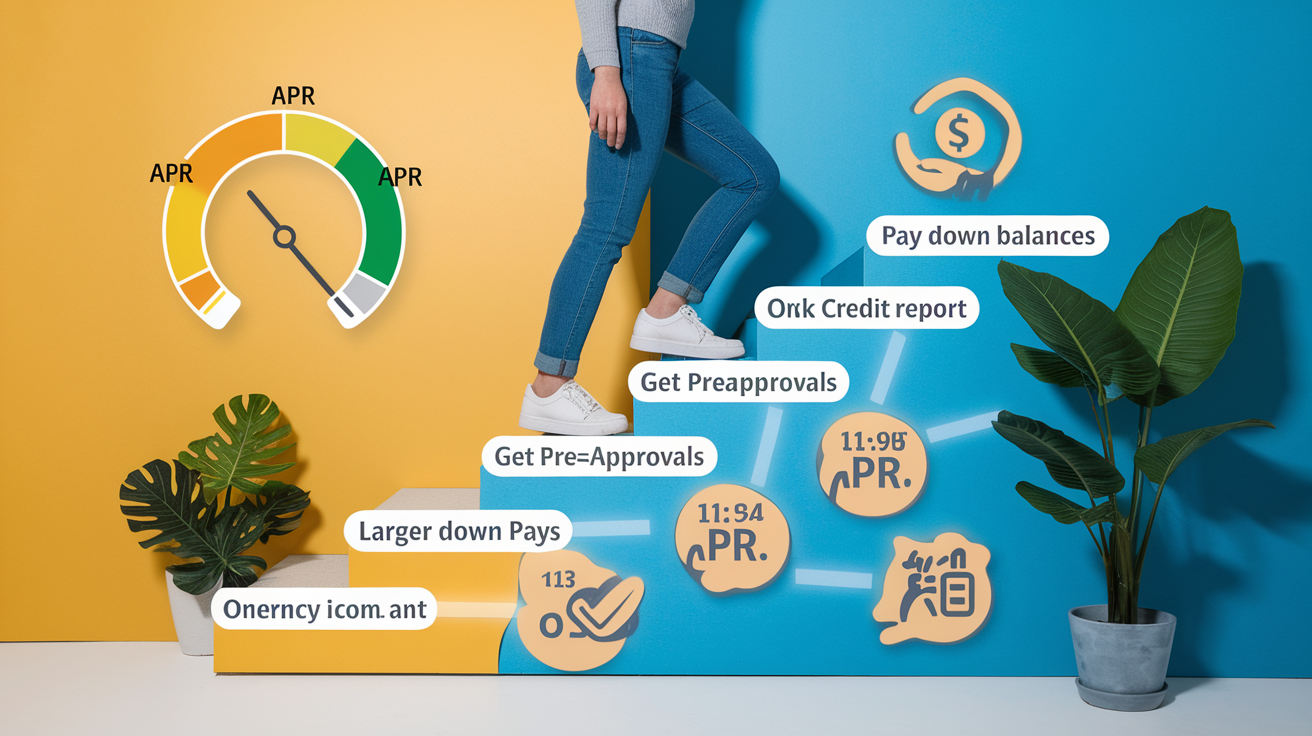
No matter which path you choose, a few tactics consistently lower your APR, reduce fees, and keep your monthly payment manageable.
Start by improving your credit before you apply. Pay down credit card balances to below 30% of your limit. Make all payments on time for at least three months. Check your credit report for errors and dispute anything incorrect. Even a 20-point score increase can drop your APR by half a percentage point, saving hundreds over the loan term. If your score is below 650, consider waiting a few months to clean up your credit rather than accepting a high-rate subprime loan today.
Always get written preapprovals from multiple lenders and bring them to the dealership. This forces the dealer to compete on price and proves you’re a serious buyer. When dealers know you can walk away with financing already lined up, they’re more likely to waive fees, match your rate, or throw in extras to close the deal.
Compare APRs and total cost, not just monthly payment. A lower payment often means a longer loan term, which can double your total interest paid. Run the numbers. A $30,000 loan at 6% for 60 months costs about $3,200 in interest. Stretch it to 84 months and you’ll pay closer to $4,600.
Make a larger down payment. Putting down 20% on a new car or 10% on a used car shrinks the loan principal, reduces interest charges, and keeps you from going underwater (owing more than the car is worth) if you need to sell or trade in early.
Ask for autopay or relationship discounts. Many banks and credit unions cut 0.25% off your APR if you set up automatic payments from an account at their institution. Existing customers may get an additional loyalty discount.
Avoid loan terms longer than 60 months unless absolutely necessary. Longer terms lower payments but cost more overall and leave you stuck with an aging car that still has years of payments remaining.
Refinance if you took dealer financing and rates drop or your credit improves. Credit unions especially make refinancing easy. If you can shave even 1 percentage point off your APR, refinancing can save $500 to $1,000 or more on a typical loan.
Final Words
In the action, we compared dealer financing and bank loans across rates, approval speed, negotiation power, terms, and hidden fees. We explained rate markups, listed pros and cons, covered approval timelines and add-ons, gave a six-step decision framework, and shared practical tips.
Quick takeaway: get preapproval, compare APR and total cost, separate price and financing, and refuse unnecessary add-ons.
Use the framework to decide how to choose between dealer financing and bank loan for a car so you walk away with a smarter, lower-cost deal.
FAQ
Q: Is it better to finance a car with a bank or dealership?
A: Financing a car with a bank or dealership depends on whether you want convenience or lower cost: dealers are faster and offer promos; banks usually give lower, more predictable APRs. Compare pre-approval and total loan cost.
Q: What should you never reveal to the dealer when negotiating?
A: You should never reveal your maximum budget, monthly payment limit, trade-in payoff, or how urgent you are to buy, because those details weaken your bargaining power.
Q: What is the $3000 rule for cars?
A: The $3,000 rule for cars usually means if a repair will cost more than $3,000, it’s often cheaper to replace the car. Meanings vary, so check the source or context.
Q: How much does a car salesman make off a $20,000 car?
A: A car salesman typically makes about $200 to $1,200 commission on a $20,000 sale, depending on dealer markup and pay plan. Exact pay varies widely by dealership and deal.