


Want to gamble with your monthly payment for a lower starting rate?
Or lock in a steady number and sleep better at night?
Before you pick, know the real cost and the worst-case payment.
This post shows a clear, step-by-step way to compare fixed vs variable loan offers.
You’ll learn which numbers to collect, how to turn rates into monthly payments, and how to stress-test variable loans so you can see the dollar risk.
Follow this method and you’ll pick the loan that fits your timeline, budget, and comfort with change.
Core Methodology for Comparing Fixed vs Variable Rate Loan Offers

Before you compare offers, collect the right numbers from each lender. For fixed rate loans note the interest rate, APR, loan amount, term, and any upfront or ongoing fees. For variable rate loans you also need the index source, the lender margin added to that index, how often the rate adjusts, the cap per adjustment, and the lifetime cap. Example: a 10/10 ARM that uses index plus a 2.75 percent margin, allows a 2 percent increase at each adjustment, and has a 6.95 percent lifetime cap. If a lender won’t share those details, treat the offer as incomplete.
You’ll want to convert rates into monthly payments so you can compare apples to apples. Use the standard amortization method: monthly payment equals principal times monthly rate divided by one minus the quantity one plus monthly rate raised to the minus total months. Hard numbers help. A $300,000 loan at a fixed 6.00 percent over 30 years has a monthly payment around $1,798.65. The same loan starting at a 4.00 percent ARM begins near $1,432.25. If that ARM later resets to 6.00 percent, your payment jumps to about $1,798.65 — roughly $366.40 more per month, or $4,396.80 a year. Seeing that dollar difference tells you whether early savings are worth the future risk.
Seven step comparison workflow
- Get every term for each offer: interest rate, APR, fees, index, margin, caps, floors, and adjustment schedule.
- Normalize offers by APR when fees differ so you’re comparing total cost, not just headline rates.
- Calculate the initial monthly payment for each offer using the amortization method.
- Stress test variable offers at current rate plus 1 percent, plus 2 percent, and plus 3 percent to see likely payment jumps.
- Compare total interest paid over the ownership period you expect, not necessarily the full loan term. Plan to sell or refinance in five years? Use five years of interest.
- Inspect adjustment rules closely: when rates reset, what index moves them, how big each allowed increase is, and what the absolute ceiling is.
- Decide if you have the income and savings buffer to handle the worst reasonable payment scenario.
Do this and you’ll have concrete monthly payments and total cost ranges to weigh against your budget and timeline.
Key Differences Between Fixed and Variable Rate Loan Structures
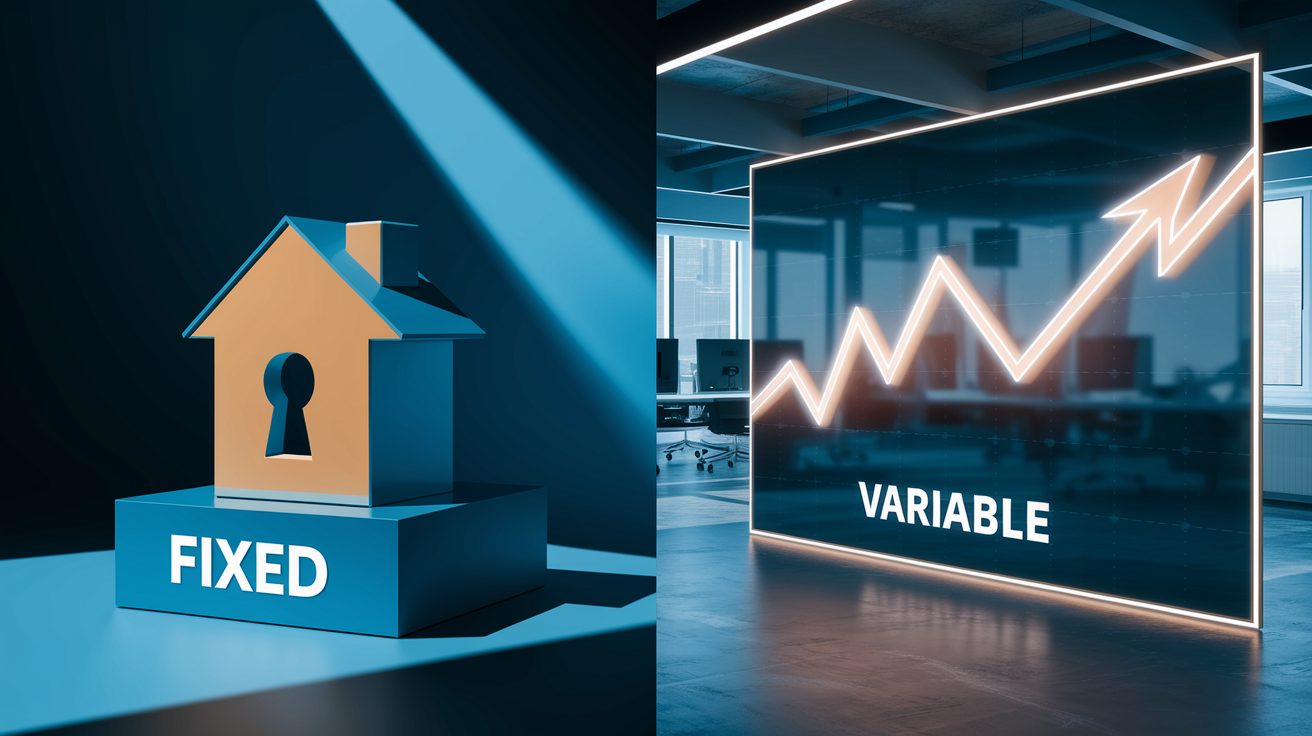
Fixed rate loans lock the interest rate at closing and don’t change. Your monthly payment stays the same for the life of the loan whether it’s a 15 year mortgage, a 7 year auto loan, or a 5 year personal loan. Examples include conventional mortgages, auto loans, motorcycle loans, boat and RV loans, personal loans, and lump sum home equity loans. If market rates climb, you keep your lower rate. If rates fall, you’d need to refinance to take advantage.
Variable rate loans tie your rate to a benchmark index such as the prime rate, SOFR, or a Treasury yield. The lender adds a margin to that index to set your rate. So if the index is 3.20 percent and the margin is 2.75 percent, your rate is 5.95 percent. When the index moves, your rate and payment can move too. Common variable products include ARMs, HELOCs, and most credit cards. The borrower carries the interest rate risk.
Six structural points to note
- Rate stability: fixed doesn’t change; variable resets on a schedule tied to an index.
- Payment stability: fixed payments stay the same; variable payments can rise or fall.
- Caps: variable loans have per adjustment caps and lifetime caps; fixed loans don’t need caps because the rate is constant.
- Floors: variable loans sometimes have minimum rates below which they won’t fall; fixed loans don’t move.
- Index behavior: variable loans depend on economic forces that move the index; fixed loans are insulated after closing.
- Risk profile: fixed shifts rate risk to the lender; variable shifts it to you.
If you want long term budget certainty, fixed is usually safer. If you plan to hold the loan only briefly or can tolerate swings and expect to refinance or pay off early, variable can offer lower initial cost.
Practical Cost Comparison Tools for Fixed vs Variable Loan Offers

Use a spreadsheet or online calculator and plug in loan amount, term, and the quoted rate for both options. Gather fees too. Example: a $20,000 loan over 10 years at a fixed 6.50 percent yields a monthly payment near $227.29, total payments around $27,275, and total interest about $7,275. The same loan starting at a variable 4.50 percent begins near $207.18 monthly, total payments about $24,862, and total interest about $4,862. If the variable rate never rises, you’d save about $20 a month and $2,413 in interest. But if the variable rate climbs to 7.00 percent, the monthly payment would be about $232.36 and total interest roughly $7,883 — more than the fixed option.
Gather these five inputs before you compare
- Loan principal you plan to borrow.
- Term in months or years.
- Interest rate, or for variable loans the starting rate plus margin and index.
- Any fees rolled into the loan or paid upfront.
- Your expected repayment horizon, which may be shorter than the loan term.
| Comparison Metric | Fixed Loan | Variable Loan |
|---|---|---|
| Starting payment | $227.29 per month at 6.50 percent | $207.18 per month at 4.50 percent |
| APR impact | APR close to nominal rate when no fees | APR close to nominal rate when no fees; check index plus margin |
| Stress scenario result (rate to 7 percent) | $227.29 per month unchanged | $232.36 per month, about $5.18 more than fixed starting payment |
Run the calculations side by side for every offer. Look at both starting payments and the payment range under realistic and worst case scenarios so you pick the loan that matches your timeline and tolerance for swings.
Assessing Your Risk Tolerance and Financial Stability

Start with income stability. If your paycheck is steady and layoffs are unlikely, you can tolerate more variability. If your income swings or you work seasonally or on commission, predictable fixed payments protect your budget.
Next, check your savings buffer. Advisors often recommend three to six months of essential expenses in reserve. If a variable loan could raise your payment by $366.40 per month, can you handle that without relying on credit cards or skipping bills? If not, fixed removes that risk. A practical rule: if you can’t absorb a more than 10 percent payment increase without altering essentials or dipping into savings, favor fixed.
Also ask how uncertainty affects you mentally. Some people sleep better with one fixed number. Others tolerate cycles and plan to refinance or pay off early. Neither choice is morally right. Pick the loan that matches your cash flow, emergency cushion, and honest comfort with month to month changes.
Scenario Planning and Stress Testing

Stress testing turns rate risk into dollars. Start with the quoted variable rate and calculate the monthly payment. Then bump the rate by 1 percent, recalculate, and note the dollar change. Repeat at plus 2 percent and plus 3 percent. For the $300,000 ARM that starts at 4 percent, a 1 percent jump to 5 percent raises the payment by about $160 per month; 2 percent to 6 percent adds about $366.40; 3 percent to 7 percent adds roughly $544.
Compare those stressed payments to your budget and savings. If any scenario breaks your budget, the variable loan is too risky. Model total interest over the actual time you expect to hold the loan, not the full term. Plan to sell or refinance in seven years? Run the seven year totals for fixed and each variable scenario to see the real cost.
Include these stress test factors
- Starting variable rate and initial monthly payment.
- Payments at current rate plus 1 percent, plus 2 percent, and plus 3 percent.
- Per adjustment cap and lifetime cap.
- Index source and recent trend.
- Total interest over your expected holding period for each scenario.
If the worst realistic variable outcome still saves you money over your timeline and you can handle the highest payment, variable may be a smart bet. If a small increase already causes real hardship, pick fixed and avoid the stress.
When to Choose Fixed and When Variable

Choose fixed when you need budget certainty and plan to hold the loan long term. Long term homeowners who expect to stay in the house 10 years or more benefit from locking a rate. People consolidating debts or financing a major renovation often prefer the predictability a fixed payment gives.
Choose variable if you have a short horizon, flexibility, or a clear plan to refinance or sell before adjustments hit. If you expect rates to fall or stay flat, or if the variable rate is significantly lower initially and you can tolerate swings, variable can save money.
Quick checklist to help you decide
- Repayment horizon: longer than 10 years tends to favor fixed; shorter than 5 years makes variable worth considering.
- Income predictability: unstable income leans toward fixed.
- Starting rate gap: if variable is more than 1.5 percentage points below fixed and you can tolerate swings, it may save you money.
- Disclosure: if the lender won’t give margin, caps, and index source, reject the variable offer.
- Refinance likelihood: if you’ll likely refinance or pay early, variable can work; if not, pick fixed.
- Stress test: if worst case variable exceeds your budget, choose fixed.
- Fee impact: if origination or other fees change APR materially, run total interest over your expected timeline to decide.
Final Words
You’ve gathered rates, APRs, fees, index and margin, used the PMT formula, and stress-tested +1–3% moves to see payment shock.
That step-by-step method—normalize APRs, calculate initial payments, compare total interest, and review caps and adjustment rules—gives a clear, apples-to-apples view of outcomes.
Follow these steps and you’ll know how to compare fixed rate vs variable rate loan offers and pick the one that fits your budget and peace of mind. You’ve got this.
FAQ
Q: What key terms should I collect from each fixed and variable loan offer?
A: The key terms you should collect are the interest rate, APR, fees, index, margin, adjustment frequency, periodic and lifetime caps, loan term, payment schedule, and any prepayment penalties.
Q: How do fixed-rate and variable-rate loans differ?
A: Fixed-rate loans keep the same monthly payment; variable-rate loans tie to an index (Treasury, prime, or SOFR) so rates and payments can change over time based on that index plus a margin.
Q: How do I calculate monthly payments to compare offers?
A: To calculate monthly payments use PMT = P*r/(1-(1+r)^-n). For example: $300,000 at 6% → $1,798.65; ARM at 4% → $1,432.25; if rate rises to 6% → +$366.40.
Q: What is an ARM and how do its adjustment rules work?
A: An ARM (adjustable-rate mortgage) sets rates by an index plus a margin; example 10/10 ARM adjusts every 10 years, margin +2.75%, 2% per adjustment cap, lifetime cap 6.95%.
Q: How should I stress-test variable-rate offers?
A: To stress-test variable offers model +1%, +2%, +3% rate shocks, apply periodic caps (2%) and lifetime caps (6.95%), then recalc payments and total interest for your expected ownership period.
Q: What practical tools should I use to compare fixed vs variable loans?
A: Practical tools include online payment calculators, APR normalization, side-by-side comparison tables, lifetime interest calculators, and spreadsheets that include fees so APR shows the true cost.
Q: When is a fixed rate usually the better choice?
A: A fixed rate is usually better if you plan to keep the loan long term, need payment stability, can’t absorb more than a 10% payment rise, or are consolidating debt or funding major repairs.
Q: When might a variable rate be sensible?
A: A variable rate can be sensible for short-term ownership, planned refinancing, or HELOC use (up to $150,000 with no prepayment penalty) if you accept possible payment swings.
Q: How big was the example ARM payment shock in dollars and yearly impact?
A: The example ARM payment jump was +$366.40 per month, which equals +$4,396.80 per year, a clear payment shock to factor into your budget and stress tests.
Q: What seven-step workflow should I follow to compare fixed and variable offers?
A: The seven-step workflow is: 1) gather terms, 2) normalize APR, 3) calculate initial payments, 4) stress-test +1–3%, 5) compare total interest, 6) check adjustment rules, 7) assess your risk tolerance.