


Think a tiny monthly payment means a great deal?
Low monthly bills can hide a huge final bill called a balloon payment – a lump sum due after a short term.
Before you get dazzled, compare the real cost: monthly payment, total interest plus fees (APR), exact balloon size, and how likely you are to refinance or sell when it’s due.
This post walks you through those checks, shows the main red flags, and gives simple steps to compare offers apples to apples so you’re not surprised at the end.
Core Comparison Framework for Balloon Payment Loans and Their Risks

A balloon payment is a huge lump sum that comes due at the end of your loan term, usually after 3 to 10 years. Your regular monthly payments barely touch what you owe, and then suddenly you’re staring at a final bill that might be twice your monthly payment or tens of thousands of dollars all at once. The loan term is way shorter than the schedule they use to figure out your monthly bill, which keeps those payments low while you’re making them but leaves most of the principal sitting there unpaid when time runs out. You’ll need to write a massive check, refinance into a new loan, or sell the property to close things out. The final payment structure creates real uncertainty about how much you’ll actually pay in total and whether you can even get refinancing when the balloon arrives, so every balloon loan comparison has to start with the risks instead of getting distracted by today’s low monthly payment.
When you compare balloon loans to fully amortizing loans, look at the monthly payment first, then calculate what you’ll actually pay over time. A balloon loan’s advertised interest rate looks straightforward, but the APR matters more because it wraps in fees and the compounding effect of deferring principal. Calculate the total interest you’ll pay during the term, add the balloon payment itself, then layer in the refinancing closing costs you’ll face if you can’t pay the balloon in cash. On a $300,000 home, refinancing closing costs run between $6,000 and $15,000, and that’s new money out of your pocket before you even address the remaining principal. A fully amortizing loan spreads all of that principal repayment across every monthly payment. Your monthly bill is higher, sure, but there’s no surprise final check and no need to refinance into an uncertain rate environment.
The biggest risk gap between balloon and amortizing loans is that balloon loans bet on your future ability to refinance or sell. If interest rates climb between the day you close and the day your balloon is due, refinancing may cost hundreds more per month or lock you into terms you can’t afford. If home values drop or lenders tighten credit standards, you may not qualify for a new loan at all. When you can’t pay the balloon, the lender can foreclose because your home is collateral, and that foreclosure shows up on your credit report for seven years. It blocks future mortgages and increases the cost of every other loan you take. Amortizing loans don’t carry that cliff edge risk because you’re paying down principal every month and you never face a sudden all or nothing repayment demand.
Key comparison metrics to use when evaluating any balloon loan:
-
Monthly payment. Balloon loans offer lower monthly bills because you defer principal repayment, but those savings disappear when the balloon comes due.
-
Total interest cost. Add up every dollar of interest you’ll pay during the term, then estimate the interest cost of the refinance loan you’ll need to cover the balloon.
-
Balloon size. Get the exact dollar figure for your final payment in writing. It should appear on your loan estimate or amortization schedule.
-
Refinancing likelihood. Model scenarios where rates rise by one, two, or three percentage points and check whether you could still qualify and afford the new monthly payment.
-
Equity buildup rate. Some balloon loans are interest only, meaning you own exactly zero additional equity at maturity. Others pay down a small slice of principal, so you need to know which type you’re comparing.
-
Payment shock risk. Calculate the difference between your highest expected monthly payment under refinancing and your current monthly budget to see if you can absorb the jump without defaulting.
Deep Dive Into Balloon Loan Structures and Payment Behavior

Balloon loans come in several structural variations, and the structure controls how much principal you pay down before the balloon arrives. A common commercial structure is the 5/25 balloon, where your monthly payments are calculated as if the loan will stretch across 25 years, but the entire remaining balance is due at the end of year five. Another variation is the 7/23 balloon, which uses a 23 year amortization schedule but calls the loan due after seven years. In both cases, you make regular payments that look manageable but you’re only scratching the surface of the principal, so when the term ends you still owe most of what you borrowed. Interest only balloon loans take this even further by requiring you to pay only the interest charge each month with zero principal reduction, which means your loan balance on day one equals your balloon payment amount on the final day. Partially amortizing balloons fall in between, letting you chip away at some principal during the term but still leaving a large lump sum at maturity.
The structure you choose determines how much equity you build and how large your balloon will be. On a $200,000 loan with a 5/25 structure at 6 percent interest, your monthly payment might run around $1,288, but at the end of year five you’ll owe roughly $183,000 as a balloon payment because you’ve only paid down about $17,000 of principal. An interest only balloon on the same loan would carry a monthly payment of only $1,000 but leave you with the full $200,000 balloon at maturity. When you’re comparing offers, ask the lender for a full amortization schedule that shows every payment and the remaining balance after each one, then highlight the row for the final payment date to see your exact balloon figure.
| Loan Structure | Payment Pattern | Balloon Size Indicator | Key Comparison Factor |
|---|---|---|---|
| 5/25 Balloon | Monthly principal plus interest calculated on 25 year schedule | Roughly 90 to 95% of original loan amount remains | Low equity buildup. Large refinancing need at year 5 |
| 7/23 Balloon | Monthly principal plus interest calculated on 23 year schedule | Roughly 85 to 90% of original loan amount remains | Slightly more equity than 5/25. Still requires major refinance or sale |
| Interest Only Balloon | Monthly interest only. No principal reduction | 100% of original loan amount due at maturity | Lowest monthly payment. Highest balloon payment and zero equity growth |
| Partially Amortizing Balloon | Monthly principal plus interest on custom schedule shorter than full amortization | Varies. Typically 50 to 80% of original amount remains | Moderate equity buildup. Balloon size depends on agreed amortization period |
Comprehensive Risk and Exit Feasibility Analysis for Balloon Loans
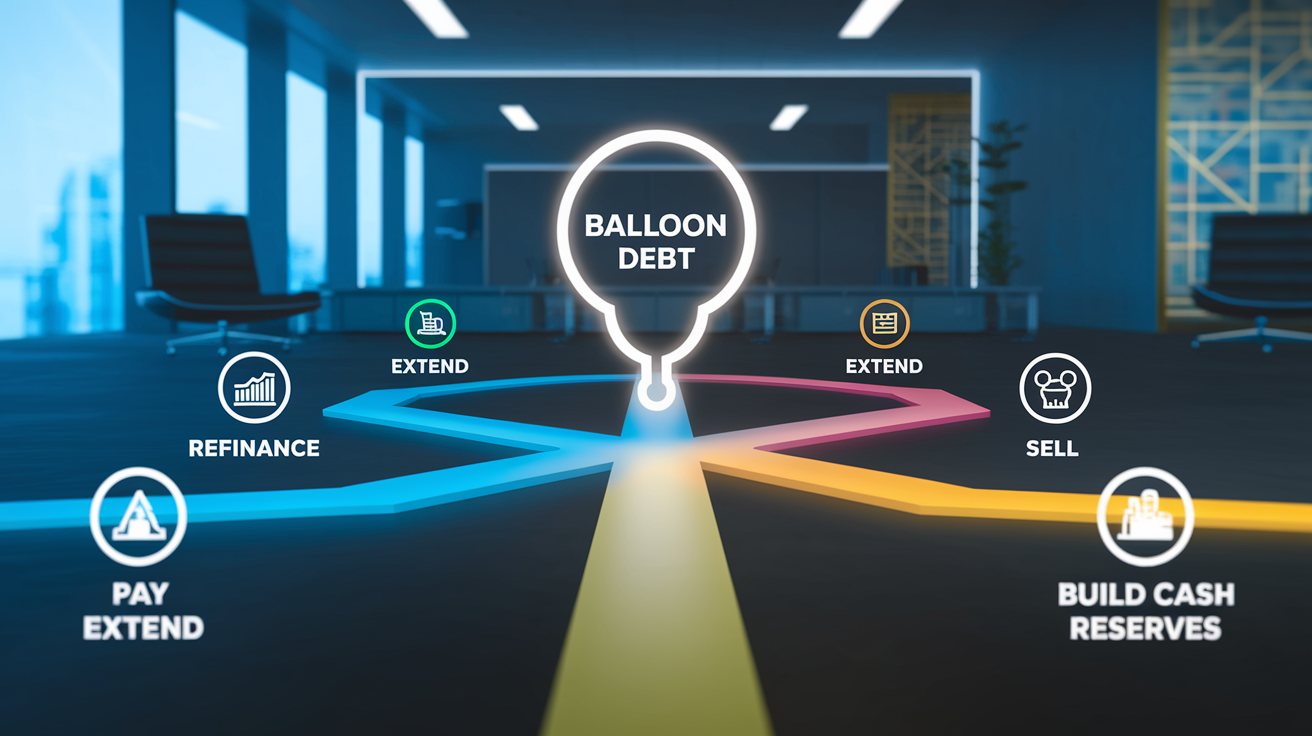
The core risk in any balloon loan is that you’re making a bet on two future unknowns: the interest rate environment when your balloon comes due and your ability to qualify for new financing or sell the property at that moment. If you take out a balloon loan at 5 percent today and rates climb to 7 percent by the time you need to refinance, your monthly payment on the new loan can jump by hundreds of dollars even though you’re borrowing the same principal amount. Payment shock modeling means running the numbers with rate increases of one, two, and three percentage points above your current rate, then checking whether your household income can absorb the new monthly bill without cutting into savings or missing other obligations. Interest rate exposure is highest on interest only balloons because you’re refinancing the full original balance, but even partially amortizing structures leave you exposed to large increases if rates move against you.
Lenders making balloon loans typically require excellent credit, stable income, and sufficient cash reserves because they know the final payment creates default risk. Most conventional refinancing requires a credit score at or above 620, and if your score has dropped since you took out the balloon, you may not qualify for a new loan when the time comes. Lenders also look at your debt to income ratio (DTI, the total of all your monthly debt payments divided by your gross monthly income) and often cap DTI at 43 percent for refinancing, meaning if your balloon payment forces you into a higher monthly obligation, you might hit that ceiling and get turned down. Equity thresholds matter just as much because lenders want to see that you own at least 10 to 20 percent of the home’s current value before they’ll refinance. If property values fall between origination and maturity, you can end up underwater or close to it, and lenders will either refuse the refinance or demand a large down payment to bring your loan to value ratio back into acceptable range. Collateral value volatility is the invisible threat here because real estate markets move in cycles, and a downturn that drops your home’s appraised value by 10 percent can wipe out the equity you need to refinance.
Market conditions at balloon maturity can shut down refinancing or sale options even when your personal finances look solid. During economic stress, lenders tighten standards by raising minimum credit scores, lowering maximum DTI thresholds, and requiring larger down payments, which means borrowers who qualified easily a few years earlier suddenly can’t get approved. Structural limitations add another layer of difficulty. For example, SBA 504 loans are designed to fund business growth and job creation, but the SBA doesn’t always allow refinances of existing balloon debt, so if you were counting on that program as your exit you may find the door closed. Prepayment penalties are common on balloon loans, though most lenders waive penalties during the final 90 days of the term, creating a narrow window where you can pay down or retire the loan early without triggering extra fees. If you’re planning to pay the balloon in cash, confirm the penalty waiver period and check your cash flow forecast to make sure the funds will be available when you need them.
The realistic exit paths for a balloon loan are refinance, negotiate an extension, pay early, sell the asset, or prepare cash reserves, and each one depends on conditions you can’t fully control. Refinancing works when rates are stable or falling, your credit is strong, and property values have held or climbed, but it fails when any of those conditions reverse. Negotiating an extension with your lender is possible if you have a good payment history and the lender has appetite for restructuring, but many lenders prefer to close out balloon loans on schedule rather than carry the risk forward, especially if they suspect you’re in financial trouble. Paying early avoids refinancing risk and stops interest from accruing, but it requires a large cash reserve and may trigger prepayment penalties if you’re outside the waiver window. Selling the property is a clean exit if you can find a buyer and the sale price covers your remaining loan balance plus transaction costs, but a market downturn can leave you with insufficient proceeds to pay off the balloon, forcing you to bring cash to closing or walk away. Preparing cash reserves means saving enough during the loan’s term to write a check for the balloon payment, which is realistic only if the balloon is relatively small or your income is high and stable.
All feasible exit paths:
Refinance into a new loan with manageable monthly payments and a longer term.
Negotiate a term extension or conversion to a fully amortizing structure with your current lender.
Pay the balloon early using savings, especially during the prepayment penalty waiver period.
Sell the property before or at maturity and use the proceeds to retire the balloon.
Build cash reserves throughout the loan’s term so you can pay the balloon without refinancing or selling.
Negotiation Points That Shape Balloon Loan Outcomes

Before you sign a balloon loan, negotiate the terms that give you the most flexibility to handle or avoid the final payment. Start with the prepayment penalty clause because most balloon loans include penalties that charge you a percentage of the remaining balance if you pay off the loan early, but lenders often waive those penalties during the last 90 days of the term. Ask the lender to put the waiver period in writing and confirm the exact penalty amount for earlier prepayment so you can model scenarios where paying down part of the principal in year four or five makes sense. If the lender won’t waive penalties entirely, negotiate a lower penalty percentage or a longer waiver window, like the final six months instead of three. Another negotiation target is the maturity extension option. Some lenders will agree in advance to extend the balloon due date by one or two years if you make all payments on time and meet certain conditions like maintaining a minimum credit score or equity level. Get those extension terms spelled out in the original loan agreement so you’re not starting from scratch when the balloon approaches.
You can also negotiate the amortization schedule itself to reduce the size of the balloon. If a lender offers you a 5/25 structure, ask whether they’ll switch to a 5/20 or 5/15 amortization, which increases your monthly payment slightly but pays down more principal before the balloon arrives, shrinking the final lump sum. Some lenders will allow you to make extra principal payments during the term without penalty as long as you stay current on your regular monthly bill, so confirm whether that’s permitted and whether there’s a cap on how much extra you can pay each year. Negotiate the refinancing commitment too. While most lenders won’t guarantee refinancing years in advance, some will include language that gives you priority or streamlined underwriting if you’re in good standing when the balloon comes due, which reduces the risk that you’ll be turned down for reasons outside your control.
Key terms to negotiate before closing:
Prepayment penalty waiver period and penalty percentage if you pay early.
Maturity extension option with specific conditions and maximum extension length.
Amortization schedule adjustments to reduce balloon size and increase equity buildup.
Comparing Balloon Loans to Other Loan Types
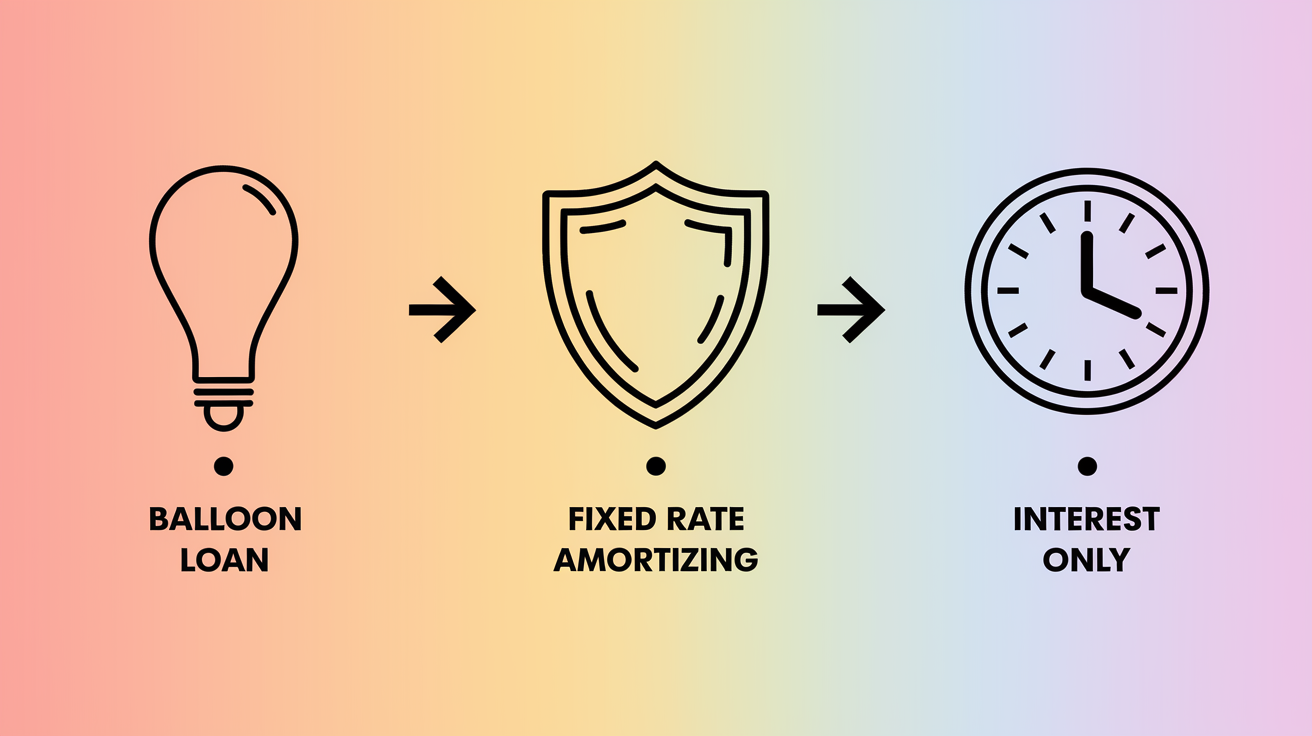
When you’re deciding whether to take a balloon loan, compare it side by side with conventional mortgages, FHA loans, VA loans, USDA loans, and adjustable rate mortgages to see which structure fits your income, timeline, and risk tolerance. Conventional mortgages typically require a credit score of 620 or higher and a down payment as low as 3 percent, but they use a fully amortizing structure that spreads principal repayment across the entire term, so you never face a surprise final payment and your monthly bill stays predictable. FHA loans allow down payments between 3.5 and 10 percent and may accept credit scores as low as 500, making them accessible for borrowers who can’t qualify for conventional terms, and they also amortize fully over 15 or 30 years. VA loans are available to qualifying veterans and service members and can offer zero down payment with no private mortgage insurance requirement, typically looking for credit scores around 620 and providing a federal guarantee that covers up to 25 percent of the home’s value if you default. USDA loans target buyers in eligible rural and suburban areas and also allow zero down payment, though they carry income limits and geographic restrictions. Adjustable rate mortgages (ARMs) give you a low introductory rate for a set period, commonly one to ten years, and then adjust periodically based on market rates, but unlike balloon loans they continue amortizing principal throughout the life of the loan, so even if your rate and payment increase, you’re still gradually paying down what you owe instead of deferring it all to the end.
Balloon loans make sense only in narrow situations where you’re confident you can exit the loan before maturity or refinance without hitting a rate spike. If your plan depends on selling the property in three years or getting a big income boost that will let you refinance easily, a balloon loan’s lower monthly payment can preserve cash flow in the short term. But for most borrowers, the long term cost and risk profile favor fully amortizing loans because you build equity steadily, you’re not vulnerable to refinancing failure, and you avoid the payment shock of a large final lump sum. In one real world example, renting in certain metro areas can save around $1,822 per month compared to buying, which means if a balloon loan is your only path to homeownership, running a rent versus buy analysis might reveal that renting and saving for a larger down payment is the safer move.
Five common alternatives to balloon loans:
Conventional fixed rate mortgage with 15 or 30 year amortization and predictable monthly payments.
FHA loan with low down payment requirements and full amortization, suitable for lower credit scores.
VA loan with federal guarantee, often zero down payment, and no PMI requirement for qualifying veterans.
USDA loan with zero down payment for eligible rural and suburban buyers, subject to income and location limits.
ARM with low introductory rate and periodic adjustments, but continuous principal amortization throughout the term.
| Loan Type | Monthly Payment Behavior | Long Term Cost | Risk Profile |
|---|---|---|---|
| Balloon Loan | Low monthly payment during term. Large lump sum at maturity | High if refinancing required. Includes new closing costs and potential rate increases | High. Refinancing, rate, and foreclosure risk all concentrated at maturity |
| Fixed Rate Amortizing | Higher monthly payment. Steady principal reduction every month | Moderate. Total interest paid over full term, but no surprise costs or refinancing fees | Low. Predictable payments, no refinancing dependence, steady equity growth |
| Interest Only Loan | Lowest monthly payment. Zero principal reduction during interest only period | High. Deferred principal repayment increases total interest. May include balloon or conversion | High. Payment shock when principal payments begin. Low equity buildup until conversion |
Total Cost Comparison: Calculating True Borrowing Cost

To compare the true cost of a balloon loan against an amortizing loan, you need to account for every dollar you’ll pay over the loan’s life, including the final balloon payment and the cost of refinancing or paying it off. Start by calculating the present value of the balloon payment, which adjusts the future lump sum back to today’s dollars so you can compare it fairly to the monthly payments on an amortizing loan. If your balloon is $180,000 due in five years and your discount rate (the rate you could earn on that money if you saved it instead) is 4 percent, the present value is roughly $147,900, meaning paying that balloon in five years is equivalent to spending $147,900 today. Add the present value of the balloon to the total interest you’ll pay during the term, then compare that sum to the total interest cost of a fully amortizing loan over the same five years. If the balloon loan saves you $200 per month during those five years but costs you $10,000 in refinancing closing costs when the balloon arrives, your real savings shrink to $2,000 ($200 times 60 months minus $10,000), and that’s before you account for the risk that rates might rise and push your new monthly payment higher than the amortizing loan would have been.
Next, compute the effective APR for the balloon loan by including all fees and the cost of the deferred principal repayment. The advertised interest rate on a balloon loan might be 5.5 percent, but when you fold in origination fees, closing costs, and the present value of the balloon payment, the effective APR can climb to 6.5 percent or higher. Compare that effective APR to the APR on a traditional mortgage, which bundles fees into a single rate that reflects your true borrowing cost. Refinancing fees are a major hidden cost because every time you refinance you pay closing costs again, typically 2 to 5 percent of the home’s price, so if you refinance a $250,000 home, expect to pay between $5,000 and $12,500 just to get a new loan. Add that to the total interest you’ll pay on the new loan and you’ll often find that the balloon structure costs thousands more than a single amortizing loan that runs the full term without requiring refinancing.
Four step process to calculate and compare total borrowing cost:
Calculate the present value of your balloon payment by discounting it at your opportunity cost rate or the rate you could earn by saving that money in a safe investment.
Compute the effective APR by adding all upfront fees, monthly interest charges, and the present value of the balloon, then solving for the annual percentage rate that equates the loan amount to the total cost.
Include expected refinancing fees by multiplying your home’s projected value at balloon maturity by the closing cost percentage (2 to 5 percent) and adding that amount to your total cost.
Compare the sum of all costs, monthly interest during the term, refinancing closing costs, and interest on the new loan, against the total interest cost of a fully amortizing loan over the same period to see which option costs less and carries lower risk.
Practical Decision Tools: Worksheets, Checklists, and Scenarios

Before you commit to a balloon loan, work through a structured decision checklist that forces you to model best case, likely, and worst case scenarios for rates, property values, and your personal finances. A practical decision tool starts with gathering your current credit scores from all three major bureaus (Experian, Equifax, and TransUnion) because lenders will pull all three when you refinance and use the middle score to determine your rate and approval. If your score has dropped since you took out the balloon, find out why and start fixing it immediately by making every payment on time, paying down credit card balances below 30 percent of your limit, and disputing any errors on your reports. Next, estimate your home’s likely value at balloon maturity by researching comparable sales in your neighborhood and adjusting for market trends. If values are flat or falling, calculate how much cash you’ll need to bring to a refinance closing to meet the lender’s minimum equity requirement, typically 10 to 20 percent.
Seven item decision checklist before taking or keeping a balloon loan:
Pull your credit reports from all three bureaus and confirm your scores are at or above the refinancing threshold for your target loan type (commonly 620 for conventional and VA, sometimes lower for FHA).
Calculate the exact balloon payment amount using your lender’s amortization schedule and verify the due date so you know how much time you have to prepare.
Model three refinancing scenarios. One with rates unchanged, one with rates 2 percent higher, and one with rates 3 percent higher. Calculate the monthly payment for each to see if you can afford the worst case.
Estimate refinancing closing costs by multiplying your home’s projected value at maturity by 2 percent (optimistic), 3.5 percent (realistic), and 5 percent (conservative), then add those amounts to your total cost comparison.
Project sale proceeds under a downturn scenario by taking your home’s current value, reducing it by 10 percent, subtracting 6 percent for agent commissions and closing costs, and checking whether the net proceeds cover your balloon payment.
Review your loan agreement for prepayment penalty terms, extension options, and any lender commitments to refinance, then contact your lender 12 to 18 months before maturity to confirm their current refinancing policies and rates.
Build a cash reserve equal to at least 25 percent of your balloon payment so you have a fallback if refinancing fails or sale proceeds fall short, and keep that reserve in a liquid, low risk account separate from your emergency fund.
Final Words
Define the balloon, calculate the final lump sum, and judge offers by risk, not just by low monthly payments.
You used a step-by-step framework to compare monthly payment, APR vs interest rate, total cost, equity buildup, refinancing chances, and negotiation levers — plus checklists and scenario worksheets to stress-test outcomes.
Use this guide on how to compare loans with balloon payments and their risks. Model refinancing, check equity and reserves, and get terms in writing. You’ll make a smarter, safer choice.
FAQ
Q: Are balloon loans risky and what are the main risks?
A: Balloon loans are risky because they end with a large lump-sum payment you may need to refinance or pay in cash. Risks include payment shock, failed refinance if rates rise or equity drops, slow equity buildup, and possible foreclosure.
Q: What is the 3 7 3 rule in mortgage?
A: The 3 7 3 rule in mortgage is not a universal standard; its meaning varies by lender or region. Ask your lender to explain those numbers and get the rule and any loan estimate in writing.
Q: Which loan has the highest risk?
A: Loans with the highest risk are short-term, high-interest products that can leave you unable to pay at maturity—examples include payday loans and balloon loans without a clear refinancing exit.