


Think the lower interest rate always wins? Think again.
Lenders hide fees and tweak terms so the cheapest-looking offer can cost thousands more.
This post shows a fast, six-step method to compare two loan offers apples to apples.
You’ll standardize rates (APR), fees, monthly payments, loan term, and the total true cost.
Do these checks and you’ll see the real price, not the marketing pitch, so you can pick the loan that actually saves you money.
How to Compare Loan Offers (Fast Method)

When two lenders put offers on the table, they never look identical. One shows a lower interest rate but charges a fat origination fee. The other quotes a higher rate but promises “no upfront costs.” If you rely on interest rate alone, you’ll miss the full picture. Sometimes the cheap-sounding loan ends up costing thousands more when you add fees and total repayment.
The fast comparison method fixes that. It standardizes every variable so you see the true, apples to apples cost. You’ll walk through the same six checks on every loan, compare the same numbers in the same order, and land on the offer that saves you the most money over the life of the loan.
Here’s the framework:
Collect the APR from each lender. APR rolls interest and most fees into one annual percentage, so it’s the best single number for comparing total borrowing cost. If a lender won’t give you APR, ask for a written fee schedule and interest rate so you can estimate it yourself.
List all fees side by side. Write down origination fees, application fees, processing charges, credit check costs, and prepayment penalties for each loan. Some lenders call the same fee by different names. Compare them line by line, not by label.
Calculate the total repayment amount. Multiply the monthly payment by the number of payments, then add every upfront fee and closing cost. That’s what you’ll actually pay from application to final payoff.
Compare the monthly payments. Two loans with the same principal can have wildly different monthly bills. Check whether the payment fits your budget, but don’t pick the lowest payment if it comes with a longer term. It might cost you more overall.
Check how loan term affects total cost. A four year loan costs less in total interest than a six year loan, even if the monthly payment is higher. Use an amortization calculator to see how much interest you’ll pay over the life of each offer.
Calculate the difference in overall cost. Subtract the cheaper loan’s total repayment from the more expensive one. That’s the dollar amount you save (or lose) by choosing one offer over the other.
Once you’ve run all six steps, you’ll know which loan is genuinely cheaper. The numbers don’t lie. APR, total repayment, and itemized fees will show you the real cost, not the marketing pitch. If the difference is small, tie break on flexibility (can you prepay without a penalty?) or lender reputation. If the gap is big, take the cheaper loan and move forward with confidence.
Understanding and Calculating APR
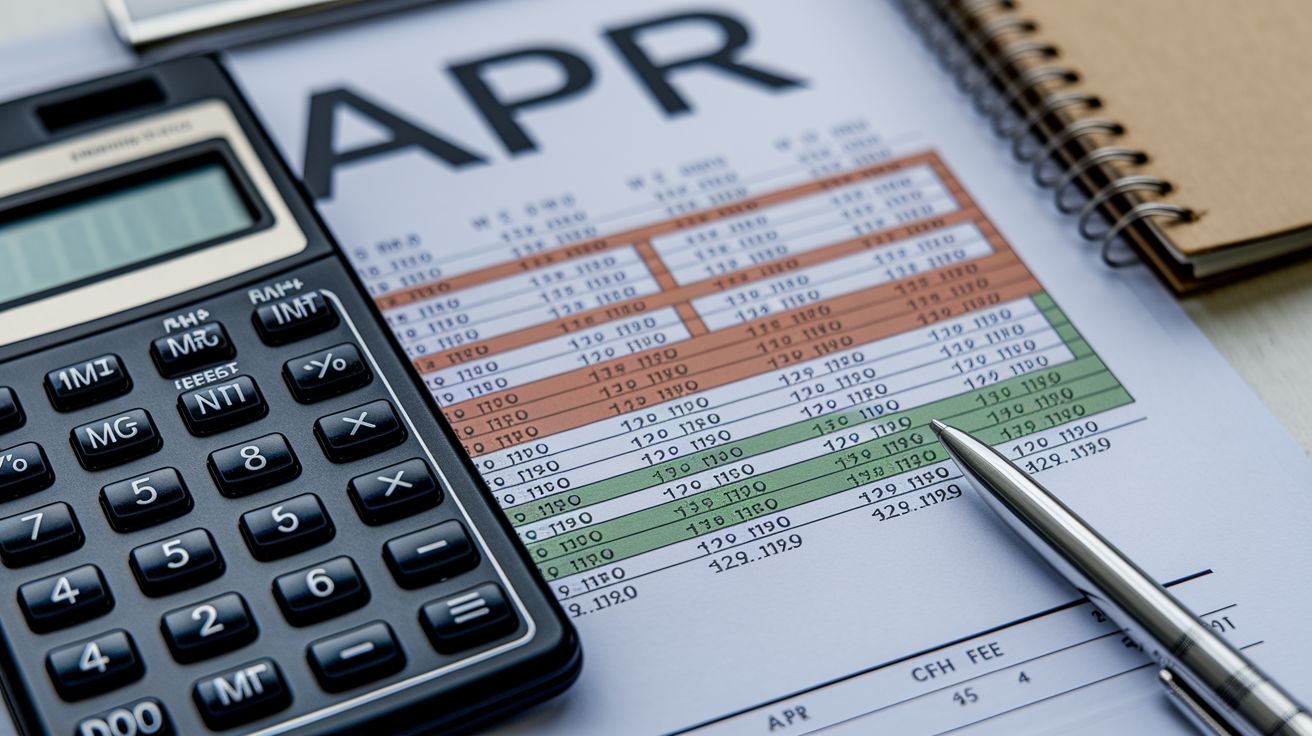
APR is the full year cost of borrowing expressed as a percentage. It includes your interest rate plus most mandatory fees: origination charges, points, broker fees, and sometimes closing costs. All rolled into one number. That’s why APR almost always runs higher than the interest rate you see in the headline. When you compare loans, APR is your fastest way to spot the cheaper deal.
Here’s an example. Loan A advertises a 7.5% interest rate with no origination fee. Loan B advertises 7.0% interest but charges a 2% origination fee. At first glance, Loan B looks cheaper. But when you calculate APR (spreading that 2% fee across the life of the loan) the APR on Loan B jumps to 7.6%, making it more expensive than Loan A.
APR accounts for interest charges over the full loan term, origination and underwriting fees paid at closing, discount points you purchase to lower the rate, and mortgage insurance premiums and other required add ons for some loan types.
Even loans with identical interest rates can rank differently once you compare APR. A lender offering 6.75% interest with $3,000 in fees will show a higher APR than a lender offering the same rate with $1,200 in fees. That APR gap tells you the second offer is cheaper, even though the rate looks the same.
Always ask for APR in writing. It’s required on official loan estimates. Use it as your baseline comparison metric before you look at anything else.
Evaluating Total Cost of Borrowing

Monthly payment gets all the attention, but it’s not the number that shows which loan is cheaper. Total cost is what you actually pay from start to finish: every dollar of principal, every dollar of interest, and every fee the lender charges.
If you only compare monthly payments, you might pick a loan that costs $5,000 more over five years just because it spreads the pain across more months.
| Loan Variable | What to Add | Why It Matters |
|---|---|---|
| Principal + Interest | Monthly payment × number of payments | Shows the base repayment before fees |
| Upfront Fees | Origination, application, underwriting, closing costs | These reduce your net proceeds or add to total cost |
| Ongoing Charges | Mortgage insurance, service fees, late penalties | Recurring costs that pile up over the term |
To get total cost, pull the amortization schedule from your lender or run the loan through a mortgage calculator. Add up every payment from month one to payoff, then tack on all the one time and recurring fees. Now you’ve got a single dollar figure for each loan.
Subtract the cheaper total from the more expensive one. That’s your savings if you pick the right offer. When the gap is $200, it’s a wash. When it’s $4,000, you know which loan to take. Total cost strips away the guesswork and makes comparison automatic.
Identifying and Itemizing Loan Fees

Lenders don’t all charge the same fees, and they don’t always call them the same thing. One might list a “loan processing fee” while another calls it an “administrative charge.” But both hit your wallet the same way. To compare apples to apples, you need a complete, line by line list of every fee each lender will charge, from application to final payoff.
Start by asking for a written fee breakdown before you apply. If the lender says “we’ll disclose that later,” walk away. Transparency up front means fewer surprises at closing.
Once you have the paperwork, check for these seven fees:
Origination fee. Usually 0.5% to 5% of the loan amount. Covers the lender’s cost to process and fund your loan.
Application fee. A flat charge (often $50 to $500) to review your application and pull credit.
Underwriting fee. Covers the cost of verifying income, employment, and creditworthiness.
Appraisal fee. Required for mortgages. Typically $300 to $600 for a professional property valuation.
Credit report fee. Small charge (around $25 to $50) to pull your credit from the bureaus.
Prepayment penalty. A fee (sometimes a percentage of the balance) if you pay off the loan early.
Late payment fee. Either a flat dollar amount or a percentage of the overdue payment.
Some lenders advertise “zero closing costs” or “no origination fee” but quietly roll those expenses into a higher interest rate or tack them onto the loan balance. Compare the APR and total repayment to see if a “no fee” loan actually costs more over time.
Add up every dollar in column A and column B, then subtract. If Loan A charges $2,800 in total fees and Loan B charges $1,100, you’re starting $1,700 behind with Loan A before you make the first payment. Fees aren’t negotiable at every lender, but knowing the gap gives you leverage to ask for credits or to walk toward the cheaper offer.
Comparing Loan Terms and Monthly Payments

Loan term is the number of months or years you’ll make payments. Stretch the term and your monthly payment drops, but your total interest climbs. Shorten the term and you pay more each month, but you escape interest faster and own the asset (or clear the debt) sooner.
Here’s the trade off in action. A $20,000 car loan at 6% APR over four years costs about $470 per month and racks up roughly $2,560 in total interest. Extend that same loan to six years and the monthly payment falls to around $322, but total interest jumps to about $3,184. You save $148 every month but pay an extra $624 over the life of the loan. Monthly relief can feel good today, but it costs you tomorrow.
When you compare two loan offers, follow these three steps to isolate the term impact:
Match the loan amount and interest rate (or APR) across offers. If the terms are different lengths, you’re not comparing apples to apples. You’re comparing a cheap monthly bill to total cost savings.
Run an amortization schedule for each term. Most online calculators will show you month by month principal, interest, and balance. Look at the “total interest paid” line at the bottom.
Decide whether the lower monthly payment is worth the extra interest. If your budget is tight and you need breathing room, a longer term makes sense. If you can afford the higher payment, a shorter term saves money and builds equity (or cuts debt) faster.
Don’t pick a loan just because the payment fits your budget this month. Check what it costs over the full term, then choose the balance of affordability and total savings that works for your situation.
Example: Side by Side Comparison of Two Loan Offers

Let’s say you’re borrowing $15,000 for a home improvement project. Lender A offers a five year fixed personal loan. Lender B offers the same principal over the same term but with different fees and a slightly higher rate. Here’s how the numbers stack up:
| Variable | Loan A | Loan B | What It Means |
|---|---|---|---|
| Interest Rate | 8.5% | 9.0% | Loan A has a lower nominal rate |
| Origination Fee | $750 (5%) | $0 | Loan A charges a big upfront fee; Loan B doesn’t |
| APR | 9.8% | 9.0% | APR reveals Loan A is more expensive overall |
| Monthly Payment | $306 | $311 | Payments are nearly identical |
| Total Repayment | $19,110 | $18,660 | Loan B costs $450 less over five years |
At first glance, Loan A looks cheaper. 8.5% beats 9.0%, and the monthly payment is $5 lower. But that $750 origination fee pushes the APR nearly a full point higher, and when you multiply 60 payments and add all fees, Loan A costs you $19,110 versus $18,660 for Loan B. The $5 per month savings vanishes when you account for the upfront charge.
Loan B is the better deal. It saves you $450 in total cost, has no origination fee (so you get the full $15,000 at closing), and carries a lower APR despite the slightly higher interest rate.
This is why comparing interest rate alone is misleading. APR and total repayment tell the real story. Always build a table like this before you sign, and let the numbers pick the winner.
Red Flags and Hidden Costs to Watch For

Some loan offers look great on paper until you read the fine print. Lenders who want your business fast will advertise low rates, skip over fees in conversation, or bury expensive terms in the contract. If you don’t catch the red flags early, you’ll find out at closing. Or worse, months into repayment when a penalty hits.
Watch for these five warning signs:
Vague or missing fee disclosures. If the lender won’t give you a written breakdown of all fees before you apply, assume hidden charges are coming.
Advertised rate requires conditions you don’t meet. “Rates as low as 5.99%*” often means you need perfect credit, a huge down payment, or autopay enrollment to qualify. Most borrowers pay more.
Prepayment penalty buried in the offer. Some lenders charge 2% to 5% of the remaining balance if you pay off the loan early, turning a windfall into a trap.
Mandatory add on products. Requiring you to buy credit insurance, payment protection, or a specific title company can add hundreds or thousands in costs.
Rate changes between verbal quote and written offer. If the lender quoted one rate on the phone and a different (higher) rate shows up on the loan estimate, ask why in writing and get a new quote before proceeding.
These red flags don’t just inflate the monthly payment. They distort total cost comparisons. A loan with a 7% rate and a 3% prepayment penalty might end up more expensive than an 8% loan with no penalty if you plan to refinance or pay extra.
Always compare the APR, read every page of the loan estimate, and ask the lender to explain (in writing) any fee or term that isn’t crystal clear. If they dodge the question or pressure you to sign fast, that’s the biggest red flag of all.
Final Words
Start by lining up APR, all fees, total repayment, monthly payments, term effects, and the net cost.
The article walked you through the six-step fast method: collect APR, list fees, add up total repayment, compare monthly amounts, weigh term impact, and calculate the cost difference.
Use the example and APR to see which loan really costs less, not just which monthly payment feels smaller.
If you follow these steps on how to compare two loan offers apples to apples, you’ll pick the clearer, cheaper option with confidence.
FAQ
Q: How to compare different loan estimates? / When comparing loan offers, you should?
A: Comparing loan estimates means matching APRs, listing all fees, calculating total repayment, comparing monthly payments, checking term length, and picking the offer with the lowest overall cost that fits your budget.
Q: Can a 70 year old woman get a 30 year mortgage?
A: A 70 year old woman can get a 30-year mortgage if she shows steady income, sufficient assets or a qualified co-borrower; lenders evaluate ability to repay, not age alone.
Q: What are the 5 C’s of loan appraisal?
A: The 5 C’s are Character (credit history/trustworthiness), Capacity (income and DTI), Capital (savings and down payment), Collateral (assets securing the loan), and Conditions (loan purpose and economy).