


Most borrowers see “approved” and sign — that’s how you end up paying $2,000 extra without realizing it.
Lenders won’t line up their offers for you.
You have to compare the real cost, not the flashy rate.
This post shows a simple total cost analysis to compare two loan offers with different fees and terms.
You’ll learn the five steps to turn APR, fees, monthly payment, and payoff timeline into one clear number.
Do this once and you can stop guessing which loan actually saves you money.
Step-by-Step Method to Compare Two Loan Offers

Most borrowers see “approved” and sign. That’s how you end up paying $2,000 extra without realizing it. Lenders won’t line up their offers side by side for you. You’ve got to do it yourself. The whole point is figuring out what you’ll actually pay, not what the marketing says.
Run these five steps on every offer. If a lender won’t give you the numbers, that tells you something. The calculation matters more than the brand or how fast they promise to fund.
Here’s the process:
1. Calculate the APR for each offer. When a lender says “8.5% interest” but tacks on a 3% origination fee, that 8.5% isn’t your real cost. APR bundles interest plus mandatory fees, annualized across the loan term. Use the lender’s published APR or plug the numbers into a loan calculator yourself. APR is the first number you compare.
2. Identify all fees in dollar terms. Turn percentages into actual cash amounts. Borrow $10,000 with a 5% origination fee? That’s $500 out of your pocket. Write down origination fees, prepayment penalties (if they apply), late fees, service charges, any account maintenance costs. Add them up per offer.
3. Determine total repayment over the full loan term. Multiply your monthly payment by the number of months. Payment of $350 for 36 months means total repayment is $12,600. Subtract the loan amount to see total interest paid. Add all upfront fees to get your all-in cost.
4. Compare monthly payments against your budget. Check whether each payment fits the 30–40% debt to income guideline. A payment that eats 50% of your monthly take-home can force you to miss other bills, even if the total cost looks better on paper.
5. Determine break-even duration if one offer has higher upfront fees. Divide the upfront fee by the monthly savings from the lower APR. Loan A charges $800 upfront but saves you $25 per month versus Loan B? Break-even is 32 months. If you’re planning to pay off or refinance before month 32, Loan B costs you less.
Each step translates marketing language into actual cash. The offer that sounds best can cost hundreds more when you add everything up.
Key Terms Used in Loan Comparisons

APR (Annual Percentage Rate) is your all-in price tag. It wraps interest rate plus mandatory fees into one annualized percentage so you can compare apples to apples across lenders. Two loans quote 9% interest, but one charges a 4% origination fee and the other charges nothing? Their APRs won’t match. The one with the fee will show a higher APR, even though both claim “9%.”
Origination fees are upfront charges, usually 1% to 8% of the loan amount. They’re deducted from your proceeds or added to your balance. You borrow $15,000 with a 3% origination fee? You get $14,550 in cash but owe $15,000 plus interest. That cuts your net proceeds and raises your real cost per dollar received.
Prepayment penalties are fees charged if you pay off the loan early. Often a percentage of the remaining balance or a flat number of months’ interest. Planning to refinance in two years or make extra payments? A loan with a prepayment penalty can wipe out the benefit of a lower interest rate. Always ask if the penalty exists and how they calculate it.
Fixed vs variable rate: a fixed rate stays put for the life of the loan, so your payment never changes. A variable rate can start lower but adjusts with a benchmark (like the prime rate), meaning your payment can go up. Rate increases 2%? Your monthly payment increases too. Fixed is predictable. Variable is riskier but sometimes cheaper at the start.
Loan term length is how many months or years you’ve got to repay. A 60 month term lowers your monthly payment compared to 36 months, but you’re paying interest for longer, so total interest is higher. For example, $10,000 at 10% for 36 months costs about $1,616 in interest. Stretch it to 60 months and interest jumps to about $2,748. Shorter term equals higher payment but lower total cost.
Worked Example: Comparing Two Loans With Real Numbers

You apply for a $12,000 personal loan and get two offers. Here’s what each lender says:
| Offer | APR | Loan Term (months) | Fees | Monthly Payment | Total Cost |
|---|---|---|---|---|---|
| Loan A | 8.0% | 60 | $600 origination (5%) | $243.32 | $15,199.20 |
| Loan B | 10.5% | 60 | $0 | $258.10 | $15,486.00 |
Loan A looks cheaper at first because 8.0% beats 10.5%. But the $600 origination fee gets deducted from your proceeds, so you receive $11,400 in cash while owing $12,000. Your total repayment is $243.32 × 60 = $14,599.20, plus the $600 fee = $15,199.20 all in. Loan B charges no upfront fee, so you get the full $12,000 in hand, and total repayment is $258.10 × 60 = $15,486. Loan A is cheaper by $286.80 over five years, even with the fee.
Now change the scenario. You’re planning to pay off the loan in 24 months instead of 60. Recalculate the monthly payment at each APR for 24 months. Loan A at 8.0% becomes $543.04 per month for 24 months = $13,032.96 total, plus $600 fee = $13,632.96. Loan B at 10.5% becomes $551.33 per month × 24 = $13,231.92 total. In the 24 month payoff case, Loan B wins by $401.04 because you’re not carrying the higher APR as long, and you avoid paying the upfront fee for a short duration loan.
The cheaper loan depends on how long you’ll hold it. Confident you’ll keep the loan for the full 60 months? Loan A saves money. Expecting a bonus or refinance in two years? Loan B’s zero fee structure is better. Run the math for your real payoff timeline, not the lender’s advertised term.
Decision Criteria: Choosing the Best Loan for Your Situation

Your decision depends on more than which number is lower. Use these borrower-specific factors to pick the loan that fits your real life, not just the spreadsheet:
Payoff timeline: Planning to pay off early or refinance within 24 months? Prioritize low or zero upfront fees. A lower APR doesn’t help if you pay a fat origination fee and then close the loan before the interest savings catch up.
Cash flow and monthly budget: A $50 higher monthly payment might break your budget even if it saves $300 over three years. If your income is tight or irregular, the lower monthly payment keeps you current. That’s worth more than total cost savings you can’t afford.
Prepayment penalty risk: If your loan has a prepayment penalty and you might refinance, quantify the penalty cost. It’s 2% of the balance and you’re planning to refi in 18 months? Add that penalty into your total cost comparison.
Fixed vs variable rate tolerance: If rates are rising or you want payment certainty, pick the fixed rate loan even if the variable starts lower. Comfortable with payment fluctuation and planning a short hold? Variable can save money up front.
Origination fee vs net proceeds: If one lender deducts the fee from your cash and you need the full amount in hand, you’ll have to borrow extra to cover the fee. That raises your loan balance and total interest, changing the math.
Lender flexibility and hardship options: One lender allows payment deferrals or extra payments without penalty and the other doesn’t? That flexibility can be worth a slightly higher rate if your income is unstable.
Run the total cost calculation first to see which is mathematically cheaper. Then layer in your real payoff plan, your monthly budget cap, and your tolerance for rate changes or penalties.
Numbers are close (within $200–300 over the full term)? Pick the loan with better flexibility and fewer gotchas. One loan is $1,000+ cheaper over the term? Take the cheaper one unless your budget absolutely can’t handle the monthly payment. The goal is the loan you can afford to repay without default, at the lowest all-in cost your situation allows.
Loan Comparison Worksheet (Printable Format)
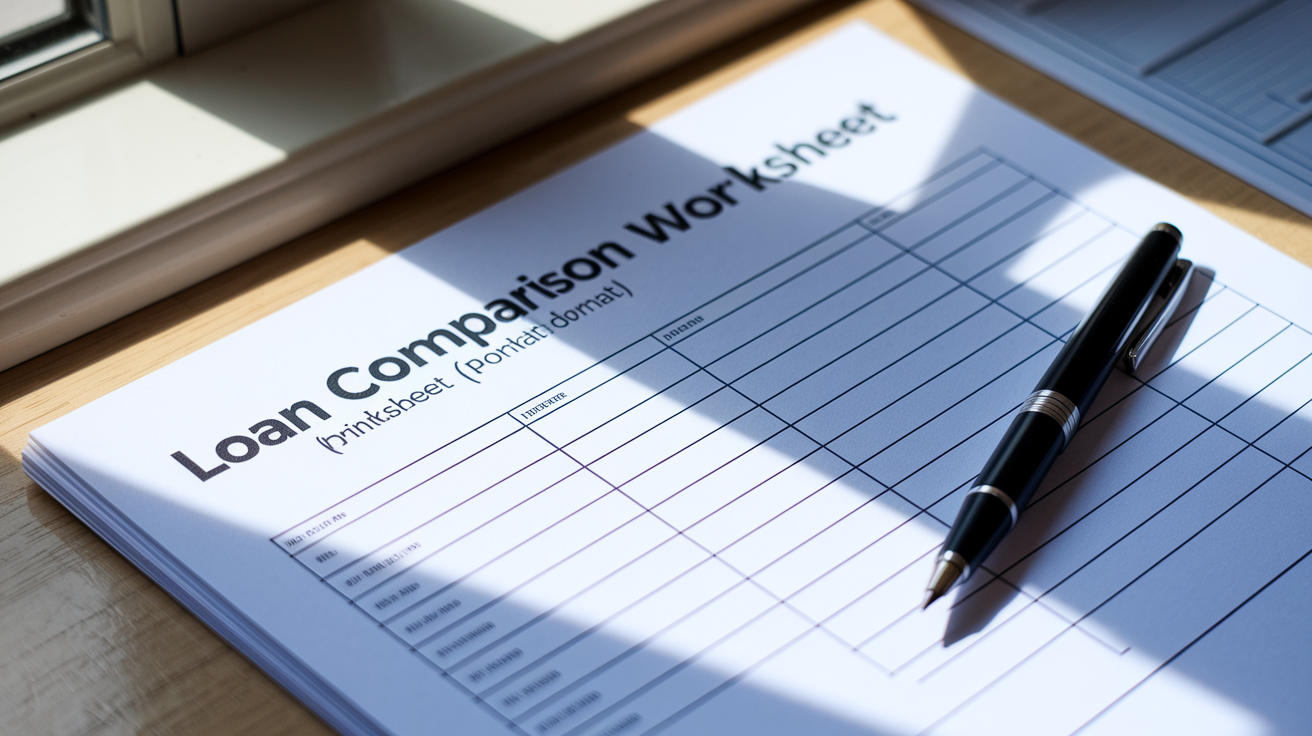
Use this table to compare two offers side by side. Fill in the numbers the lender gives you, then calculate total cost and compare the bottom line.
| Factor | Loan A | Loan B |
|---|---|---|
| Principal (amount borrowed) | ||
| Interest Rate (nominal) | ||
| APR | ||
| Term (months) | ||
| Origination Fee ($) | ||
| Other Fees ($) | ||
| Monthly Payment ($) | ||
| Total Cost (monthly payment × term + all fees) |
Print or copy this table and fill it in during your prequalification calls. The “Total Cost” row is your decision number. It shows what you actually pay, not what the lender’s ad highlights. Compare that line first, then check whether the monthly payment fits your budget and whether any prepayment penalties or variable rate clauses change the picture. This worksheet keeps you honest and prevents you from choosing based on whoever called you back first.
Final Words
You now have a clear five-step method: calculate APR, list every fee, work out total repayment, compare monthly payments, and find the break-even point. Use each step to see which loan really costs less for your timeline.
You also learned key terms, saw a worked example with real numbers, and got a printable worksheet to line offers up side-by-side.
Run the numbers, ask the lender the right questions, and you’ll know how to compare two loan offers with different fees and terms. You’re ready to choose with confidence.
FAQ
Q: How do you compare loan offers to get the best deal? / When comparing loan offers, you should?
A: To compare loan offers and get the best deal, you should calculate APR, list every fee, total repayments, compare monthly payments, and find the break-even point to see which costs less for your timeline.
Q: What makes it easier to compare loans with different fees, rates, and terms?
A: Using APR, matching the same loan term, and a side-by-side worksheet makes it easier to compare loans with different fees, rates, and terms, showing the true yearly cost and monthly impact.
Q: What are the 3 C’s for a loan?
A: The 3 C’s for a loan are Character (credit and payment history), Capacity (ability to repay from income), and Capital (your savings or down payment). Lenders use them to judge risk.