


What if paying off your loan early costs you thousands?
You’d expect saving money by getting out of debt, right?
But many loans hide prepayment penalties that do the opposite.
They live in promissory notes, fee lists, or under phrases like yield maintenance.
Missing them can turn a smart refinance into a costly mistake.
In this post you’ll learn how to spot penalty clauses, run the math on real costs, and use clear, practical moves to avoid or reduce these fees before you sign.
Know the rules. Save your cash.
Understanding Prepayment Penalties and How to Identify Them

Prepayment penalties are fees lenders charge when you pay off a loan early. Could be the entire balance or more than the allowed extra payment. Lenders lose interest when you repay ahead of schedule, so they add this fee to recoup some of that lost income. You’ll find these penalties on mortgages, personal loans, and auto loans, and they can run anywhere from a few hundred dollars to several thousand depending on your loan structure and remaining balance.
Here’s the thing: you won’t always see “prepayment penalty” spelled out clearly. Lenders bury it in the promissory note, the fee schedule, or under sections called “Prepayment,” “Early Repayment Terms,” or even “Breakage Fees.” If your loan includes a Truth in Lending disclosure, penalties should show up there too. The clause will explain when the fee applies, how it’s calculated, and how long it lasts. Can’t find it after checking those spots? Ask your lender directly for the prepayment terms before you sign anything.
Not every loan has a prepayment penalty. Some lenders offer penalty free products, especially on shorter term loans or for borrowers with solid credit. But if your loan does include one, here are five signs it’s hiding in your agreement:
- The loan document mentions “early termination fees,” “yield maintenance,” or “breakage charges.”
- A fee schedule shows a percentage tied to your outstanding balance or a flat dollar amount if you pay off the loan before a certain date.
- The contract specifies a lock in period (no prepayment allowed in the first three years, for example).
- The lender lists restrictions on additional principal payments or caps how much extra you can pay each year without penalty.
- Your Truth in Lending disclosure or initial loan estimate mentions a penalty or shows an “Early Payoff Fee” line.
How Prepayment Penalties Are Calculated
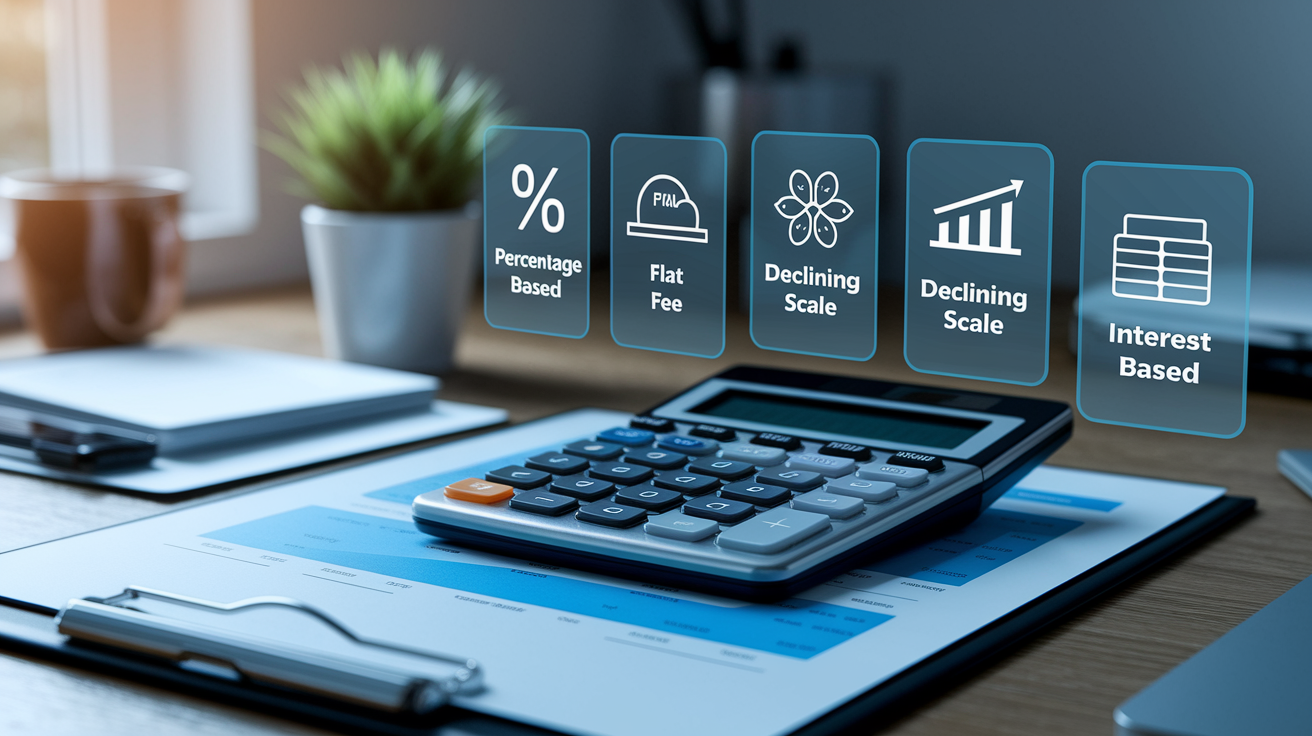
Lenders use four main methods to calculate prepayment penalties. Each one produces a different cost. Knowing which model your loan uses helps you estimate exactly what you’ll pay if you decide to refinance or pay off the loan ahead of schedule.
Percentage Based is the most common. The lender charges a fixed percentage of your remaining loan balance. If you owe $100,000 and your penalty is 2%, you’ll pay $2,000. Usually ranges from 1% to 5% of the outstanding principal.
Flat Fee means the penalty is a set dollar amount spelled out in the loan contract, no matter how much you still owe. Lenders typically charge between $200 and $500, though the amount can be higher on large commercial loans. This method is straightforward because the cost doesn’t change with your balance.
Declining Scale means the penalty percentage drops each year you hold the loan. A typical schedule might be 3% in year one, 2% in year two, and 1% in year three, then zero after that. If you owe $150,000 and pay off the loan in year two, the penalty would be $3,000 (2% of $150,000).
Interest Based (Months of Interest) is when the lender calculates the penalty as a specific number of months of interest on the amount you prepay. If your contract says “six months of interest” and your monthly interest is $400, the penalty is $2,400. Some loans use a formula tied to the difference between your loan rate and the current market rate, which can make the penalty larger when rates have dropped.
| Method | Typical Amount | Example |
|---|---|---|
| Percentage Based | 1%–5% of balance | 2% of $100,000 = $2,000 |
| Flat Fee | $200–$500 | Flat $400 fee |
| Declining Scale | 3%–2%–1% over 3 years | 2% of $150,000 in year two = $3,000 |
| Interest Based | 3–6 months of interest | 6 months × $400/month = $2,400 |
Finding and Interpreting Prepayment Clauses in Loan Documents

Prepayment clauses usually live in sections labeled “Prepayment,” “Fees,” “Repayment Terms,” or inside your Truth in Lending disclosure. If those sections don’t exist or don’t mention early payoff, check the promissory note line by line. Pay attention to any paragraph that talks about paying extra principal or ending the loan before maturity. Lenders are required to disclose penalties in federally regulated loans, but the wording can be technical or buried under other fees.
The tricky part? Lenders don’t always call it a “prepayment penalty.” They use indirect terms that mean the same thing but sound less alarming. If you spot any of the following phrases, you’re looking at a prepayment penalty in disguise:
“Early termination fee” gets charged when you close the loan before the scheduled end date.
“Yield maintenance fee” compensates the lender for lost interest. Common on commercial loans.
“Breakage fee” or “breakage cost” covers the lender’s loss when you disrupt their expected cash flow.
“Defeasance clause” requires you to replace the loan collateral with securities. Expensive and complex.
When you find the clause, read it twice. Note the exact percentage or dollar amount, the years it applies, and whether it covers all early payments or just full payoffs. If the language is confusing, call the lender and ask for a plain English explanation and a written example showing what you’d owe if you paid off the loan today.
Comparing Prepayment Penalties Across Lenders

Lenders handle prepayment penalties in completely different ways, so comparing them is one of the smartest steps you can take before committing. Some lenders don’t charge penalties at all, especially on shorter term loans or adjustable rate products. Others lock you in for three to five years with penalties that can be thousands of dollars. The structure matters as much as the rate. A lower interest rate with a steep penalty can end up costing more than a slightly higher rate with no penalty if you refinance or sell early.
When you’re shopping, don’t just ask “Is there a prepayment penalty?” Ask how it’s calculated, how long it lasts, and whether partial prepayments are allowed without triggering the fee. Some lenders let you pay an extra 10% or 20% of the principal each year without penalty, which gives you flexibility if you come into extra cash. Others restrict any early payment during the lock in period. Get these details in writing so you can run the numbers.
Here’s a simple four step process to compare lenders on prepayment penalties:
- Request the loan estimate or a sample contract from each lender and locate the prepayment section.
- Note the penalty type (percentage, flat fee, declining scale, or interest based) and the duration it applies.
- Calculate the penalty cost using your expected payoff timeline. If you plan to refinance in three years, use the balance you’d owe at that point and apply the penalty formula.
- Compare the total cost of each loan (rate, fees, and penalty) over the time you expect to hold it, not just over the full term.
If two lenders offer similar rates but one has a three year declining penalty and the other has none, the penalty free loan is usually the better deal unless you’re certain you’ll hold the loan for the full term.
Real Numerical Examples of Prepayment Penalty Costs

Seeing the actual dollar amounts makes it easier to understand how much these penalties can hurt. Let’s say you take out a $200,000 mortgage with a 2% prepayment penalty. If you refinance or sell the house after two years when you still owe $190,000, the penalty is $3,800 (2% of $190,000). That’s a big chunk of money that comes straight out of your pocket before you can close the new loan or hand over the title.
Now imagine the same $200,000 loan with a flat fee of $400. No matter when you pay it off or how much you still owe, you’ll pay $400. That’s predictable and manageable.
But if your loan uses a declining scale (3% in year one, 2% in year two, 1% in year three) and you pay off $180,000 in year one, the penalty jumps to $5,400 (3% of $180,000). Wait until year three when you owe $160,000, and the penalty drops to $1,600 (1% of $160,000).
| Loan Amount | Penalty Type | Total Penalty |
|---|---|---|
| $190,000 remaining | 2% of balance | $3,800 |
| $200,000 original | Flat $400 fee | $400 |
| $180,000 in year one | 3% declining scale | $5,400 |
These examples show why it’s worth running the math before you commit. A $400 flat fee is easy to absorb, but a $5,400 penalty might wipe out most of the savings you’d get from refinancing to a lower rate.
Strategies to Avoid or Reduce Prepayment Penalties

The best way to handle prepayment penalties is to avoid them in the first place. That starts before you sign the loan. Many lenders offer penalty free loans if you ask, especially if you have strong credit or you’re willing to accept a slightly higher interest rate in exchange for flexibility. If the lender won’t budge, you can still negotiate the terms. Ask for a shorter penalty period, a lower percentage, or an exception that lets you prepay without penalty if you’re refinancing with the same lender or selling the property.
If you already have a loan with a penalty, timing is everything. Declining scale penalties drop each year, so waiting even a few months can save you thousands. Some lenders allow partial prepayments up to a certain amount each year without triggering the fee, so you can chip away at the balance and reduce what you’ll owe when the penalty expires. Check your contract for any annual prepayment caps and use them.
Here are six proven strategies to minimize or dodge prepayment penalties:
Choose a no penalty loan upfront. Ask lenders for products that don’t include prepayment fees. They exist, especially for shorter terms and adjustable rate loans.
Negotiate before closing. Request a waiver, a lower penalty percentage, or a shorter penalty period (two years instead of five) during the application process.
Use partial prepayment allowances. If your contract allows 10% or 20% extra principal each year without penalty, make those payments annually to shrink the balance before the penalty expires.
Time your payoff strategically. If you have a declining penalty, wait until it drops to the lowest tier or expires entirely before refinancing or paying off the loan.
Refinance with the same lender. Some contracts waive the penalty if you refinance into a new loan with the same institution. Ask whether that exception exists.
Sell or refinance when rates justify the cost. If market conditions give you a big enough gain (lower rate, higher home value, or cash out equity), paying the penalty might still leave you ahead financially.
The best strategy depends on your loan type and your timeline. If you’re planning to move or refinance within a few years, avoid penalty loans entirely. If you’re locked into one, use partial prepayments and wait for the penalty to decrease or expire before making a big move.
Step by Step Guide to Evaluating Your Loan for Prepayment Penalties
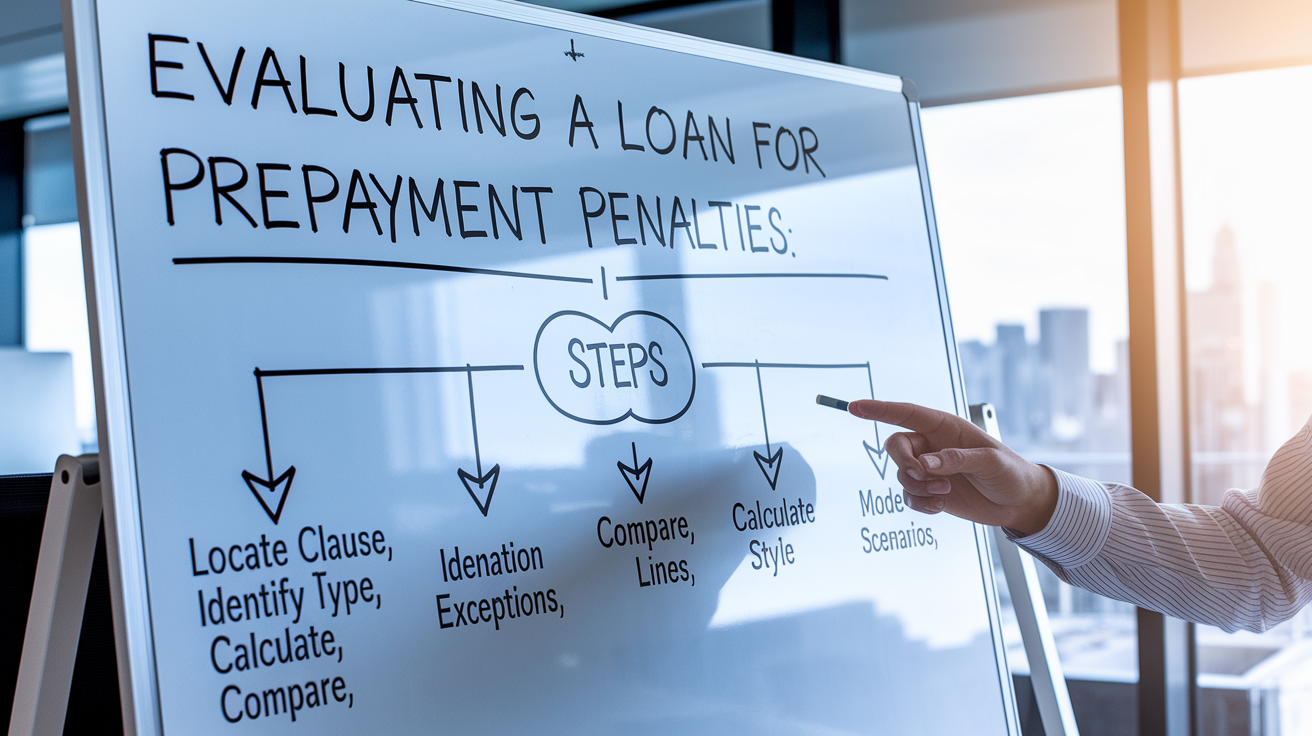
Figuring out whether paying off your loan early makes financial sense requires a clear, step by step assessment. Here’s the process to follow so you know exactly what you’ll owe and whether the penalty outweighs the benefit of refinancing, selling, or paying off the debt.
Locate the prepayment clause in your loan documents. Check the promissory note, the “Prepayment” or “Fees” section, and your Truth in Lending disclosure. Can’t find it? Call your lender and request the exact language.
Identify the penalty type. Determine whether it’s percentage based, flat fee, declining scale, or interest based, and note the specific rates or amounts.
Find the penalty duration. Look for the start and end dates. Some penalties apply for the first three years, others for the full term. Mark the date when the penalty expires or drops to zero.
Check for exceptions and caps. See if the contract allows partial prepayments (often 10% to 20% annually) or waives the penalty for specific situations like refinancing with the same lender, selling to a third party, or casualty loss.
Calculate the penalty for your expected payoff date. Use your current or projected loan balance and apply the penalty formula. If you owe $150,000 and the penalty is 2%, you’d pay $3,000.
Compare the penalty to the financial benefit. If you’re refinancing, subtract the penalty from your total interest savings over the new loan term. If you’re selling, subtract the penalty from your net proceeds to see if the deal still makes sense.
Model different timing scenarios. Run the numbers for paying off the loan today, in six months, and after the penalty period ends. See which timing gives you the lowest total cost.
Verify the exact amount with your lender. Before you commit to refinancing or paying off the loan, request a payoff statement that includes the penalty fee so there are no surprises at closing.
Final Words
in the action, we defined prepayment penalties, showed where to find the clauses, and walked through how lenders calculate those fees. We compared offers, ran real cost examples, and gave practical steps to reduce or avoid charges.
Quick takeaway: read the prepayment clause, estimate the fee in dollars, and compare the total cost before you pay early.
Follow the step-by-step checklist and you’ll know how to evaluate prepayment penalties and strategies to avoid them, giving you more control and likely saving money.
FAQ
Q: What is a prepayment penalty?
A: A prepayment penalty is a fee a lender charges when you pay a loan off early. It makes up for interest the lender loses and is usually written in the promissory note or fee schedule.
Q: Why do lenders charge prepayment penalties?
A: Lenders charge prepayment penalties to recover interest they’d lose if you repay early, protect their expected profits, and discourage quick payoffs that disrupt their funding plans.
Q: What loan types commonly have prepayment penalties?
A: Prepayment penalties commonly appear on mortgages, some auto loans, and certain personal or business loans; many government-backed loans and standard refinances often don’t include them.
Q: Where can I find prepayment clauses in my loan documents?
A: Prepayment clauses are usually found in sections titled “Prepayment,” “Fees,” “Repayment Terms,” or the Truth-in-Lending disclosure; check those pages for exact fee language.
Q: How are prepayment penalties calculated?
A: Prepayment penalties are calculated as a percentage of the remaining balance (often 1–5%), a flat fee ($200–$500), a declining scale (for example 3–2–1%), or by months-of-interest formulas.
Q: How much could a prepayment penalty cost me?
A: A prepayment penalty could cost, for example, $4,000 on a $200,000 loan with a 2% fee; calculate it by applying the stated percentage or flat fee to your remaining balance.
Q: How can I tell if a loan includes a prepayment penalty?
A: You can tell a loan includes a prepayment penalty by spotting phrases like “prepayment fee,” “early termination fee,” “yield maintenance,” “breakage fee,” or a multi-year lock in the fee section.
Q: How can I avoid or reduce prepayment penalties?
A: You can avoid or reduce penalties by asking for a no-penalty loan, negotiating terms, timing payoff after the penalty period, making partial prepayments, or refinancing into a penalty-free loan.
Q: How do I compare prepayment penalties across lenders?
A: To compare prepayment penalties across lenders, compare penalty duration, calculation method, total dollar cost, and partial-payment rules; get each offer in writing and run the same cost example.
Q: What steps should I follow to evaluate whether paying my loan early is worth it?
A: To evaluate early payoff, read the clause, note the calculation, estimate the fee, calculate interest you’d save, factor refinancing or other costs, then compare total savings before deciding.