


Think a personal loan is all about your credit score? Lenders care just as much about proving your income.
This guide shows the exact documents and simple prep steps you need, recent pay stubs, W-2s or 1099s, tax returns, bank statements, plus employer contact info.
You’ll also get quick checks for salaried workers, the self-employed, gig workers, and retirees.
Do this before you apply and you’ll cut processing time, stop surprise requests, and give your application the best shot at approval.
Core Income Verification Steps for Personal Loan Preparation

Income verification confirms three things: how much you earn, when you get paid, and where the money comes from. Lenders use this to stop fraud, meet Federal Housing Agency requirements for government-backed mortgages, and figure out your rate and repayment term. Consumer-permissioned VOIE platforms can pull your income and employment info in under 30 seconds. That’s way faster than digging through boxes of old pay stubs. When you prep accurate materials, you cut down processing delays and boost your approval chances, especially if your income jumps around or comes from multiple places.
Lenders check whether your reported earnings match your tax returns, whether deposits line up with pay stubs, and whether you’ve stayed at the same job long enough. Mismatches between tax returns and payment documents are among the four most common verification problems, alongside irregular bonuses, self-employment proof, and heavy tax deductions. Accurate prep means your application shows real, verifiable income a lender can confirm through employer contact, bank statements, or automated payroll systems.
Submitting false income documents is fraud. You can face steep fines or prison time, so accuracy matters for legal reasons, not just speed. When your paperwork is complete and consistent, lenders move your application through underwriting faster. Borrowers who present clear, reconciled records reduce the risk of follow-up requests that can delay approval by several business days.
Prep actions to finish before you apply:
- Grab your most recent 2 to 4 pay stubs showing year-to-date earnings and recent pay periods
- Request your last 2 years of W-2 or 1099 forms from employers or tax preparers
- Download your last 2 years of federal tax returns, including all schedules like Schedule C or K-1
- Pull 1 to 3 months of bank statements that show recurring deposits matching your claimed income
- Get employer contact info including your supervisor’s name, title, and direct phone number
- Request an employment verification letter from HR if you’ve been at your current job less than two years
- Check that your bank deposits match the amounts listed on pay stubs and tax forms
- If self-employed, compile a year-to-date profit and loss statement signed by your accountant or CPA
- Confirm your Social Security Number or ITIN is correct on all forms before submitting
- Review all documents for readability and consistency across income sources
Prep timelines run anywhere from 1 to 14 days depending on how fast you can access records from employers, tax preparers, or payroll portals. If you start early, you avoid the common bottleneck of waiting for third-party confirmations like employer letters or IRS transcripts. Organizing your materials before you start the application also lets you spot inconsistencies and fix them before a lender review, when delays cost time and funding windows.
Acceptable Personal Loan Income Verification Documents You Must Prepare
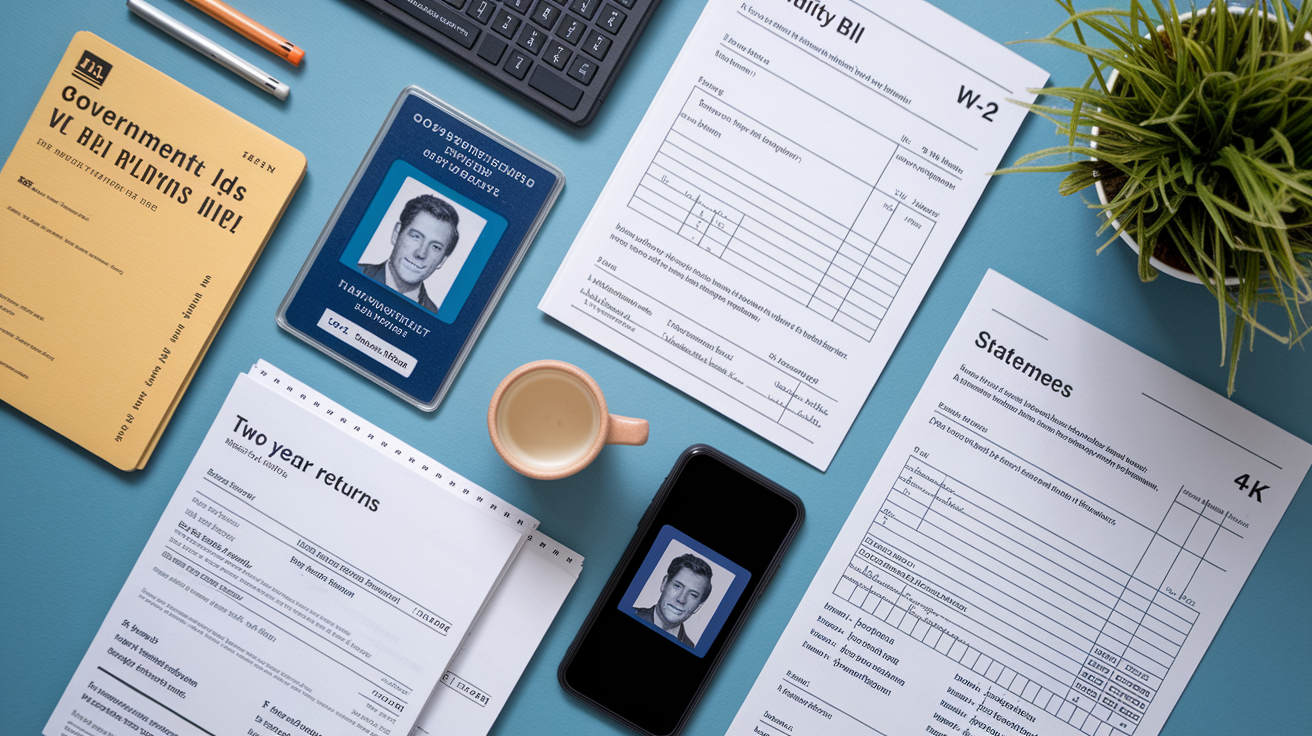
Lenders need a combination of identity, income, and address documents to confirm you’re who you say you are and earn what you claim. Most ask for two forms of government-issued ID: driver’s license, state-issued ID, birth certificate, certificate of citizenship, military ID, or Social Security card. Clear smartphone photos or scanned images work best. Files should be high-contrast and fully readable. Your Social Security Number or Individual Taxpayer Identification Number must appear on the application form and match the name on your income documents.
Income verification documents prove the source, frequency, and amount of your earnings. For traditionally employed applicants, lenders want recent pay stubs (typically the last 2 to 4 pay periods), W-2 forms for the past 2 years, tax returns for the past 2 years, and 1 to 3 months of bank statements. Self-employed and freelance applicants must provide 1099 forms for the past 2 years, tax returns with Schedule C or other business schedules, and sometimes a year-to-date profit and loss statement prepared or certified by a CPA. Lenders also accept proof of address: utility bills, lease or rental agreements, mortgage statements, home or vehicle insurance documents, voter registration cards, property tax receipts, or recent bank or credit card statements.
| Document Type | What Lenders Verify |
|---|---|
| Pay Stubs | Gross and net income, employer name, pay frequency, year-to-date totals, deductions |
| W-2 and 1099 Forms | Annual earnings, employer or client identification, reported income to IRS |
| Tax Returns (Form 1040) | Adjusted gross income, filing status, claimed deductions, Schedule C or K-1 business income |
| Bank Statements | Deposit frequency and amounts, cash reserves, negative balances, overdrafts, consistency with reported income |
| Government-Issued ID | Legal name, date of birth, address, photo match, expiration date, document authenticity |
| Proof of Address | Current residence, recent move history, match between application address and billing statements |
Acceptable digital formats include high-quality PDFs scanned at about 300 dots per inch (dpi), so all text is readable and borders are intact. Many lenders accept files under 5 megabytes (MB) per document, so compress large scans if necessary while keeping clarity. If you submit physical copies, send notarized or certified originals only if the lender asks for them, and always keep one backup for your records.
Preparing Income Verification for Different Employment Types

Salaried/Hourly Employees
Salaried employees and hourly workers have the most straightforward prep path. Assemble your most recent 2 to 4 pay stubs, the last 2 years of W-2 forms, 1 to 3 months of bank statements, and a letter from your employer confirming your job title, start date, and current salary. If you earn bonuses, commissions, or overtime, include documentation showing those payments over the past 6 to 12 months. Lenders average variable income to calculate your qualifying earnings. Keep a one-page summary of your employment history, listing each employer, job title, and dates of employment, especially if you’ve changed jobs within the past two years.
Self-Employed Applicants
Self-employed individuals and business owners face tougher documentation requirements because lenders can’t verify income through a third-party payroll department. You must provide your last 2 years of federal tax returns, including all schedules like Schedule C for sole proprietors, Schedule K-1 for partnership or S-corporation income, or full corporate returns if you run a C-corporation. Lenders also want a year-to-date profit and loss statement, ideally signed by a certified public accountant (CPA), along with 1 to 3 months of business bank statements showing consistent deposits. If your business is registered, include copies of your business license or registration documents.
Required documents for self-employed borrowers:
- Last 2 years of federal tax returns (Form 1040) with all schedules attached
- Schedule C (Profit or Loss from Business) or Schedule K-1 (Partner’s Share of Income)
- Year-to-date profit and loss statement certified or signed by a CPA
- Business bank statements for the past 1 to 3 months showing recurring deposits
- Personal bank statements for the same period to verify cash flow and reserves
- Business license, registration, or articles of incorporation if applicable
Freelancers & Gig Workers
Freelancers, gig workers, and 1099 contractors should prep 1099 forms for the past 2 years, a 3 to 6 month deposit summary or cash-flow ledger, and recent bank statements. Because your income can vary month to month, lenders calculate an average based on your tax returns and deposit history. Include client contracts, signed letters from clients confirming ongoing work, or invoices showing regular billing. If you use platforms like Upwork, Fiverr, or DoorDash, download annual earnings summaries and transaction histories that show payment frequency and amounts.
Retirees & Fixed-Income Applicants
Retirees and applicants receiving fixed income should provide pension award letters, Social Security Administration (SSA) benefit statements, 1099-INT or 1099-DIV forms showing interest or dividend income, and recent bank statements. Lenders verify that your retirement deposits are recurring and consistent, so include 3 to 6 months of bank records showing direct deposits from the SSA, pension funds, or investment accounts. If you receive alimony or child support, supply the court decree or award letter and proof of consistent deposits for at least 6 months.
How Lenders Verify Income and Employment for Personal Loans

Lenders use manual and automated methods to confirm your income and employment status. Traditional verification means calling your employer or HR department to verify your job title, start date, and current salary. Many lenders also review pay stubs and bank statements to make sure your reported earnings match your deposit history. Automated verification has gotten faster and more common, with consumer-permissioned platforms like Plaid or VOIE (Verification of Income and Employment) databases pulling data directly from payroll systems or bank accounts, often in under 30 seconds.
When you authorize a lender to link your bank account, the system reads transaction data in “read-only” mode. The lender can’t move money or change account settings. This method is preferred because it provides instant verification and speeds funding, whereas micro-deposit verification, where the lender sends small test deposits to your account and you confirm the amounts, can delay funding by several business days. Some lenders may request your online banking user ID and password to verify account ownership and deposit patterns, though this practice is less common and raises data-security concerns.
Key lender checks during income verification:
- Employer name and contact info match what’s listed on pay stubs and tax forms
- Gross income on pay stubs matches the figures reported on W-2s and tax returns
- Bank deposits align with stated pay frequency and amounts on pay stubs
- Year-to-date earnings on your most recent pay stub track consistently with previous pay periods
- Self-employment income on Schedule C or K-1 matches deposits in business bank accounts
Bank-linking tools and automated payroll access speed approval because they eliminate manual document review and employer callbacks. If your employer uses a major payroll provider like ADP, Paychex, or Gusto, your lender may pull verification directly from the payroll system, cutting processing time from days to minutes. False documents or inflated income claims trigger immediate red flags in automated systems, and submitting fraudulent records can land you steep fines or prison time under federal lending and fraud statutes.
Organizing Income Verification Documents for Faster Personal Loan Approval

Create a single folder on your computer or in cloud storage labeled with your name and the application date, then split it into categories: Identity, Income, Employment, Address, and Bank Statements. Name each file clearly using a consistent format, like “LastNameDocumentTypeDate.pdf.” For example, “SmithPaystub2026-03-15.pdf” or “SmithTaxReturn2025.pdf.” This naming convention makes it easy for lenders to locate specific documents and prevents confusion if you need to resubmit or update a file.
Scan paper documents at about 300 dpi resolution and save them as PDFs, keeping file sizes under 5 MB when possible. If a file exceeds the size limit, use PDF compression tools to reduce it without losing readability. Check that all text is sharp, borders are intact, and sensitive info like account numbers or Social Security Numbers is visible only where required. Keep one local backup copy on your device and one encrypted copy in a secure cloud service like Google Drive, Dropbox, or OneDrive.
Steps to organize and prep your files:
- Create a master checklist listing every document the lender requested
- Scan or convert all paper documents to PDF format at high resolution
- Label each file with a clear, consistent naming convention
- Review each file for legibility and completeness before uploading
- Keep original paper documents in a physical folder for reference
- Store digital copies in two locations, one local, one encrypted cloud backup
Secure upload methods include using the lender’s official portal, which typically encrypts data during transmission, or sending files via password-protected email if the lender allows it. Never share documents through unsecured messaging apps or public file-sharing links. If you’re uploading through a mobile app, make sure your device is updated and connected to a secure Wi-Fi network, not public Wi-Fi, to reduce the risk of interception.
Troubleshooting Income Verification Issues Before You Apply

Mismatches between tax returns and payment documents are among the most common verification challenges, especially if you claimed deductions or adjusted gross income that lowers your reported earnings. If your tax return shows less income than your pay stubs because of retirement contributions, health insurance premiums, or business expenses, prep a one-page explanation letter that breaks down the difference. Attach supporting documents like W-2s, 1099s, and year-to-date pay stubs to show your actual earnings before deductions.
Irregular bonuses, commissions, or overtime can complicate verification if your income varies month to month. Lenders typically average variable income over 6 to 12 months, so gather bank statements and pay stubs covering that period to show consistency. If you’re a seasonal worker or earn most of your income during certain months, provide a written explanation of your work cycle and include tax returns for the past 2 years to show total annual earnings. For example, if you work in construction and earn more in summer, your letter might say, “I work full-time May through October, averaging $8,000 per month, and part-time November through April, averaging $3,000 per month.”
Employment gaps or recent job changes require you to be proactive. If you’ve been unemployed for more than 60 days, include a brief cover letter explaining the gap and attach your new offer letter, start date, and first few pay stubs. If you started a new business within the past year, provide your business registration, a year-to-date profit and loss statement, 3 months of bank statements, and copies of signed client contracts or invoices showing active income. Lenders are more lenient when you provide context and supporting evidence upfront rather than waiting for them to request it.
Supporting documents for non-traditional or irregular income:
- Written explanation letter outlining the source and frequency of your income
- Six to twelve months of bank deposit records showing consistent or seasonal patterns
- Signed contracts, client letters, or platform earnings summaries for freelance or gig work
- Court decree or award letter for alimony, child support, or legal settlements
- Pension or SSA benefit statements for retirees with fixed recurring deposits
Debt, Bank Statements, and Additional Financial Verification Requirements

Lenders calculate your debt-to-income ratio (DTI) by dividing your total monthly debt payments by your gross monthly income. Many lenders prefer a DTI under about 40 to 45 percent, though thresholds vary by loan type and lender policy. To prep, list all current monthly obligations including student loans, auto loans, credit cards, rent or mortgage payments, and any other recurring debts. Provide the creditor name, account balance, and minimum monthly payment for each, and attach recent statements to verify the amounts.
Bank statements for the past 1 to 3 months confirm your cash flow and reserves. Lenders review deposits to make sure they match your reported income, check for overdrafts or negative balances that suggest financial instability, and verify that you have enough liquid assets to cover initial loan payments if your income fluctuates. If you receive rental income, attach signed lease agreements and Schedule E from your tax return showing rental profit or loss. If you have investment income, provide 1099-INT or 1099-DIV forms and recent brokerage statements.
What lenders look for in bank statements:
- Recurring deposits that match your pay frequency and amounts on pay stubs
- Average monthly balance and whether it’s increasing, stable, or declining
- Overdrafts, insufficient-fund fees, or negative balances indicating cash-flow problems
- Large unexplained deposits that could be gifts, loans, or unreported income
For joint applications, both applicants must provide full income and debt documentation. The lender will combine your incomes to calculate qualifying earnings and total your debts to determine the joint DTI. Each co-borrower should prep the same document checklist: pay stubs, tax returns, bank statements, and debt summaries. Confirm that both Social Security Numbers are accurate on the application form. If one applicant has stronger credit or lower debt, clarify who will be the primary borrower and who will be listed as the co-borrower to boost approval odds.
Pre‑Application Timeline and Income Verification Checklist
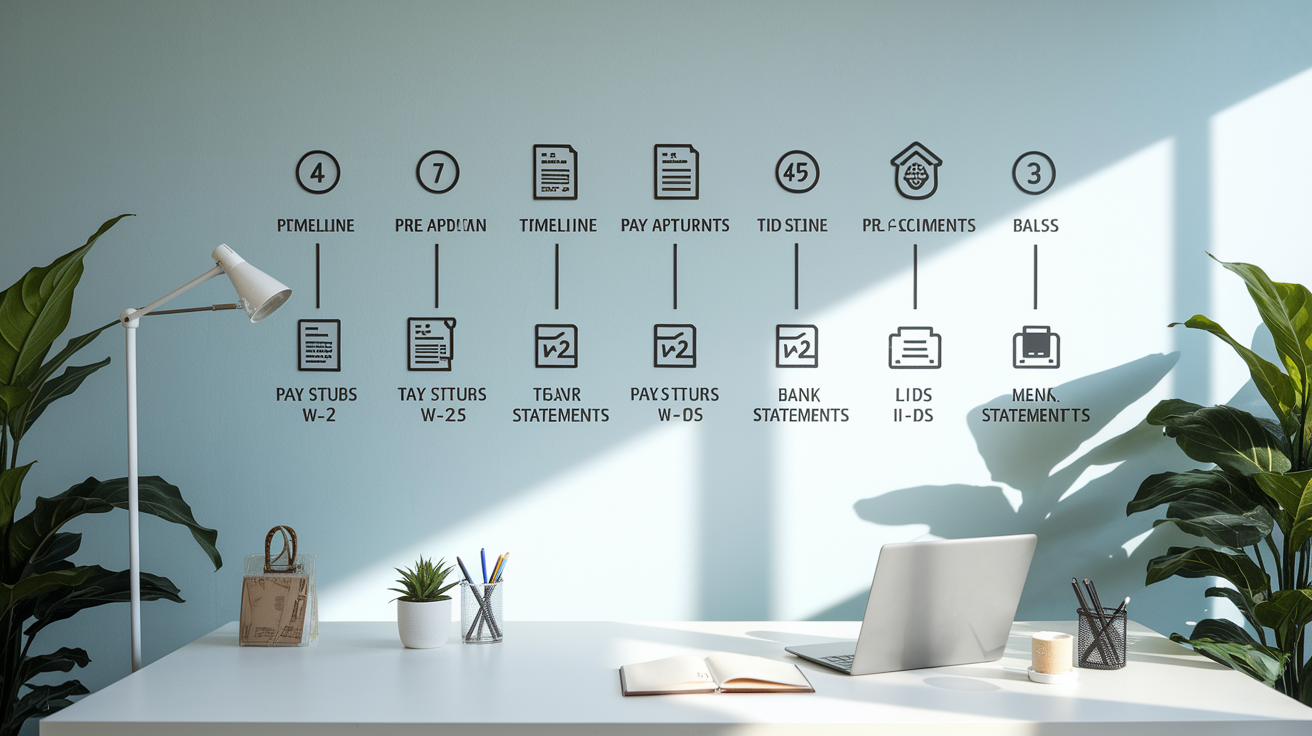
Prep can take anywhere from 1 to 14 days depending on how fast you can access records from employers, payroll portals, tax preparers, or accountants. If you’re self-employed, allow extra time to compile business records, request certified tax transcripts from the IRS, or have your CPA sign a profit and loss statement. Starting early cuts the risk of missing a lender’s funding window or delaying approval because a key document isn’t ready.
Step-by-step pre-application prep process:
- Review the lender’s full document checklist and note any items specific to your employment type or income sources.
- Request pay stubs from your employer or download them from your payroll portal (typically the last 2 to 4 pay periods).
- Retrieve W-2s or 1099s for the past 2 years from your tax preparer, employer, or IRS account.
- Download federal tax returns for the past 2 years, including all schedules like Schedule C, K-1, or Schedule E.
- Pull 1 to 3 months of bank statements from your checking and savings accounts. Verify deposits match reported income.
- If self-employed, compile a year-to-date profit and loss statement and have your accountant sign or certify it.
- Gather two forms of government-issued ID, proof of address documents, and a list of all monthly debts with account numbers and payment amounts.
- Organize all files into a labeled folder, scan or convert to PDF, and create a master index page listing each document.
Responding within 48 to 72 hours to lender requests prevents delays and keeps your application moving through underwriting. If the lender asks for clarification or additional documents mid-process, submit them right away rather than waiting. Keeping organized records also protects you during potential audits by tax authorities or lenders, because you can produce verified income documentation on demand and show that your application was accurate and complete.
Final Words
In the action, we walked through the exact steps to get your income proof ready: what lenders check, acceptable documents, and how to prepare by job type.
You also saw how lenders verify income, tips to organize files for faster review, common problems, and a pre-application timeline to avoid delays.
Use the checklist and timeline to practice how to prepare income verification for personal loan approval before you apply. Get things ready early and you’ll cut surprises and speed up approval.
FAQ
Q: How is income verified for a personal loan and how does a loan officer verify income?
A: Income for a personal loan is verified by checking pay stubs, tax returns, bank deposits, employer contacts, payroll portals, and consumer-permissioned services like Plaid or VOIE; loan officers may also call employers.
Q: Can I write my own income verification letter and is it possible to get a personal loan without income proof?
A: You can write an income verification letter, but lenders usually require supporting documents; getting a personal loan without income proof is rare—some lenders accept alternate verification, a co-borrower, or secured options.