


Think paying a collector just makes things worse?
It can, unless you get deletion in writing.
A pay-for-delete letter is a short, formal offer where you pay a set sum and the collector agrees to remove a negative item from your credit reports.
If it works, you speed up credit repair by years.
If it fails, you could lose money.
This step-by-step guide shows how to confirm who owns the debt, write a tight letter, require a signed agreement on company letterhead before payment, and follow up until the entry is actually removed.
Step-by-Step Process for Negotiating a Pay-for-Delete Agreement
A pay-for-delete letter is basically a settlement offer you put in writing. You’re asking a creditor or collection agency to wipe negative entries from your credit file in exchange for payment. Collections can stick around on your reports for 7 to 10 years unless you get them removed earlier, so if you pull this off, you’re speeding up credit repair by a lot. Fair warning: it’s not guaranteed. Plenty of collectors will say no. But following the right steps gives you the best shot.
Before you send any payment offer, you need to confirm who actually owns the debt right now and whether the balance is even valid. Debt moves around. It can go from the original creditor to collection agents, or get sold outright to debt buyers. Only the current holder can agree to delete an entry. If you send your letter to the wrong party or offer to pay a debt you don’t actually owe, you’re wasting time and giving collectors extra paperwork they might use against you later. That’s why verification and timing matter so much, especially if the negative item is already a few years old and getting close to the automatic drop-off date.
Here’s the most important protection rule: never send payment before you have a written, signed agreement on the collector’s official letterhead. Verbal promises don’t count. Recorded calls don’t count. Emails from generic addresses don’t count. If the collector backs out later or doesn’t remove the entry, that signed document is your only proof of what was agreed. Keep copies of everything: your original letter, the signed agreement, certified-mail receipts, proof of payment. If the deletion doesn’t happen, you’ll need those records to follow up or file a complaint.
- Send a debt validation request within 30 days of initial contact from the collector to confirm the balance and account details before you start negotiating.
- Write and mail your pay-for-delete letter via certified mail with return receipt. Include your contact information, the account number, a specific settlement amount, and an explicit deletion clause requiring removal from Equifax, TransUnion, and Experian.
- Include a deadline for acceptance, commonly 15 calendar days. State that the offer is a restricted settlement, not a promise to pay, and will be rescinded if not accepted in writing within that window.
- Wait to receive a signed written agreement on company letterhead from an authorized representative before taking any further action.
- Once the signed agreement arrives, send payment by the agreed method (typically cashier’s check, money order, or wire transfer) and include a copy of the signed agreement with your payment.
- Monitor all three credit bureaus for removal of the entry, and follow up immediately if the deletion doesn’t occur within the typical 30 to 45-day credit-file update cycle.
Identifying Which Debts Qualify for Pay-for-Delete Negotiation

Not every debt is a realistic candidate for pay-for-delete. Corporate banks, national credit unions, and many large original creditors often won’t budge because they have strict contracts with credit bureaus and internal policies against removing accurate negative information. But collection agencies that purchase debt in bulk? Especially small utility accounts like phone, cable, power? They’re more likely to consider deletion proposals. Debt buyers who paid pennies on the dollar to acquire your file might be willing to delete if your offered payment exceeds what they originally spent to acquire your account.
The negotiation gets easier when the collector stands to profit from accepting your offer quickly rather than chasing you for months or years. For example, if a debt buyer paid $20 for a $500 account, offering $150 can look pretty attractive because it’s triple their investment. Small charged-off accounts under $500 and accounts from regional or specialty collectors tend to be negotiable. Medical debts sent to third-party agencies sometimes qualify for pay-for-delete, especially when the collector is looking to close files quickly and doesn’t want the ongoing administrative cost of reporting and verification. Prioritize older debts that may be lower priority for the collector and accounts with collection agencies rather than the original creditor whenever possible.
Small utility or phone/cable accounts sent to collections (typically under $1,000) are good candidates. So are debts owned by third-party debt buyers rather than the original creditor. Charged-off accounts from regional or specialty collection agencies can work. And accounts where the collector paid a fraction of the original balance to acquire the debt? Those are worth targeting.
Writing an Effective Pay-for-Delete Letter With Essential Clauses

A strong pay-for-delete letter is precise, formal, and transactional. Your goal is to frame the payment as a restricted settlement offer that only becomes valid if the collector agrees in writing to delete the entry. Don’t apologize for the debt. Don’t explain hardship. This is a business negotiation, not a request for sympathy. Keep the tone neutral and clear: you’re offering a payment in exchange for specific action, and both sides must follow the exact terms or the deal is off.
Start with your full name and mailing address, followed by the date and the collector’s full name and address. Include the account number and the settlement amount you’re offering. Write it as a specific dollar figure, not a percentage or range. State that the payment is offered as satisfaction of the debt in full and that the collector agrees to remove all references to the account from Equifax, TransUnion, and Experian. Add a clause specifying that the debt will not be listed as “paid collection” or “settled account,” which can still carry negative weight under older scoring models. Close with a deadline for acceptance (commonly 15 calendar days) and a statement that the offer is conditional and restricted, meaning it’s rescinded if not accepted in writing by the deadline.
Never send payment with the initial letter. Instead, require the collector to return a signed copy of the agreement on company letterhead, signed by an authorized representative, before you send any funds. This signed document must include every clause you specified: deletion from all three bureaus, treatment as full satisfaction, and no reporting of “paid” or “settled” status. Without that signed agreement, you have no proof and no leverage if the collector takes your money and leaves the negative item on your reports.
Your letter needs your full name and current mailing address, plus the collector’s full legal name and business address. Include the account number, the amount you’re offering, and the exact balance or settlement the payment is intended to satisfy. Add a deletion clause: “You agree to completely remove any and all references to this account from Equifax, TransUnion, and Experian that you have reported to and validated this account.” Include a satisfaction statement: “You agree to accept this payment as satisfying the debt in full and to not list this debt as a ‘paid collection’ or ‘settled account.'” Set a deadline for acceptance (for example, “This offer expires 15 calendar days from the date of this letter”) and state that the offer is conditional and restricted until accepted in writing on company letterhead by an authorized representative.
Negotiation Tactics and Scripts for Pay-for-Delete Discussions
Negotiating pay-for-delete requires balance. Be firm and confident, but not aggressive or confrontational. Most collectors are used to people who beg, threaten, or disappear. When you approach the conversation with clear terms and a specific offer, you stand out as someone who can actually close the deal quickly. Research who currently owns the debt and what they likely paid for it if it’s been sold. If the collector bought your $800 medical bill for $60, offering $200 is a reasonable starting point. It triples their investment and saves them the hassle of chasing you for months or garnishing wages.
Start your negotiation by confirming account details, then immediately introduce the pay-for-delete concept. Don’t bury your ask at the end of a long explanation. Say exactly what you’re proposing: a lump-sum payment in exchange for deletion from all three credit bureaus. If you’re negotiating by phone, follow up the call with a written letter that documents everything discussed. Collectors often give short payment windows once they agree, so only offer amounts you can actually pay within a few days. If your budget is tight, start your offer lower (maybe 30 to 40 percent for older accounts) and be ready to move up slightly if the collector counters.
Sample Opening Script
“I’m calling about account [number]. I know this debt has been on my credit report, and I’m prepared to settle it today if we can agree to full deletion from Equifax, TransUnion, and Experian. I can pay [offer amount] by cashier’s check this week in exchange for a written agreement that you’ll remove the account entirely. Can you authorize that?” This script is direct, shows you’re ready to pay immediately, and sets the expectation that everything must be in writing before money changes hands.
Responding to Objections
When a collector says “We don’t do pay-for-delete” or “I’m not authorized to delete accurate information,” stay calm and ask who can authorize it. Try: “I understand policy, but I’m offering a lump sum to close this account quickly. If you can’t approve deletion, can I speak to a supervisor or settlement specialist?” If they still refuse, ask for a settlement without deletion and mention you’ll explore other options. Sometimes a second call to a different representative yields better results. Large banks and original creditors are less flexible, so if the account is still with the original creditor, your odds are lower. Focus your energy on debts that have been sold or assigned to third-party agencies.
How to Calculate a Reasonable Offer
A common guideline is 40 to 50 percent of the balance for newer accounts and 30 to 40 percent for debts older than two years. If the collector is a debt buyer, find out what they typically pay (often 5 to 20 cents per dollar of original balance) and offer an amount that gives them a reasonable profit margin. For example, if your $600 debt was purchased for $60, offering $180 to $240 is attractive because it’s three to four times their cost. If the debt is nearing the seven-year mark and about to drop off your report automatically, mention that you’re willing to pay now only if deletion is part of the deal, since waiting costs the collector any recovery. Never mention hardship or apologize. Frame your offer as a smart business decision that benefits both sides.
Documentation, Written Agreements, and Payment Methods for Pay-for-Delete Deals

Once a collector verbally agrees to pay-for-delete, your next task is to lock everything down in writing. Request that the agreement be sent on company letterhead, signed by an authorized representative, and dated. The document must spell out the exact amount you’ll pay, the deadline for payment, and the explicit commitment to delete the account from Equifax, TransUnion, and Experian. Keep a copy of that signed agreement in a dedicated file along with your original letter, certified-mail receipts, and any email or phone-call notes. If the deletion doesn’t happen, this paper trail is your evidence for follow-up disputes or complaints to the Consumer Financial Protection Bureau.
Send payment by a method that creates a clear, traceable record. Cashier’s checks and money orders are common because they don’t expose your bank-account information, and you get a receipt. Wire transfers work if the collector requires them, but keep your confirmation number and transaction details. Include a copy of the signed agreement with your payment and write the account number on the memo line. Store proof of payment (the check copy, receipt, or wire confirmation) with your file, and take a photo or scan as backup. Don’t pay with a credit card unless it’s the only option accepted, because card payments are harder to trace and collectors sometimes reverse agreements if disputes arise.
| Document | Why It Matters |
|---|---|
| Certified-mail receipt with tracking number | Proves you sent the pay-for-delete letter and when the collector received it, critical if they claim they never got your offer |
| Signed written agreement on company letterhead | The only enforceable proof that the collector promised to delete the account; verbal or email promises aren’t enough for disputes or legal claims |
| Proof of payment (check copy, money-order receipt, or wire confirmation) | Shows you fulfilled your side of the agreement; if the collector fails to delete, this document supports your complaint or dispute |
Following Up After Payment and Verifying Successful Deletion
(((alt-img6)))
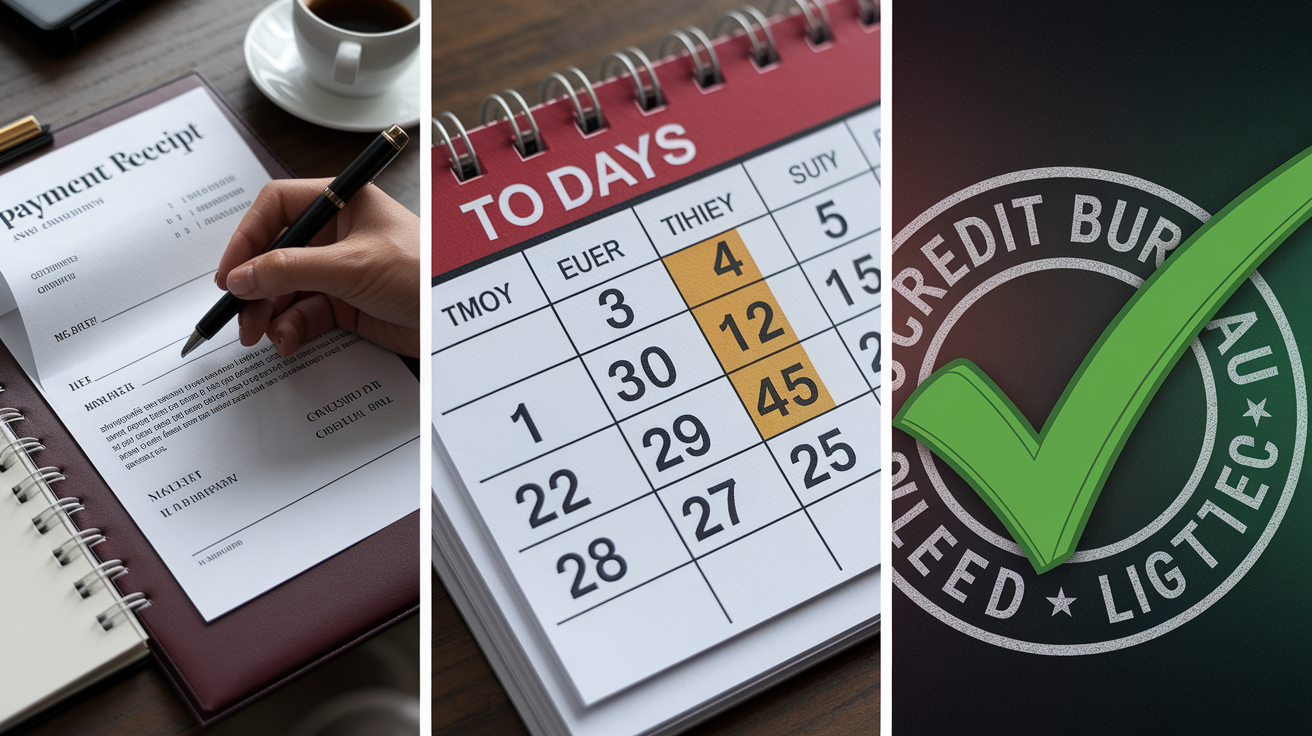
After you send payment, allow 30 to 45 days for the credit bureaus to process the deletion. Collectors typically submit updates to Equifax, TransUnion, and Experian on a monthly cycle, and each bureau may take a few weeks to reflect the change. Pull a fresh copy of your credit report from all three bureaus about six weeks after the collector confirms receipt of your payment. Check each report carefully to confirm the account is completely gone, not just marked “paid” or “settled,” which can still hurt your score under older models.
If the account still appears after 45 days, send a follow-up letter to the collector referencing the signed agreement and your payment proof. Include copies of both documents and request immediate deletion. If the collector ignores your follow-up, file a complaint with the Consumer Financial Protection Bureau and dispute the entry directly with the credit bureaus, attaching the signed pay-for-delete agreement and payment receipt. Most bureaus will investigate within 30 days, and if the collector can’t justify the continued reporting, the entry must be removed.
Wait 30 to 45 days after payment for the collector to submit updates and for the bureaus to process the deletion. Pull your credit reports from Equifax, TransUnion, and Experian to verify the account no longer appears in any form. If the entry remains, send a certified follow-up letter to the collector with copies of the signed agreement and proof of payment, requesting immediate removal. If the collector doesn’t respond or refuses to act, file a complaint with the Consumer Financial Protection Bureau and dispute the entry directly with each credit bureau, including all documentation.
Legal and Credit-Score Implications of Pay-for-Delete Requests
(((alt-img7)))
Pay-for-delete is legal. There’s no law against offering to pay a debt in exchange for deletion, and there’s no law against a collector accepting that offer. But collectors aren’t legally required to agree. In fact, many have contracts with credit bureaus that discourage or prohibit removing accurate negative information in exchange for payment, because the bureaus want reporting to stay consistent and reliable. Large banks and original creditors typically refuse pay-for-delete on policy grounds, even when it’s technically permissible under law, because they prioritize relationships with the credit bureaus over individual settlements.
Credit-scoring models have changed in ways that reduce the benefit of pay-for-delete. FICO 9, FICO 10, and VantageScore 3.0 and 4.0 either downweight or completely ignore paid collection accounts, so if your lender uses one of those models, removing a paid collection may have little or no impact on your score. The catch is that most lenders still rely on FICO 8, which does penalize collections even after they’re paid. That means a successful pay-for-delete can still deliver a meaningful score boost for many borrowers, especially those applying for mortgages or auto loans where FICO 8 remains the standard.
The seven-year reporting rule still applies. Accurate negative items can remain on your credit report for up to seven years from the original delinquency date, and collections follow the same timeline. If a debt is already five or six years old, waiting out the clock may be smarter than negotiating, especially if the collector won’t budge on deletion. Pay-for-delete works best when you’re applying for a major loan in the near future and need the negative entry gone now, or when the debt is recent enough that seven years feels too long to wait.
What to Do If Pay-for-Delete Is Refused: Alternatives and Next Steps
(((alt-img8)))
If the collector refuses your pay-for-delete offer, you still have options that don’t involve walking away or paying the full balance without any benefit. One common alternative is to negotiate a settlement without deletion. You pay less than the full amount, the account is marked “settled” or “paid,” and while it doesn’t remove the negative entry, it stops collections activity and prevents further damage. This approach works when you need the debt closed but the collector won’t agree to deletion under any terms.
Another route is disputing the debt under the Fair Credit Reporting Act if you believe the information is inaccurate or unverifiable. Send a dispute letter to each credit bureau identifying the account and explaining why it should be removed. Common reasons include incorrect dates, wrong balance, or failure to validate. The bureaus must investigate within 30 days, and if the collector can’t verify the details, the entry gets deleted. If the debt is already paid and you have a good payment history otherwise, try a goodwill letter asking the original creditor or collector to remove the entry as a courtesy. Goodwill letters work best when the debt was an isolated mistake and you’ve been responsible since.
You can negotiate a settlement without deletion, paying a reduced amount to close the account and stop collections activity, though the entry will remain on your report. Or dispute the account with Equifax, TransUnion, and Experian under the Fair Credit Reporting Act if you believe the information is inaccurate or can’t be verified. Send a goodwill letter to the creditor or collector if the debt is already paid, explaining any extenuating circumstances and requesting removal as a courtesy. Wait for the seven-year automatic expiration if the debt is already several years old and nearing the drop-off date. File a complaint with the Consumer Financial Protection Bureau if the collector made promises it didn’t keep or violated the Fair Debt Collection Practices Act during negotiations.
Final Words
In the action, you followed a start-to-finish checklist: verify the debt, send a conditional pay-for-delete letter, insist on a signed written agreement, pay by money order or cashier’s check, then monitor all three credit bureaus for removal.
You also learned how to pick good accounts, build the letter with essential clauses, use negotiation scripts, and organize proof and follow-up steps if deletion doesn’t appear.
Use this negotiating pay-for-delete letters step-by-step guide as a map—take it one written step at a time, keep copies, and you can clean up your credit history. You’ve got this.
FAQ
What is the step-by-step process for negotiating a pay-for-delete agreement?
The step-by-step process for negotiating a pay-for-delete agreement includes verifying the debt within 30 days, sending a written pay-for-delete letter with specific deletion clauses, insisting on signed written acceptance on company letterhead, paying only with money order or cashier’s check after receiving written confirmation, and monitoring all three credit reports to confirm removal.
Which types of debts qualify for pay-for-delete negotiation?
Debts that qualify for pay-for-delete negotiation typically include small utility accounts, phone or cable bills, medical debts, and older charged-off accounts purchased by debt buyers. Large banks and credit unions rarely agree to pay-for-delete, making smaller third-party collectors and debt buyers better candidates for successful negotiation.
What should be included in a pay-for-delete letter?
A pay-for-delete letter should include your name and address, the collector’s information, the account number, the specific settlement amount, a clause requiring deletion from all three bureaus, a statement that payment satisfies the debt in full, a 15-day acceptance deadline, and a signature line for company letterhead confirmation.
How do you calculate a reasonable offer for pay-for-delete?
You calculate a reasonable offer for pay-for-delete by researching what the collector paid for the debt and offering 40 to 50 percent for newer debts or 30 to 40 percent for older accounts. The offer should exceed the collector’s purchase price while remaining affordable for you.
Why should you use certified mail for pay-for-delete letters?
You should use certified mail for pay-for-delete letters because it provides proof of delivery through a return receipt, creating a documented timeline if disputes arise. This trackable delivery method protects you by verifying the collector received your conditional payment offer in writing.
How long does it take for a deleted account to disappear from credit reports?
A deleted account typically disappears from credit reports within 30 to 45 days after the collector confirms removal. You should check all three bureaus separately, since reporting updates occur on different schedules and manual deletions may require follow-up if one bureau lags behind.
Is pay-for-delete legal under FDCPA and FCRA regulations?
Pay-for-delete is legal under FDCPA and FCRA regulations, but collectors are not required to accept these agreements. Credit bureau reporting contracts discourage the practice, meaning many creditors refuse regardless of your offer, though no federal law prohibits negotiating deletion as part of settlement.
How does pay-for-delete affect your credit score?
Pay-for-delete affects your credit score by removing the negative tradeline entirely, which can increase scores significantly under older models like FICO 8. Newer scoring models such as FICO 9, FICO 10, and VantageScore 3.0 and 4.0 already minimize paid collection impact, reducing the benefit of deletion.
What are the alternatives if a collector refuses pay-for-delete?
Alternatives if a collector refuses pay-for-delete include disputing inaccurate information with the bureaus, sending a goodwill deletion letter for debts already paid, waiting for the seven-year reporting expiration, requesting verification under Section 609, or filing a CFPB complaint if written promises were broken.
Should you pay a debt before receiving a written pay-for-delete agreement?
You should never pay a debt before receiving a written pay-for-delete agreement on company letterhead. Verbal promises are unenforceable, and collectors can legally accept payment without honoring deletion, leaving you with no recourse and the negative mark still reporting.
What payment method provides the best proof for pay-for-delete deals?
A money order or cashier’s check provides the best proof for pay-for-delete deals because these traceable payment methods create permanent records without exposing your bank account information. Keep copies of the payment instrument and mailing receipt as part of your documentation file.
How do you verify a pay-for-delete was successful across all bureaus?
You verify a pay-for-delete was successful by pulling reports from Equifax, Experian, and TransUnion 30 to 45 days after payment and confirming the tradeline no longer appears. If one bureau still shows the account, contact the collector with your written agreement and request manual deletion.